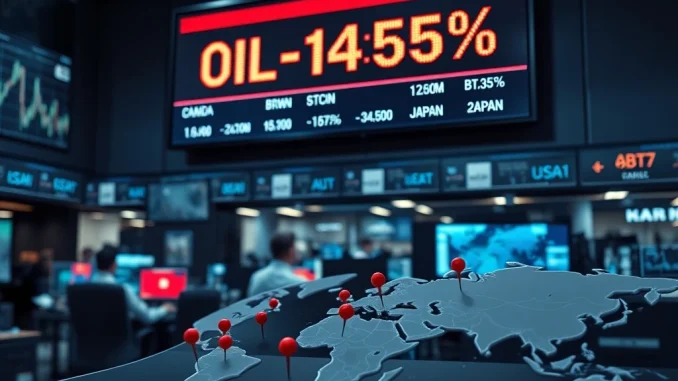
LONDON, March 11, 2026 — Global oil markets experienced a violent reversal early Monday, with prices plummeting over 14% after reports surfaced that Group of Seven (G7) finance ministers planned an emergency call to discuss a massive, coordinated release of strategic crude reserves. This potential policy response aims to calm markets reeling from a near 25% overnight spike driven by escalating Middle East tensions. Concurrently, Bitcoin (BTC) rebounded sharply from a weekend low, climbing nearly 3.5% as the immediate risk-off sentiment eased. The dramatic oil price retreat underscores how geopolitical shocks and coordinated government action are creating unprecedented volatility across both traditional and digital asset classes.
G7 Considers Unprecedented Strategic Reserve Release
According to a report from The Financial Times, G7 finance ministers scheduled an urgent call to discuss tapping national strategic stockpiles. The proposal involves a coordinated release of 300 million to 400 million barrels of crude. This volume represents a significant portion of the roughly 1.5 billion barrels held collectively by member states. The G7 countries—Canada, France, Germany, Italy, Japan, the United Kingdom, and the United States, with the European Union as a participant—last coordinated a reserve release in March 2022, totaling 60 million barrels. The current discussion signals a far more aggressive response to what officials perceive as a severe supply shock threatening global economic stability.
The news triggered an immediate market reaction. On the decentralized exchange Hyperliquid, front-month crude oil futures, which had surged nearly 25% to a high above $117 per barrel during Sunday’s thin trading, collapsed by roughly 14.5% to trade near $100. This swift repricing demonstrates that traders are quickly factoring in the high probability of a substantial government intervention, even as physical supply routes remain under threat. “The market is telling you it believes the G7 will follow through,” said veteran energy analyst Clara Vance of PetroStrategies. “A release of this magnitude could bridge a supply gap for several weeks, buying time for diplomatic channels to work.”
Bitcoin and Risk Assets Rebound from Geopolitical Jitters
The calming effect extended to cryptocurrency markets. Bitcoin (BTC), which had fallen to around $65,725 during the peak of the oil spike, rebounded to nearly $68,000 within hours, according to data from CoinGecko. This correlation highlights the evolving, albeit complex, relationship between macro commodity shocks and digital asset volatility. In a market note, CryptoQuant analyst Darkfost observed that soaring energy prices and tensions in critical chokepoints like the Strait of Hormuz traditionally dampen risk appetite. “Historically, periods when oil prices regain strength often coincide with BTC end-of-cycle phases,” Darkfost wrote, suggesting that sustained energy-driven inflation could complicate the monetary policy outlook that cryptocurrencies are sensitive to.
However, the rapid rebound suggests other factors are at play. Some traders view Bitcoin as a potential hedge against currency debasement that could follow expansive fiscal measures, like funding emergency reserve replenishment. Furthermore, the episode showcased the 24/7 nature of crypto markets, which allowed for immediate repositioning while traditional equity and commodity exchanges were closed.
Onchain Trading Venues See Record Activity
The crisis underscored a growing trend: the migration of traditional asset trading to decentralized, onchain platforms during off-hours. Hyperliquid, a leading decentralized perpetuals exchange, saw extraordinary volume in its oil-linked contracts. Analytics hub Pine Analytics reported that Tradexyz, a trading interface built on Hyperliquid, processed over $720 million in volume during the weekend of March 8-9, surpassing its previous record set in late February after initial US-Israeli strikes on Iran.
“These two waves of demand in the past month show the platform is absorbing demand for traditional assets by people who don’t have TradFi access, or at points in time when these exchanges are offline,” Pine wrote in an X post. This activity points to a structural shift where decentralized finance (DeFi) protocols provide critical market infrastructure during global crises, offering continuous liquidity and exposure to assets like oil when centralized venues are shuttered.
Anatomy of the Price Spike and Policy Response
The weekend’s 25% surge was not an isolated event but the climax of a weeks-long escalation. The following timeline and impact analysis detail the key drivers:
- Late February Catalyst: Initial US-Israeli airstrikes on Iranian targets first disrupted market equilibrium, sending oil above $90 and triggering a 700% spike in Iranian crypto outflows as citizens sought financial sanctuary.
- Supply Chain Anxiety: Subsequent naval incidents in the Strait of Hormuz, a passage for about 20% of global oil shipments, amplified fears of a physical supply interruption.
- Weekend Gap Risk: With traditional futures markets closed, limited liquidity on electronic and decentralized platforms exacerbated price moves, creating a “gap” that had to be filled upon Monday’s open.
- Strategic Reserve Calculus: The G7’s proposed 300-400 million barrel release is strategically aimed at filling this perceived physical gap and breaking the momentum of speculative buying.
Historical Context and Market Implications
Coordinated strategic releases are rare and signal extreme governmental concern. The table below compares key elements of the 2022 release with the current proposal:
| Initiative | 2022 Release (Mar-Apr) | 2026 Proposed Release |
|---|---|---|
| Total Volume | 60 million barrels | 300-400 million barrels |
| Primary Catalyst | Russia’s invasion of Ukraine | Escalation of Middle East conflict threatening Strait of Hormuz |
| Price Impact (1-week) | Brent crude fell ~$10/barrel (9%) | Futures down ~$17/barrel (14.5%) on announcement |
| Duration of Drawdown | Released over 6 months | Expected to be front-loaded for immediate impact |
The scale of the current proposal is nearly five to seven times larger, indicating governments are preparing for a potentially more severe and protracted disruption. Energy economists warn that while effective in the short term, such large drawdowns deplete insurance buffers and must eventually be replenished, potentially creating future market tightness.
What Happens Next: Markets in a Holding Pattern
All eyes are now on the official outcome of the G7 finance ministers’ call. Market participants anticipate a formal announcement outlining volumes, release schedules, and participating nations within 24-48 hours. The effectiveness of the move will be judged by its ability to keep prices below critical psychological levels and its impact on physical market differentials. Simultaneously, the US Department of Energy will likely issue guidance on the mechanics of its drawdown from the Strategic Petroleum Reserve (SPR), which currently holds about 550 million barrels, its lowest level in decades following the 2022 release.
Industry and Analyst Reactions
Reactions have been mixed. The International Energy Agency (IEA), which coordinates reserve releases among its member countries, has yet to issue a statement but is almost certainly involved in the planning. Major oil trading houses, speaking on background, express relief at the potential price cap but concern over increased government intervention in markets. “It’s a necessary painkiller,” one Singapore-based trader noted, “but it doesn’t cure the underlying disease of geopolitical instability.” Environmental groups have criticized the move, arguing it perpetuates fossil fuel dependence instead of accelerating a transition to renewables, especially amid record-breaking global temperatures.
Conclusion
The dramatic retreat in oil prices following the G7’s emergency deliberations highlights the powerful role of policy expectations in modern markets. While the threat to physical supply from Middle East conflict remains very real, the prospect of a massive, coordinated release of strategic reserves has, for now, stanched the bleeding. This intervention has had a ripple effect, helping Bitcoin and risk assets stage a recovery. However, this remains a fragile equilibrium. Investors should monitor the formal G7 announcement, actual crude export flows from the Persian Gulf, and the subsequent replenishment plans for strategic stockpiles. The episode also cementsthe role of onchain trading venues as critical liquidity providers during global crises, a trend likely to grow in future market shocks. The coming days will test whether government stockpiles can truly offset the volatile geopolitics of global energy.
Frequently Asked Questions
Q1: What exactly is the G7 proposing to do with oil reserves?
The G7 is discussing a coordinated release of 300 to 400 million barrels from their national strategic petroleum reserves. This involves physically selling government-owned crude onto the market to increase immediate supply and lower prices.
Q2: Why did Bitcoin price rebound when oil prices fell?
Bitcoin’s rebound is linked to easing immediate risk-off sentiment. The potential G7 action reduced fears of an uncontrolled energy price spiral that could force aggressive central bank tightening, which is typically negative for risk assets like cryptocurrencies.
Q3: How quickly could this oil be released onto the market?
If past actions are a guide, the US portion could begin moving within 2-3 weeks via a combination of accelerated sales already mandated by Congress and new emergency exchanges or sales. Other G7 nations have varying release mechanisms, but the intent is a rapid, front-loaded response.
Q4: What are strategic petroleum reserves?
They are government-owned stockpiles of crude oil stored in massive underground salt caverns or other secure facilities. They are intended for use during severe supply disruptions, like wars or natural disasters, to ensure national energy security.
Q5: Could this affect gasoline prices for consumers?
Yes, but with a lag. Lower crude oil prices typically translate to lower wholesale gasoline prices, which can then filter down to retail pumps over several weeks. The size of this proposed release is aimed at having a meaningful downward impact on consumer energy costs.
Q6: How does this impact traditional oil traders and DeFi platforms like Hyperliquid?
Traditional traders must now factor in a large, predictable sell volume from governments. For DeFi platforms, the event validates their role in providing 24/7 liquidity; record volumes on Hyperliquid show traders used these venues to hedge or speculate when traditional markets were closed.