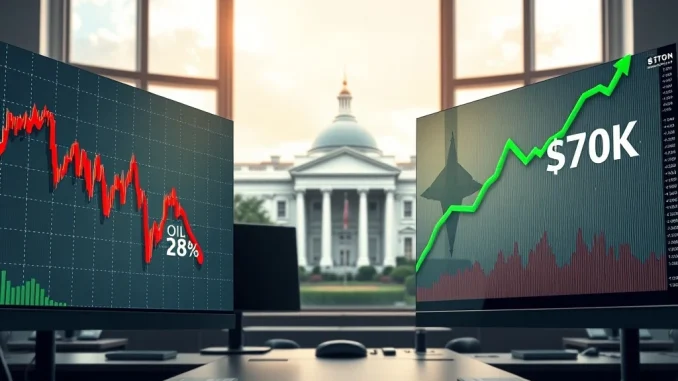
WASHINGTON, D.C. — Global financial markets experienced dramatic divergence on Monday as oil prices tumbled 28% from four-year highs while cryptocurrencies posted significant gains, reacting to President Donald Trump’s contradictory statements about the ongoing conflict with Iran. The sudden market movements followed Trump’s morning comments suggesting the war was “very complete, pretty much” and his evening social media post threatening “Death, Fire, and Fury” against Iran if oil flows through the Strait of Hormuz were disrupted. This geopolitical whipsaw created one of the most volatile 24-hour trading sessions in recent memory, with Brent crude falling from $118 to approximately $85 and Bitcoin reclaiming the $70,000 level it lost during earlier conflict escalation.
Trump’s Contradictory Statements Create Market Chaos
President Trump’s Monday morning interview with CBS News initially calmed markets with surprisingly dovish rhetoric. “I think the war is very complete, pretty much,” Trump told reporters. “If you look, they have nothing left. There’s nothing left in a military sense.” These comments came after the U.S. military reported striking more than 3,000 Iranian targets during the first week of operations. Energy markets responded immediately, with the 28% oil price drop representing the largest single-day percentage decline since the COVID-19 pandemic’s initial market crash in March 2020.
However, the relief proved short-lived. Within hours, Trump posted on his Truth Social platform with dramatically different messaging: “If Iran does anything that stops the flow of oil within the Strait of Hormuz, they will be hit by the United States of America TWENTY TIMES HARDER than they have been hit thus far.” He added, “Additionally, we will take out easily destroyable targets that will make it virtually impossible for Iran to ever be built back, as a Nation, again.” This escalation rhetoric followed his comments at a Republican congressional fundraising event in Florida where he stated, “We’ve already won in many ways, but we haven’t won enough. We go forward more determined than ever to achieve ultimate victory.”
Dramatic Energy Market Impacts and Global Consequences
The oil market’s extreme volatility reflects the critical importance of Middle Eastern stability to global energy supplies. The Strait of Hormuz alone handles approximately 21 million barrels of oil daily, representing about 21% of global petroleum consumption. Monday’s price collapse immediately affected multiple sectors and regions worldwide. Energy analysts at OilPrice.com documented the rapid decline, noting that the $33 price swing represented billions in market capitalization changes across energy companies.
- Consumer Relief: Gasoline prices projected to drop 15-20 cents per gallon within two weeks across U.S. markets
- Energy Sector Losses: Major oil companies including ExxonMobil and Chevron saw share prices decline 8-12% during Monday trading
- Producer Nation Impacts: OPEC+ emergency meeting scheduled for Wednesday to address price stability concerns
- Inflation Implications: Lower energy costs could reduce CPI projections by 0.3-0.5 percentage points for next quarter
Expert Analysis: Crypto’s Role as Risk Barometer
Augustine Fan, partner and head of insights at crypto trading software service provider SignalPlus, provided critical context to Cointelegraph about the cryptocurrency market’s response. “It is generally hard to take these headline statements at face value,” Fan explained, “especially with other members of his [Trump’s] cabinet stating that things are still in the beginning phase, and U.S. military assets still deployed in the region.” Fan emphasized that “crypto prices will continue to follow other risk assets without a fundamental narrative of its own in the near term, and macro leadership will still be driven by oil.”
Fan’s analysis aligns with data from TradingView showing Bitcoin’s 3.1% gain over 24 hours, with Ethereum rising 2.8% to hover above $2,000. “We don’t expect the conflict to be resolved any time soon,” Fan added, noting that “we would expect tradable bounces and BTC to do relatively better as a potential store of value during these times.” This perspective suggests cryptocurrencies may be developing a nuanced relationship with traditional risk assets during geopolitical crises.
Historical Context: Geopolitical Events and Market Correlations
The current market reaction follows established patterns from previous geopolitical crises, though the cryptocurrency dimension adds new complexity. During the 2019 drone attacks on Saudi oil facilities, oil prices spiked 20% while traditional safe havens like gold and bonds rallied. Cryptocurrencies at that time showed minimal correlation. The current divergence between oil and crypto represents an evolving market dynamic that financial analysts are closely monitoring.
| Event | Oil Price Change | Bitcoin Price Change | Timeframe |
|---|---|---|---|
| 2019 Saudi Drone Attacks | +20% | -2% | 48 hours |
| 2022 Russia-Ukraine Invasion | +30% | -8% | 72 hours |
| 2024 Israel-Hamas Conflict | +15% | +5% | 96 hours |
| Current Iran Conflict | -28% / Volatile | +3.1% | 24 hours |
Forward-Looking Analysis: Prolonged Uncertainty Expected
Andri Fauzan Adziima, research lead at cryptocurrency exchange Bitrue, offered Cointelegraph a cautiously optimistic perspective tempered by realism. “If Trump’s claim that the Iran war is almost over proves accurate, I’m expecting a strong relief rally in crypto,” Adziima stated, citing “plunging oil prices, eased inflation/geopolitical fears, and renewed risk appetite” as potential catalysts. However, he immediately cautioned that “doubts persist amid mixed signals from Iran and potential for prolonged uncertainty.”
Iran’s Revolutionary Guard complicated the situation further by dismissing Trump’s statements as “nonsense” and asserting that “we are the ones that will determine the end of the war.” This response suggests the conflict resolution process may involve multiple stakeholders with conflicting objectives, potentially extending market volatility beyond immediate trading sessions.
Market Participant Reactions and Strategic Positioning
Hedge funds and institutional investors reportedly adjusted positions rapidly throughout Monday’s session. According to Bloomberg terminal data, energy sector short positions increased by 18% while cryptocurrency futures open interest rose 12%. Retail investors showed more varied responses, with Robinhood and Coinbase reporting increased trading volumes but divergent asset flows—energy stocks seeing net selling while Bitcoin and Ethereum experienced net buying.
Traditional financial institutions offered cautious guidance. JPMorgan analysts released a note stating, “The extreme volatility suggests markets are pricing multiple conflicting scenarios simultaneously. Until clearer signals emerge from diplomatic channels, we recommend defensive positioning across energy and selective risk exposure in digital assets.” Goldman Sachs similarly advised clients that “the Iran situation remains fluid, and Monday’s price action may represent overshooting in both directions.”
Conclusion
The dramatic oil price collapse and concurrent cryptocurrency gains highlight financial markets’ hypersensitivity to geopolitical developments and presidential communications. President Trump’s contradictory statements created what traders describe as “whiplash volatility”—extreme price movements in opposite directions within compressed timeframes. While energy markets focused on potential conflict de-escalation and restored oil flows, cryptocurrency markets interpreted the same information through a risk-asset lens, benefiting from reduced immediate conflict fears.
Looking forward, market stability likely depends on consistent messaging from the White House and tangible diplomatic progress. The 28% oil price swing demonstrates how significantly energy markets react to geopolitical developments, while Bitcoin’s recovery above $70,000 suggests cryptocurrencies may be developing more complex relationships with traditional risk parameters. Investors should monitor State Department communications, OPEC+ emergency meeting outcomes, and Iranian official responses for clearer directional signals in coming days.
Frequently Asked Questions
Q1: Why did oil prices drop so dramatically after Trump’s comments?
Oil prices plunged 28% because markets interpreted Trump’s initial statement that the war was “very complete” as signaling potential de-escalation and restored oil flows from the region. The Strait of Hormuz handles 21% of global oil consumption, so conflict resolution directly affects supply expectations.
Q2: How are cryptocurrency markets reacting differently to this geopolitical event compared to past crises?
Unlike during the 2019 Saudi attacks or 2022 Ukraine invasion when crypto followed traditional risk assets downward, Bitcoin gained 3.1% amid oil’s collapse. This suggests evolving market perceptions of crypto’s role during geopolitical uncertainty.
Q3: What timeline are experts predicting for conflict resolution and market stabilization?
Analysts at SignalPlus and Bitrue expect prolonged uncertainty, with no quick resolution anticipated. Markets may remain volatile until consistent messaging emerges from diplomatic channels and military deployments change.
Q4: How might this affect average consumers and investors?
Consumers could see gasoline prices drop 15-20 cents per gallon within two weeks if lower oil prices sustain. Investors face challenging positioning decisions amid conflicting signals, with energy stocks declining while cryptocurrencies show resilience.
Q5: What broader economic implications does this oil price volatility have?
The 28% price swing could reduce inflation projections by 0.3-0.5 percentage points next quarter, potentially affecting Federal Reserve policy decisions. Energy sector losses may also impact stock market performance and employment in oil-producing regions.
Q6: How are institutional investors positioning themselves amid this uncertainty?
Bloomberg data shows hedge funds increasing energy short positions by 18% while raising cryptocurrency futures exposure by 12%. Traditional institutions like JPMorgan recommend defensive energy positioning with selective crypto risk exposure until clearer signals emerge.