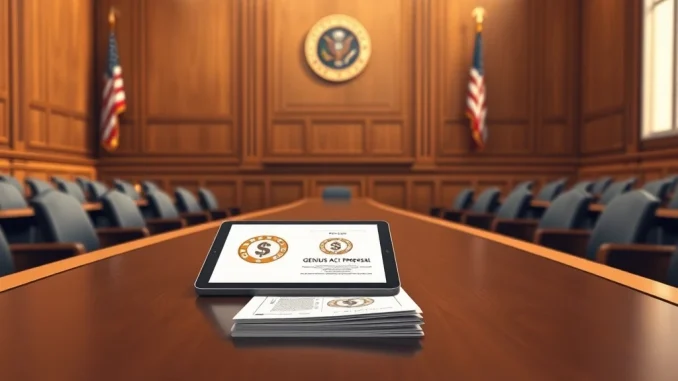
WASHINGTON, D.C. — The Office of the Comptroller of the Currency (OCC) formally opened a critical feedback period on March 15, 2026, inviting public and industry comment on its proposed implementation framework for the Guiding and Establishing National Innovation for U.S. Stablecoins (GENIUS) Act. This move marks a pivotal regulatory step toward establishing the first comprehensive federal rules for stablecoin issuers and their banking relationships nationwide. Acting Comptroller Michael J. Hsu announced the 60-day comment window, seeking detailed input on proposed safety standards, reserve requirements, and oversight mechanisms that could reshape the U.S. digital asset landscape.
OCC Launches Formal Feedback Stage on GENIUS Act Proposal
The OCC’s 87-page advance notice of proposed rulemaking (ANPR) outlines a detailed framework for integrating stablecoin activities into the national banking system. Consequently, the agency seeks specific feedback on three core pillars: issuer safety and soundness, the composition and custody of reserve assets, and the appropriate scope of federal supervisory authority. “Our goal is to foster responsible innovation while ensuring these payment instruments are safe, reliable, and trustworthy,” stated Hsu in a public memorandum released alongside the ANPR. The proposal follows nearly two years of interagency coordination with the Federal Reserve and FDIC, triggered by the GENIUS Act’s passage in late 2024.
Industry analysts immediately noted the proposal’s emphasis on “same risk, same activity, same regulation” principles long advocated by banking regulators. For instance, the OCC explicitly asks commenters whether stablecoin issuers seeking national bank charters should maintain capital and liquidity ratios equivalent to those required for traditional payment processors. Furthermore, the timeline is aggressive. The feedback period closes on May 14, 2026, with a target for final rules by the end of the fiscal year. This schedule underscores the administration’s stated priority to provide regulatory clarity ahead of the next election cycle.
5 Key Impacts of the Proposed Stablecoin Rules
The OCC’s framework, if finalized, would create immediate and long-term consequences for crypto firms, traditional banks, and consumers. The proposal aims to bifurcate the market between federally-regulated “qualified stablecoins” and other digital assets. A senior policy analyst at the Brookings Institution, quoted in their preliminary review, stated, “This is less about banning innovation and more about channeling it into a supervised corridor.” The most significant impacts center on market structure and consumer protection.
- Bank Charter Requirement for Major Issuers: The proposal suggests that stablecoin issuers with over $10 billion in circulating stablecoin value must obtain a national bank charter or become a federally-regulated trust company. This would directly impact the largest players in the current market.
- Full-Reserve Backing with Daily Attestation: Issuers must maintain high-quality liquid assets (HQLA) like Treasury bills at a 1:1 ratio to outstanding stablecoins. Crucially, these reserves require daily third-party attestation, a standard far more frequent than some state-level regimes.
- Explicit Ban on Algorithmic Stablecoins: The draft rules explicitly prohibit banking organizations from issuing, holding, or transacting in stablecoins that rely on algorithmic mechanisms to maintain parity. This formalizes a de facto ban following the 2022 market collapse.
- Interoperability and Redemption Mandates: Federally-chartered issuers must ensure their stablecoins are interoperable with other qualified stablecoins and guarantee holders a direct, frictionless redemption path to U.S. dollars within 24 hours.
- New Compliance Burdens for Partner Banks: Traditional banks that provide custody or payment services to stablecoin issuers will face new due diligence and monitoring requirements, potentially increasing operational costs.
Expert Perspectives on the Regulatory Shift
Reactions from legal and financial experts highlight both the opportunities and challenges embedded in the OCC’s approach. Professor Sarah Green, a financial regulation scholar at Georgetown University Law Center, noted, “The OCC is attempting to build a firewall. By bringing stablecoins inside the banking perimeter, they aim to isolate systemic risk from the broader, more volatile crypto ecosystem.” Conversely, some industry advocates warn of unintended consequences. The Blockchain Association, in an initial statement, argued that the $10 billion charter threshold could “cement early-mover advantage and stifle competition.” The association plans to submit detailed comments urging a tiered approach based on activity and risk profile.
An external authority, the Bank for International Settlements (BIS), published a report in February 2026 that the OCC’s ANPR references. The BIS report, “Stablecoins: the quest for stability in digital finance,” emphasizes the critical need for robust reserve governance and lender-of-last-resort backstops, principles clearly reflected in the OCC’s questions to commenters. This citation provides a global regulatory context for the U.S. action.
Comparing U.S. Stablecoin Regulation to Global Frameworks
The OCC’s proposal does not emerge in a vacuum. It represents the U.S. entry into an established global conversation on stablecoin regulation, positioning itself between the European Union’s comprehensive MiCA regime and the more activity-specific approach in the United Kingdom. The table below highlights key distinctions in regulatory philosophy and requirements.
| Jurisdiction / Framework | Licensing Authority | Core Reserve Requirement | Status |
|---|---|---|---|
| United States (Proposed GENIUS Act/OCC) | Office of the Comptroller of the Currency (Federal) | 100% HQLA, Daily Attestation | Proposed Rulemaking (2026) |
| European Union (MiCA) | National Competent Authorities (e.g., BaFin, AMF) | Liquid reserves with “sufficient” liquidity, Weekly reporting | In Force (2025) |
| United Kingdom (Financial Services Act 2024) | Financial Conduct Authority (FCA) | Principles-based, Backing assets must match liquidity profile | Final Rules Pending (2026) |
| Japan (Payment Services Act) | Financial Services Agency (FSA) | 100% Cash or Cash Equivalents held in trust | In Force (2023) |
This comparative context reveals the U.S. proposal’s distinct emphasis on integrating stablecoins into the existing federal banking supervisory structure, rather than creating a standalone regulator. Analysts suggest this could expedite adoption by traditional finance but may create friction with decentralized finance (DeFi) protocols that lack a central corporate entity.
What Happens Next in the Rulemaking Process
The path from feedback to final rule is structured and transparent. Following the May 14 comment deadline, OCC staff will analyze submissions, potentially hold public roundtables, and draft a formal Notice of Proposed Rulemaking (NPRM). That subsequent proposal, expected in Q3 2026, will include specific regulatory text and another comment period. “We are committed to a process that is both thorough and timely,” an OCC spokesperson confirmed. Key dates to watch include potential congressional oversight hearings already scheduled by the House Financial Services Committee for March 2026, where Acting Comptroller Hsu is expected to testify.
Initial Industry and Advocacy Group Reactions
Stakeholder reactions have been swift and varied, previewing the debates that will fill the comment docket. Major bank trade groups like the American Bankers Association have expressed cautious support, emphasizing the need for a level playing field. In contrast, a coalition of crypto-native firms and advocacy groups, including the DeFi Education Fund, has raised concerns about the proposal’s potential to exclude non-bank innovators and its treatment of wallet software providers. Meanwhile, consumer protection organizations like the National Consumer Law Center have welcomed the strong reserve and redemption rules but urge the OCC to add explicit fraud prevention and disclosure mandates. This spectrum of responses underscores the balancing act regulators face between innovation, stability, and protection.
Conclusion
The OCC’s opening of the feedback period on the GENIUS Act implementation marks the beginning of the most significant phase yet for U.S. stablecoin regulation. The proposal’s core focus on banking integration, ironclad reserves, and explicit prohibitions sets clear parameters for the future market. Key takeaways include the impending bank charter requirement for large issuers, the global alignment of U.S. rules with daily attestation standards, and the explicit rejection of algorithmic models. Ultimately, the quality and depth of the incoming comments will shape the final rules, determining whether the United States can foster a secure and innovative digital dollar ecosystem. Observers should monitor the OCC’s comment docket and subsequent congressional hearings for signals of the final regulatory direction.
Frequently Asked Questions
Q1: What is the GENIUS Act and what does the OCC’s feedback stage involve?
The GENIUS Act is the Guiding and Establishing National Innovation for U.S. Stablecoins Act, a 2024 law directing federal banking regulators to create rules for stablecoins. The OCC’s feedback stage is a 60-day period ending May 14, 2026, where the public and industry can submit formal comments on the agency’s detailed proposal for implementing the Act, focusing on safety, reserves, and oversight.
Q2: How will the proposed rules affect existing stablecoins like USDC or USDT?
Issuers of large stablecoins like USDC (Circle) or USDT (Tether) would likely need to obtain a national bank charter or become a federally-regulated trust company under the current proposal, given their market size exceeds the suggested $10 billion threshold. They would also need to adjust their reserve custody and attestation practices to meet the proposed daily standard.
Q3: What is the timeline for these rules to become official?
After the comment period closes on May 14, 2026, the OCC will review feedback and issue a more formal Notice of Proposed Rulemaking (NPRM) likely in Q3 2026. A final rule could be published by the end of 2026 or early 2027, following another brief comment period on the NPRM.
Q4: Can a regular person still use stablecoins if these rules pass?
Yes. The rules are designed to ensure the stablecoins you can readily buy and use are backed by secure, liquid assets and can be reliably redeemed. The proposal aims to make consumer use safer by preventing unstable algorithmic models and requiring clear redemption rights.
Q5: How does this U.S. proposal compare to regulations in Europe?
The U.S. approach, via the OCC, is more focused on integrating stablecoins into the existing banking system. Europe’s MiCA regulation creates a new, standalone licensing category for “crypto-asset service providers.” Both require strong reserve backing, but the U.S. proposal suggests more frequent (daily vs. weekly) attestation and a direct path to bank charters.
Q6: How does this affect developers building apps that use stablecoins?
For most app developers, the direct impact may be minimal if they are simply integrating stablecoins as a payment method. However, developers of protocols that mint, manage, or custody stablecoins would face significant new compliance requirements and may need to partner with a federally-chartered entity or restructure their operations.
Updated insights and analysis added for better clarity.
This article was produced with AI assistance and reviewed by our editorial team for accuracy and quality.