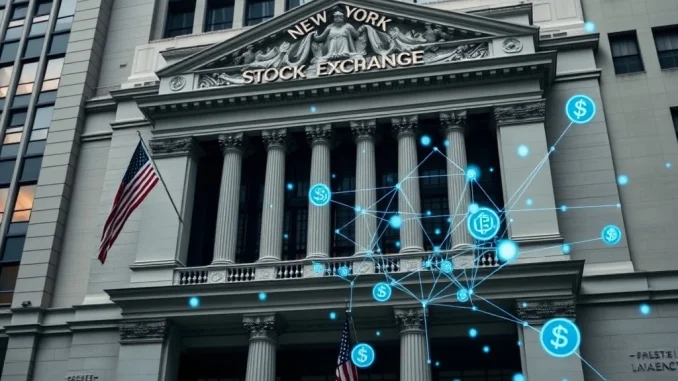
NEW YORK, March 2025 – The New York Stock Exchange’s ambitious plan to tokenize real-world assets faces significant scrutiny as a prominent academic delivers a pointed critique of its substance and implementation details. Columbia Business School professor Omid Malekan has characterized the NYSE tokenization announcement as superficial, highlighting critical omissions that raise questions about the exchange’s blockchain strategy. This development comes amid growing institutional interest in real-world asset tokenization, positioning the NYSE’s move as a potential watershed moment for traditional finance.
NYSE Tokenization Plan Lacks Crucial Implementation Details
According to recent analysis, the New York Stock Exchange’s blockchain initiative for real-world asset tokenization fails to specify fundamental technical and operational parameters. Professor Malekan specifically noted the absence of information regarding blockchain selection, permissioning structures, and economic frameworks. The announcement, while generating considerable media attention, provides insufficient detail about how the exchange intends to implement this technological transition. Consequently, industry observers question whether the plan represents substantive innovation or merely strategic positioning in the competitive digital assets landscape.
Furthermore, the NYSE tokenization proposal omits critical elements that typically define blockchain implementations. These omissions include tokenomics design, fee structures, and governance mechanisms. Such gaps create uncertainty about the project’s viability and long-term sustainability. Meanwhile, other financial institutions have launched more detailed tokenization initiatives, establishing a comparative framework that highlights the NYSE announcement’s limitations. The exchange’s historical position as a market leader increases scrutiny of its technological adaptations, making transparency particularly important for maintaining institutional confidence.
Centralization Concerns in Blockchain Implementation
Professor Malekan’s critique extends beyond missing details to address fundamental structural issues within the proposed NYSE tokenization model. He argues that the exchange’s highly centralized operational framework contradicts core blockchain principles of decentralization and distributed governance. Even sophisticated technology cannot overcome this inherent contradiction unless the NYSE fundamentally restructures its existing partnerships and relationships. This tension between traditional financial structures and blockchain ideology represents a significant challenge for established institutions entering the digital asset space.
Expert Analysis of Institutional Blockchain Adoption
Financial technology experts consistently identify centralization as a recurring obstacle for traditional institutions implementing blockchain solutions. The NYSE maintains numerous established partnerships with clearing houses, regulatory bodies, and market participants that inherently centralize control. Transitioning to a decentralized model would require renegotiating these relationships, potentially disrupting existing revenue streams and operational efficiencies. Consequently, many institutional blockchain initiatives represent incremental adaptations rather than transformative innovations. This pattern suggests that traditional financial players may prioritize maintaining control over embracing blockchain’s disruptive potential.
The following table compares key aspects of traditional financial structures versus blockchain principles:
| Aspect | Traditional Finance | Blockchain Principles |
|---|---|---|
| Governance | Centralized authority | Distributed consensus |
| Transparency | Limited to regulators | Publicly verifiable |
| Settlement | Multi-day processes | Near-instant finality |
| Intermediaries | Multiple required | Minimal or none |
Real-World Asset Tokenization Market Context
The NYSE announcement occurs within a rapidly evolving real-world asset tokenization landscape that has attracted substantial institutional investment. Major financial players including BlackRock, JPMorgan, and Franklin Templeton have launched their own tokenization initiatives with varying degrees of transparency and technical detail. This competitive environment increases pressure on the NYSE to demonstrate genuine innovation rather than symbolic adoption. Real-world asset tokenization potentially represents a multi-trillion dollar market opportunity, explaining why traditional financial institutions increasingly explore blockchain applications despite implementation challenges.
Several key developments have shaped the current RWA tokenization market:
- Institutional adoption acceleration throughout 2024-2025
- Regulatory clarity improvements in major jurisdictions
- Technological infrastructure maturation for enterprise blockchain
- Investor demand growth for tokenized traditional assets
- Cross-border settlement efficiency as primary use case
Moreover, successful tokenization initiatives typically share specific characteristics that the NYSE plan currently lacks. These include clear technical specifications, defined governance models, and transparent economic structures. The absence of these elements in the NYSE announcement raises legitimate questions about its implementation timeline and ultimate feasibility. Industry observers will closely monitor whether the exchange provides additional details that address these concerns in coming months.
Blockchain Selection and Permissioning Considerations
A critical omission in the NYSE tokenization announcement involves the specific blockchain infrastructure selection. The exchange has not disclosed whether it will utilize an existing public blockchain, develop a private consortium chain, or create a proprietary solution. Each approach carries distinct implications for security, scalability, and regulatory compliance. Similarly, the announcement fails to specify whether tokens will operate on permissioned or permissionless networks, a decision that fundamentally shapes accessibility and control structures. These technical choices significantly influence implementation complexity and potential market impact.
Technical Implementation Challenges
Enterprise blockchain implementations face numerous technical hurdles that require careful planning and detailed specification. The NYSE’s silence on these matters suggests either incomplete planning or strategic withholding of information. Technical considerations include consensus mechanism selection, smart contract architecture, interoperability protocols, and security frameworks. Each element requires extensive development and testing before deployment in regulated financial environments. The exchange’s established reputation for reliability and security increases the stakes for its blockchain implementation, necessitating particularly thorough technical planning and transparent communication.
Additionally, regulatory compliance represents a significant implementation challenge for financial blockchain projects. The NYSE operates within one of the world’s most stringent regulatory environments, requiring careful alignment between technological implementation and legal requirements. Tokenized assets must comply with securities regulations, anti-money laundering provisions, and investor protection standards. The complexity of these requirements typically necessitates detailed planning documents that address both technical and regulatory considerations. The absence of such details in the initial announcement contributes to perceptions of superficiality identified by Professor Malekan.
Industry Response and Competitive Implications
The financial industry has responded cautiously to the NYSE tokenization announcement, with many observers echoing Professor Malekan’s concerns about substance and implementation. Competing exchanges and financial institutions monitor the initiative closely, as its success or failure could influence broader institutional adoption of blockchain technology. Several European and Asian exchanges have already launched more detailed tokenization initiatives, creating competitive pressure on the NYSE to demonstrate genuine progress. This international dimension adds strategic importance to the exchange’s ability to deliver substantive innovation rather than symbolic gestures.
Market analysts identify several potential motivations for the NYSE announcement despite its current lack of detail:
- Strategic positioning in competitive digital asset landscape
- Investor relations management amid blockchain interest
- Regulatory engagement through demonstrated innovation efforts
- Partnership development with blockchain technology providers
- Market signaling to competitors and potential collaborators
Furthermore, the timing of the announcement coincides with increased regulatory attention to cryptocurrency and digital asset markets. By positioning itself as exploring blockchain applications for traditional assets, the NYSE potentially seeks to influence regulatory discussions and shape future policy frameworks. This strategic context helps explain why the exchange might announce an initiative before finalizing implementation details, though it doesn’t address concerns about the announcement’s substantive content.
Conclusion
The NYSE tokenization plan faces legitimate criticism for lacking implementation details and substantive content, as highlighted by Columbia professor Omid Malekan’s analysis. The absence of information regarding blockchain selection, permissioning structures, tokenomics, and fee frameworks raises questions about the initiative’s depth and viability. Moreover, the fundamental tension between the exchange’s centralized structure and blockchain’s decentralized principles presents significant implementation challenges. As real-world asset tokenization continues gaining institutional traction, market participants will closely monitor whether the NYSE provides additional details that address these concerns or whether the initiative remains primarily symbolic. The exchange’s response to this criticism will significantly influence perceptions of traditional finance’s capacity for meaningful blockchain innovation.
FAQs
Q1: What specific elements does the Columbia professor find lacking in the NYSE tokenization announcement?
Professor Malekan identifies several critical omissions including blockchain selection details, permissioning structure specifications, tokenomics design, and fee framework information. He also notes the absence of implementation timelines and technical architecture details.
Q2: Why does centralization present a problem for the NYSE blockchain initiative?
Blockchain technology fundamentally emphasizes decentralization and distributed control, while traditional exchanges like the NYSE operate through highly centralized structures. This creates inherent tension between the technology’s design principles and the exchange’s established operational model.
Q3: How does the NYSE announcement compare to other institutional tokenization initiatives?
Other financial institutions including BlackRock and JPMorgan have generally provided more detailed technical specifications and implementation frameworks for their tokenization projects, making the NYSE announcement appear comparatively vague.
Q4: What are real-world assets in the context of tokenization?
Real-world assets refer to traditional financial instruments and physical assets including stocks, bonds, real estate, commodities, and intellectual property that can be represented as digital tokens on blockchain networks.
Q5: What potential motivations might the NYSE have for announcing a tokenization plan without detailed specifications?
Potential motivations include strategic positioning in competitive markets, regulatory engagement through demonstrated innovation efforts, investor relations management, and partnership development with technology providers.
Q6: How might the NYSE address the criticism of its tokenization announcement?
The exchange could provide detailed technical specifications, clarify implementation timelines, disclose partnership arrangements, outline governance structures, and address how it will reconcile centralized operations with blockchain’s decentralized principles.
Updated insights and analysis added for better clarity.
This article was produced with AI assistance and reviewed by our editorial team for accuracy and quality.