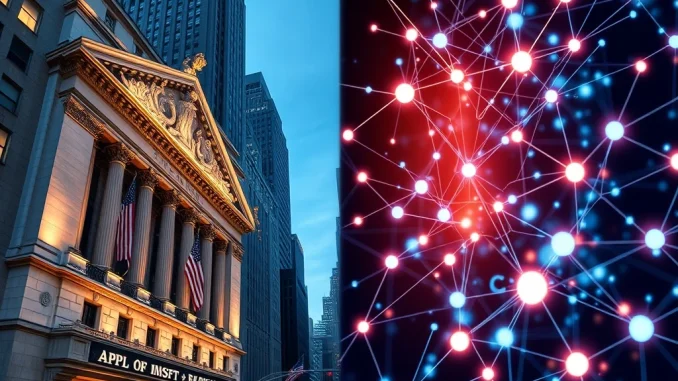
NEW YORK, March 2025 – The New York Stock Exchange (NYSE), the world’s largest stock exchange by market capitalization, is poised to shatter a century-old paradigm. According to a report by Watcher.Guru, the NYSE plans to launch a groundbreaking service enabling 24/7 trading of U.S. equities through an on-chain tokenization platform. This monumental move signals the most significant structural change to equity markets in decades, directly integrating blockchain’s immutable ledger with the bedrock of global finance. Consequently, it promises to redefine accessibility, liquidity, and operational efficiency for investors worldwide.
NYSE 24/7 Trading: Decoding the Tokenization Blueprint
The core of the NYSE’s initiative involves on-chain tokenization. This process converts ownership rights of traditional securities, like shares of Apple or Microsoft, into digital tokens on a blockchain. Each token acts as a digital certificate of ownership, recorded on a secure, transparent, and distributed ledger. Therefore, the proposed exchange would not replace the existing NYSE but would function as a complementary, parallel market operating around the clock. This model directly addresses the limitation of traditional market hours—9:30 AM to 4:00 PM ET, Monday through Friday—which has long been a constraint in our globally connected, digital-first economy.
Industry analysts point to several immediate catalysts for this shift. Firstly, the success of tokenized treasury products and real-world asset (RWA) protocols on chains like Ethereum and Solana has demonstrated robust demand and technical viability. Secondly, regulatory clarity, particularly frameworks emerging from the U.S. Securities and Exchange Commission (SEC) and legislation like the Financial Innovation and Technology for the 21st Century Act, has provided a clearer pathway for regulated entities. Finally, competitive pressure from digital-native platforms and international exchanges exploring similar concepts has accelerated development timelines.
The Technical and Operational Framework
Implementing 24/7 trading for tokenized stocks requires a sophisticated technical architecture. The NYSE will likely partner with established blockchain infrastructure firms and custodians to ensure security and compliance. Key operational components will include a dedicated matching engine for order execution, a robust digital asset custody solution, and seamless integration with existing clearing and settlement systems like the DTCC. Importantly, this system must maintain parity with the primary market, ensuring token prices accurately reflect the underlying security’s value, even during after-hours trading.
Expert Analysis on Market Impact and Challenges
Financial technology experts highlight profound implications. “This is not merely an extended hours session,” notes Dr. Anya Sharma, a fintech professor at MIT. “It’s the creation of a new, programmable asset layer for equities. Smart contracts could automate dividend payments, enable complex conditional trades, and facilitate instant settlement, moving from T+2 to T+0.” However, significant challenges remain. Market volatility in a 24/7 environment, the need for continuous liquidity provision, and managing corporate actions like stock splits on-chain are complex hurdles. Furthermore, ensuring the system is resilient against cyber threats and operational failures is paramount for maintaining trust.
The timeline for rollout remains speculative but industry observers suggest a phased approach. An initial pilot with a select basket of highly liquid, large-cap stocks is probable within 12-18 months, followed by a broader rollout. This measured strategy allows for testing, regulatory feedback, and market adaptation.
| Feature | Traditional NYSE Trading | Proposed Tokenized 24/7 Trading |
|---|---|---|
| Market Hours | 9:30 AM – 4:00 PM ET, Weekdays | 24 hours a day, 7 days a week |
| Settlement Time | T+2 (Trade date plus two days) | Potential for T+0 or near-instant |
| Asset Form | Electronic book-entry | Digital token on a blockchain |
| Accessibility | Primarily through brokers & institutions | Potential for broader, global digital access |
| Transaction Transparency | Post-trade reporting | Near-real-time on public/private ledger |
Broader Implications for Global Finance
The ripple effects of a 24/7 tokenized NYSE extend far beyond Wall Street. For investors, it enables reaction to global news and earnings reports in real-time, regardless of time zones. For companies, it could enhance global capital formation and shareholder engagement. Moreover, this development exerts pressure on other major exchanges in London, Tokyo, and Hong Kong to innovate similarly, potentially leading to a new era of interconnected, always-on global digital markets. The move also validates the broader digital assets sector, signaling that blockchain technology has matured from a speculative niche to a core infrastructure component for mainstream finance.
Regulatory oversight will be crucial. The SEC will need to adapt its monitoring for continuous markets, focusing on:
- Market surveillance for manipulation across all hours.
- Clear rules for token issuance and custody.
- Investor protection standards for a more accessible market.
Conclusion
The NYSE’s plan to introduce 24/7 trading via on-chain tokenization represents a historic convergence of traditional finance and decentralized technology. This initiative transcends a simple schedule expansion; it fundamentally re-engineers the equity market’s infrastructure for the digital age. By leveraging blockchain for on-chain tokenization, the NYSE aims to unlock unprecedented liquidity, efficiency, and global access. While operational and regulatory challenges are significant, the direction is clear: the future of securities trading is continuous, transparent, and digitally native. The success of this venture will likely set the standard for financial markets worldwide for decades to come.
FAQs
Q1: What does “on-chain tokenization” of stocks mean?
It means creating a digital token on a blockchain that represents ownership of a traditional stock. This token is a secure, tradable digital certificate recorded on a distributed ledger.
Q2: Will the new 24/7 trading platform replace the regular NYSE?
No. Initial reports suggest it will operate as a complementary, parallel market. The traditional NYSE with its current hours and rules is expected to continue functioning alongside the new tokenized platform.
Q3: How will this affect the average retail investor?
It could provide greater flexibility to trade outside standard market hours and react to news in real-time. However, it may also introduce new complexities and risks associated with 24/7 price volatility and digital asset custody.
Q4: What are the biggest risks of 24/7 tokenized stock trading?
Key risks include potential for increased volatility during thin overnight trading, cybersecurity threats targeting the digital infrastructure, and the challenge of ensuring consistent liquidity at all times.
Q5: When is the NYSE’s 24/7 tokenized trading expected to launch?
There is no official launch date. Industry analysis suggests a phased rollout, possibly starting with a limited pilot program for select stocks within the next 12-18 months, subject to regulatory approvals.
Updated insights and analysis added for better clarity.
This article was produced with AI assistance and reviewed by our editorial team for accuracy and quality.