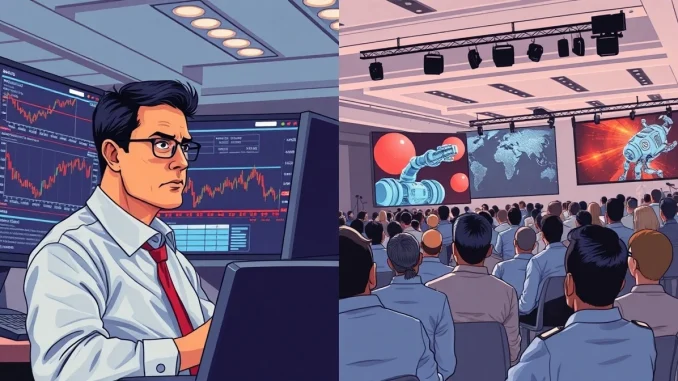
When Nvidia CEO Jensen Huang delivered his ambitious keynote at the company’s annual GTC conference in March 2026, the $4 trillion chipmaker’s stock began declining almost immediately, revealing a stark divide between Silicon Valley’s enthusiasm and Wall Street’s growing apprehension about artificial intelligence’s future trajectory.
Nvidia GTC Conference Highlights Ambitious AI Vision
During his two-and-a-half-hour presentation, Huang outlined Nvidia’s expanding technological ecosystem. The company introduced several significant developments including:
- New graphics architecture for gaming and professional visualization
- Updated networking infrastructure designed for AI workloads
- Autonomous vehicle partnerships with major automotive manufacturers
- Collaboration with Groq on chips for the Vera Rubin Observatory system
Huang presented staggering market projections that positioned Nvidia at the center of multiple technological revolutions. He described the AI agent ecosystem as a potential $35 trillion market while estimating the physical AI and robotics industry could reach $50 trillion. Furthermore, Huang projected $1 trillion in purchase orders for the company’s Blackwell and Vera Rubin chips by the end of 2027.
Wall Street’s Cautious Response to AI Optimism
Despite these ambitious projections, investors responded with skepticism. The stock decline during Huang’s presentation reflected broader concerns about AI valuation and market sustainability. Market analysts identified several factors contributing to this cautious response:
| Wall Street Concern | Silicon Valley Perspective |
|---|---|
| Uncertain return on investment timelines | Transformational technology potential |
| Valuation bubble risks | Market expansion opportunities |
| Enterprise adoption challenges | Rapid infrastructure deployment |
| Competitive landscape evolution | Platform ecosystem advantages |
This divergence highlights the different time horizons and risk assessments separating financial markets from technology innovators.
Expert Analysis of Market Uncertainty
Daniel Newman, CEO of Futurum Research, explained the market’s reaction to TechCrunch. “AI is so transformational and moving so rapidly that we don’t fully understand its implications for existing societal constructs,” Newman stated. “Markets inherently dislike uncertainty. The speed of innovation has created unexpected uncertainty that most investors never anticipated.”
Newman challenged narratives about slow enterprise AI adoption, suggesting they often rely on outdated data. “Enterprise AI adoption will reach an inflection point quickly,” he argued. “When people say it’s not happening, they’re often citing six-month-old survey data. The reality is that return on investment metrics remain undefined for many companies, creating perception gaps.”
Nvidia’s Financial Performance Versus Market Perception
Despite Wall Street’s cautious response to the GTC announcements, Nvidia’s financial results continue to demonstrate remarkable strength. The company reported 73% year-over-year revenue growth in its most recent quarterly earnings, consistently exceeding analyst expectations. Recent developments further underscore this momentum:
- Amazon commitment: Confirmed plans to purchase 1 million GPUs for AWS by 2027
- Infrastructure expansion: Continued data center and cloud partnership growth
- Platform ecosystem: Broadening developer and enterprise adoption
Kevin Cook, senior equity strategist at Zacks Investment Research, noted the company’s central economic position. “The economy increasingly orbits around Nvidia,” Cook told TechCrunch. “The company builds necessary infrastructure supporting hardware, software, and physical AI applications across diverse industries.”
The AI Bubble Debate Intensifies
The GTC conference reactions have intensified discussions about potential AI market bubbles. Several factors contribute to this ongoing debate:
Valuation concerns: Nvidia’s market capitalization has grown exponentially alongside AI enthusiasm, raising questions about sustainability.
Adoption timelines: Enterprise implementation often progresses slower than technological development, creating expectation gaps.
Competitive responses: Major technology companies are developing alternative AI chips and systems, potentially challenging Nvidia’s dominance.
Regulatory considerations: Governments worldwide are examining AI’s societal impacts, which could influence market dynamics.
However, industry observers note that bubble discussions often accompany transformative technological periods. The internet boom of the late 1990s featured similar debates before ultimately reshaping global commerce and communication.
Conclusion
The contrasting reactions to Nvidia’s GTC conference reveal fundamental differences in how Silicon Valley and Wall Street assess artificial intelligence’s future. While technology leaders focus on transformational potential and long-term market creation, financial markets weigh immediate risks, valuation concerns, and implementation challenges. Nvidia’s continued financial performance suggests the company maintains strong fundamentals despite investor apprehension. The evolving relationship between technological innovation and market acceptance will likely shape AI’s development trajectory through 2026 and beyond, with Nvidia positioned at the center of this dynamic intersection between innovation and investment.
FAQs
Q1: Why did Nvidia’s stock drop during the GTC conference?
The decline reflected investor concerns about AI market sustainability, valuation levels, and uncertainty about enterprise adoption timelines despite ambitious projections from CEO Jensen Huang.
Q2: What were the key announcements at Nvidia’s GTC conference?
Major announcements included new graphics architecture, updated networking infrastructure for AI workloads, autonomous vehicle partnerships, and collaboration with Groq on chips for the Vera Rubin Observatory system.
Q3: How does Wall Street’s view of AI differ from Silicon Valley’s?
Wall Street focuses on financial metrics, risk assessment, and near-term returns, while Silicon Valley emphasizes technological potential, market creation, and long-term transformation.
Q4: Is there currently an AI bubble according to experts?
Experts debate this question, with some pointing to high valuations and adoption challenges while others emphasize real infrastructure investment and technological advancement.
Q5: How has Nvidia performed financially despite market concerns?
The company reported 73% year-over-year revenue growth in its most recent quarter and continues to secure major commitments like Amazon’s plan to purchase 1 million GPUs by 2027.
Updated insights and analysis added for better clarity.
This article was produced with AI assistance and reviewed by our editorial team for accuracy and quality.