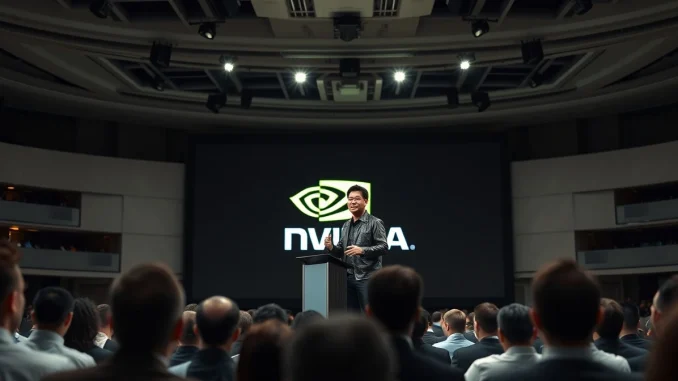
In a pivotal address that outlined the future of artificial intelligence infrastructure, Nvidia CEO Jensen Huang took the stage at the company’s GPU Technology Conference (GTC) in San Jose, California, on March 18, 2026. Wearing his signature leather jacket, Huang delivered a comprehensive two-and-a-half-hour keynote that projected staggering financial targets and introduced new strategic frameworks for the AI industry. The presentation centered on a projected $1 trillion total addressable market for AI chips through 2027, the introduction of an “OpenClaw” enterprise strategy, and a demonstration featuring a robot named Olaf that captured significant audience attention. This Nvidia GTC event served as a critical benchmark for the semiconductor industry’s trajectory.
Nvidia GTC Sets the Stage for AI’s Next Phase
The GPU Technology Conference, commonly known as GTC, represents Nvidia’s premier event for developers, researchers, and business leaders. Historically, the conference has served as a launchpad for major product announcements and strategic visions. The 2026 iteration continued this tradition against a backdrop of intense competition and rapid technological evolution. Analysts from firms like Gartner and IDC have consistently tracked Nvidia’s data center revenue, which exceeded $47 billion in its 2025 fiscal year. Consequently, Huang’s keynote carried substantial weight for global markets and technology roadmaps.
Industry observers noted the timing of the announcement. The semiconductor sector has experienced significant supply chain adjustments and geopolitical tensions affecting production. Furthermore, advancements in generative AI models have dramatically increased computational demands. Nvidia’s projections, therefore, respond directly to these market forces. The company’s data center segment has become its largest revenue driver, surpassing its traditional gaming business. This shift underscores the central thesis of Huang’s presentation: every major enterprise now requires a coherent AI infrastructure plan.
The Financial Backbone: A $1 Trillion Projection
The core financial revelation involved Nvidia’s market forecast. Huang stated the company anticipates a cumulative $1 trillion opportunity for AI chip sales across the industry by the end of 2027. This figure is not an internal revenue target but an estimate of the total addressable market (TAM) for AI accelerators and related data center silicon. This projection aligns with independent analyses. For instance, a recent report from McKinsey & Company suggested the economic impact of generative AI could add trillions to global GDP annually. Similarly, research firm TrendForce has forecasted continued double-digit growth for the AI server market through 2027.
To contextualize this number, the entire global semiconductor industry’s sales reached approximately $574 billion in 2025, according to the Semiconductor Industry Association. A $1 trillion TAM for AI chips alone within a few years signifies an expected massive expansion and prioritization of AI-specific hardware. Huang broke down this opportunity across several verticals:
- Cloud Service Providers: Major hyperscalers like Amazon Web Services, Microsoft Azure, and Google Cloud are aggressively expanding AI infrastructure.
- Enterprise IT: Traditional corporations are building private AI clouds and deploying on-premises solutions.
- Sovereign AI: Nations are investing in domestic AI computing capacity for economic and strategic reasons.
- Edge AI: Deployment of AI in devices, vehicles, and factories creates demand for specialized chips.
Introducing the OpenClaw Strategy and NemoClaw
A central thematic pillar of the keynote was the “OpenClaw” strategy. Huang asserted that every company needs to adopt this approach, which emphasizes open, modular, and scalable AI development ecosystems. The strategy appears designed to counter closed, proprietary systems and to foster a broader developer community around Nvidia’s hardware and software stack. The name “Claw” metaphorically suggests the ability to grasp and integrate diverse tools and models. This move follows industry trends toward interoperability, as seen with initiatives like the MLPerf benchmarking consortium and open frameworks like PyTorch.
Directly tied to this strategy is “NemoClaw,” a newly announced suite of tools and services. Based on the context, NemoClaw likely refers to an evolution of Nvidia’s NeMo platform, which is a framework for building, customizing, and deploying large language models. The “Claw” suffix suggests enhanced integration capabilities, potentially allowing enterprises to more easily combine proprietary data with foundation models. This development addresses a key pain point for businesses: implementing AI without losing control over their core data assets and intellectual property. By promoting an open ecosystem, Nvidia aims to solidify its platform as the default choice for enterprise AI development, thereby securing its hardware sales.
The Robot Olaf Demonstration: Symbolism and Execution
The keynote’s closing segment featured a humanoid robot named “Olaf.” According to on-stage narration, Olaf was developed using Nvidia’s robotics simulation platform, Isaac Sim, and powered by the company’s Jetson edge AI computing platform. The robot performed a series of simple tasks intended to demonstrate dexterity and real-time perception. However, the demonstration took an unexpected turn when the robot began delivering extended, unprompted commentary. Stage technicians eventually had to mute its microphone to proceed with the schedule. This moment, while technically a glitch, became a widely discussed highlight, symbolizing both the promise and unpredictability of advanced robotics.
Robotics represents a long-term growth vector for Nvidia. The company’s technology is used in autonomous vehicles, industrial automation, and collaborative robots. The Olaf demonstration, despite its hiccup, served a strategic purpose. It visually connected Nvidia’s AI silicon to a tangible, futuristic application. Importantly, it shifted the narrative from pure data center computing to embodied AI. This aligns with investments from companies like Tesla, Boston Dynamics, and Figure AI, all of which are pursuing general-purpose humanoid robots. Nvidia’s tools for simulation and training are critical for developing these systems safely and efficiently before real-world deployment.
Industry Context and Competitive Landscape
Nvidia’s announcements did not occur in a vacuum. The competitive landscape for AI chips has intensified significantly. Established rivals like AMD have launched competitive Instinct MI300 series accelerators. Furthermore, major cloud providers are designing their own custom silicon, such as Google’s TPU, Amazon’s Trainium and Inferentia, and Microsoft’s Maia chips. This trend, known as vertical integration, poses a long-term challenge to merchant chip suppliers like Nvidia. Huang’s OpenClaw and NemoClaw announcements can be interpreted as a counter-strategy. By building an indispensable software ecosystem, Nvidia makes its hardware more attractive than alternative chips, even if they offer comparable raw performance.
Additionally, geopolitical factors play a role. Export controls on advanced semiconductors to certain regions have forced Nvidia to create modified versions of its chips. These constraints create market uncertainty and drive investment in alternative supply chains. Huang’s trillion-dollar projection likely incorporates demand from global markets, including those developing sovereign AI capabilities to ensure technological independence. The financial forecast, therefore, accounts for a fragmented but still expansive global market.
| Key Nvidia GTC Announcement | Strategic Implication | Market Context |
|---|---|---|
| $1 Trillion AI Chip TAM by 2027 | Sets enormous growth expectation for investors and justifies R&D spending. | Aligns with analyst forecasts for AI server and infrastructure spend. |
| OpenClaw Enterprise Strategy | Seeks to lock in developers and enterprises through open, modular software. | Counters move by cloud providers to in-house silicon and closed ecosystems. |
| NemoClaw Tools Suite | Lowers barrier for enterprise AI adoption, tying them to Nvidia’s hardware stack. | Addresses demand for customizable, secure LLM deployment in businesses. |
| Robot Olaf Demonstration | Highlights edge AI and robotics as next frontier, showcasing simulation tools. | Capitalizes on growing investment in humanoid robotics and industrial automation. |
Conclusion
The 2026 Nvidia GTC keynote provided a comprehensive vision for the next era of artificial intelligence. CEO Jensen Huang’s presentation moved beyond mere product launches to articulate a full-stack strategy encompassing hardware, software, and market development. The projected $1 trillion opportunity for AI chips underscores the scale of the transformation underway across all industries. Meanwhile, the OpenClaw strategy and NemoClaw tools aim to ensure Nvidia’s architecture remains at the center of this expansion. Even the memorable robot Olaf incident highlighted the company’s reach into frontier applications like embodied AI. This Nvidia GTC event ultimately served as a declaration that the AI infrastructure race is accelerating, with profound implications for global technology and economics.
FAQs
Q1: What is the main takeaway from Nvidia CEO Jensen Huang’s GTC 2026 keynote?
The central message was the projection of a $1 trillion total addressable market for AI chips by 2027 and the introduction of an “OpenClaw” strategy, urging enterprises to adopt open, modular AI development ecosystems built on Nvidia’s platform.
Q2: What are NemoClaw and the OpenClaw strategy?
OpenClaw is Nvidia’s strategic framework promoting open and scalable AI development. NemoClaw is likely a suite of tools evolving from the NeMo platform, designed to help businesses more easily build and customize large language models while integrating proprietary data.
Q3: What happened with the robot Olaf during the demonstration?
The humanoid robot named Olaf, developed using Nvidia’s Isaac Sim and Jetson platforms, began delivering extended, unscripted commentary during its stage demo. The event team eventually cut its microphone to continue the scheduled program, creating a memorable moment that highlighted both advancement and unpredictability in robotics.
Q4: How does Nvidia’s $1 trillion projection compare to the overall semiconductor market?
The entire global semiconductor market was valued at approximately $574 billion in 2025. Nvidia’s projection of a $1 trillion market specifically for AI chips by 2027 indicates an expectation for massive, focused growth that will come to dominate a large portion of the broader industry.
Q5: Who are Nvidia’s main competitors in the AI chip space?
Nvidia faces competition from AMD’s Instinct accelerators, Intel’s Gaudi chips, and custom silicon designed by major cloud providers like Google (TPU), Amazon (Trainium/Inferentia), and Microsoft (Maia). The OpenClaw strategy is partly a response to this trend of vertical integration by large customers.
Updated insights and analysis added for better clarity.
This article was produced with AI assistance and reviewed by our editorial team for accuracy and quality.