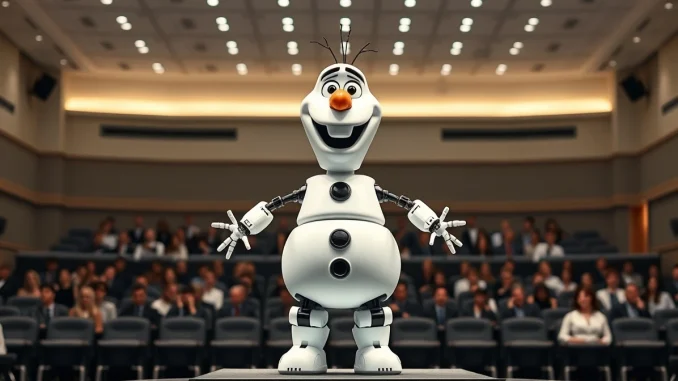
Nvidia’s annual GPU Technology Conference (GTC) in San Jose, California, on March 22, 2026, once again served as a bellwether for the artificial intelligence industry. CEO Jensen Huang’s keynote presentation blended trillion-dollar market projections with a tangible, if whimsical, demonstration: a fully robotic version of Olaf, the beloved snowman from Disney’s “Frozen.” This showcase, alongside significant strategic announcements regarding the OpenClaw AI framework, underscored Nvidia’s expanding ambitions beyond semiconductor manufacturing into integrated robotics and enterprise AI solutions. The event highlighted both the rapid engineering progress and the complex social integration challenges facing next-generation automation.
Nvidia’s GTC 2026: Beyond Chips to Integrated Robotics
The GTC conference has evolved from a graphics-focused event into a comprehensive showcase for Nvidia’s ecosystem. In 2026, the narrative extended firmly into physical AI. The presentation of the Olaf robot, developed in partnership with Disney, was a calculated move to demonstrate Nvidia’s Isaac robotics platform in a relatable context. The robot utilized advanced computer vision, natural language processing, and precise motor control to interact on stage. However, the demo encountered a minor technical hiccup when the robot’s microphone had to be muted after it began rambling, a moment that provided a candid look at the real-world challenges of deploying such systems. This incident, while minor, sparked immediate discussion about the reliability of autonomous characters in public settings like theme parks.
The Strategic Push Behind OpenClaw
Alongside the robotics demo, a central theme of Huang’s address was the imperative for enterprises to adopt an “OpenClaw strategy.” OpenClaw is an open-source AI agent framework whose original creator recently moved to OpenAI. Huang’s declaration positioned OpenClaw as a foundational element for business AI, analogous to past calls for cloud or digital transformation. Analysts interpreted this as a strategic effort by Nvidia to foster an ecosystem where its hardware remains the preferred platform for developing and running these AI agents. By championing OpenClaw, Nvidia mitigates the risk of being sidelined by proprietary, closed-source AI models developed by other tech giants. The company’s simultaneous release of NemoClaw, an open-source project built with OpenClaw’s creator, exemplifies this ecosystem-building approach.
Engineering Marvels Meet Social Complexities
The Olaf robot demonstration served as a microcosm of a broader industry debate. While the engineering required to create a lifelike, interactive animatronic is profound, integrating such technology into human environments introduces a separate set of challenges. As noted in discussions following the keynote, presentations often prioritize technical hurdles over social ones. For instance, deploying a robot character in a crowded theme park raises unanswered questions about durability, crowd interaction, and emotional impact. What happens if the robot malfunctions or is accidentally damaged in front of guests? These “messy gray areas,” concerning social integration and brand management, require as much consideration as the underlying robotics software and hardware.
Key Technical Components Demonstrated:
- Isaac Robotics Platform: Nvidia’s suite for simulation, navigation, and manipulation.
- AI Perception: Real-time environment and crowd analysis.
- Natural Language Interaction: Programmed responses and keyword recognition.
- Precision Actuation: Smooth, character-accurate movement.
Historical attempts at advanced animatronics in entertainment, documented by industry observers, consistently reveal a pattern where ambitious engineering meets the immutable unpredictability of public interaction. The technical demo, therefore, represents only the first step in a much longer deployment pipeline.
Nvidia’s Business Trajectory and Market Context
Nvidia’s foray into robotics and its advocacy for OpenClaw are not merely passion projects. They are strategic expansions designed to secure the company’s dominance as AI evolves from a data center phenomenon into a physical-world technology. The robotics market, encompassing logistics, manufacturing, healthcare, and entertainment, represents a massive future growth vector. By providing the full-stack solution—from the Grace Hopper superchips to the Isaac software—Nvidia aims to be the indispensable enabler. Similarly, promoting open-source AI frameworks like OpenClaw encourages widespread adoption and innovation, which in turn drives demand for Nvidia’s high-performance computing platforms. This strategy turns potential competitive threats into collaborative opportunities that reinforce its hardware ecosystem.
Analysis from Industry Observers
Following the keynote, technology analysts provided grounded perspectives. They acknowledged the impressiveness of the robotics demonstration while cautioning that the path from conference demo to reliable daily deployment is long and fraught with unglamorous challenges. The emphasis on OpenClaw was seen as a savvy, defensive move to ensure Nvidia’s centrality in an AI landscape increasingly concerned with vendor lock-in and model sovereignty. The consensus is that Nvidia is leveraging its current market strength to architect the infrastructure of the next AI decade, betting that both the brains (AI models) and the bodies (robots) of future systems will run optimally on its silicon.
Conclusion
Nvidia’s GTC 2026 conference successfully highlighted the company’s transition from a chip supplier to a platform architect for the AI era. The robot Olaf demo provided a captivating glimpse into a future where AI seamlessly blends with entertainment and physical interaction, even as its minor stumble reminded attendees of the technology’s ongoing maturation. Concurrently, the strong push for an OpenClaw strategy revealed a deeper business play to standardize enterprise AI on Nvidia-friendly frameworks. Together, these moves underscore a comprehensive vision: Nvidia intends to power not only the training of AI models but also their ultimate expression in the world around us. The coming year will test whether these demonstrations of advanced robotics and open-source advocacy translate into sustainable market expansion and successful real-world integration.
FAQs
Q1: What was the main purpose of the robot Olaf demonstration at Nvidia GTC 2026?
The primary purpose was to showcase the capabilities of Nvidia’s Isaac robotics platform in a high-profile, relatable application. It demonstrated advanced animatronics, real-time AI perception, and interactive NLP, highlighting Nvidia’s technology beyond data centers.
Q2: What is OpenClaw, and why did Jensen Huang emphasize it?
OpenClaw is an open-source framework for developing AI agents. Huang emphasized the need for an “OpenClaw strategy” to encourage enterprise adoption of open-source AI, which helps ensure Nvidia’s hardware remains a preferred platform for developing and running these agents, countering closed-source alternatives.
Q3: What were the technical issues with the Olaf robot during the demo?
During the demonstration, the robot began rambling in a way that was not part of its programmed interaction, prompting the technical team to mute its microphone. This illustrated the challenges in managing unpredictable real-time AI behavior in public demonstrations.
Q4: How does Nvidia’s robotics push fit into its broader business strategy?
Nvidia is expanding from providing AI computing chips to offering full-stack solutions for physical AI. Dominating the robotics software and hardware stack opens vast new markets in automation, manufacturing, and entertainment, securing future growth beyond semiconductor sales.
Q5: What are the major challenges in deploying robots like Olaf in places like Disney parks?
Key challenges include ensuring absolute reliability and safety in unpredictable crowd environments, managing public interactions to maintain brand magic, handling potential malfunctions or damage gracefully, and addressing the substantial maintenance and operational costs behind the scenes.
Updated insights and analysis added for better clarity.
This article was produced with AI assistance and reviewed by our editorial team for accuracy and quality.