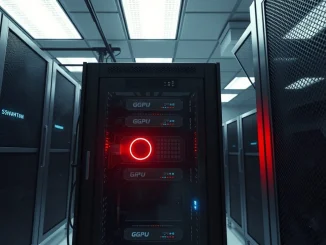
SAN JOSE, Calif. — March 17, 2026 — Nvidia CEO Jensen Huang has projected that demand for the company’s next-generation AI chips will reach $1 trillion, a staggering figure that underscores the explosive growth in artificial intelligence infrastructure.
Huang made the announcement during his keynote address at Nvidia’s annual GTC conference in San Jose, California. The executive revealed that the company has already seen approximately $500 billion in demand for its Blackwell and upcoming Vera Rubin chip architectures through 2026.
From $500 Billion to $1 Trillion
“Now, I don’t know if you guys feel the same way, but $500 billion is an enormous amount of revenue,” Huang told the audience. “Well, I’m here to tell you that right now where I stand — a few short months after GTC DC, one year after last GTC — right here where I stand, I see through 2027, at least $1 trillion.”
The projection represents a doubling of previously disclosed demand figures in less than a year. Industry analysts note that this forecast reflects the accelerating adoption of AI across multiple sectors, from cloud computing to autonomous systems.
Technical Advancements Driving Demand
The Vera Rubin computing architecture, first announced in 2024, represents Nvidia’s latest advancement in AI hardware. According to company specifications released in January, the Rubin architecture operates 3.5 times faster than the Blackwell predecessor on model-training tasks.
For inference tasks, the performance improvement reaches 5 times faster, with processing power climbing as high as 50 petaflops. Nvidia has stated it expects to ramp up production of these chips in the second half of the year.
Market data from semiconductor industry trackers indicates that AI chip demand has consistently exceeded supply throughout 2025 and early 2026. This supply-demand imbalance has contributed to the substantial order backlog Huang referenced.
Market Context and Industry Impact
The $1 trillion projection comes as Nvidia continues to dominate the market for AI training chips. According to recent financial disclosures, the company’s data center segment has been its primary growth driver for several consecutive quarters.
Huang’s announcement provides the clearest public indication yet of the scale of future demand that Nvidia anticipates. The figure encompasses orders for both the current Blackwell platform and the forthcoming Rubin generation.
Competitors in the AI hardware space, including established semiconductor firms and startups, have been racing to develop alternatives. However, Nvidia’s comprehensive software ecosystem, particularly its CUDA platform, continues to provide a significant competitive advantage according to industry assessments.
Production Timeline and Capacity
Nvidia officially began production of the Rubin architecture in January. The company’s manufacturing partners, including Taiwan Semiconductor Manufacturing Company (TSMC), have been expanding advanced packaging capacity specifically for AI chips.
Supply chain analysts monitoring semiconductor production note that lead times for advanced AI processors have remained extended despite capacity increases. This suggests that demand continues to outpace even the expanded manufacturing capabilities coming online.
The transition from Blackwell to Rubin represents a significant architectural shift. Nvidia has described Rubin as “the state of the art in AI hardware” that substantially outperforms its predecessor across multiple benchmarks.
What Comes Next
Investors and industry observers will be watching for confirmation of these demand projections in Nvidia’s upcoming quarterly earnings reports. The company’s ability to convert this projected demand into revenue will depend on manufacturing execution and continued technological leadership.
Meanwhile, enterprise customers planning large-scale AI deployments are evaluating their hardware procurement strategies. The scale of Huang’s projection suggests that AI infrastructure investment will remain a top priority for technology companies through the end of the decade.
For more details on Nvidia’s technical specifications, visit the company’s official website. Market analysis of semiconductor trends is available through the Semiconductor Industry Association.
Updated insights and analysis added for better clarity.
This article was produced with AI assistance and reviewed by our editorial team for accuracy and quality.