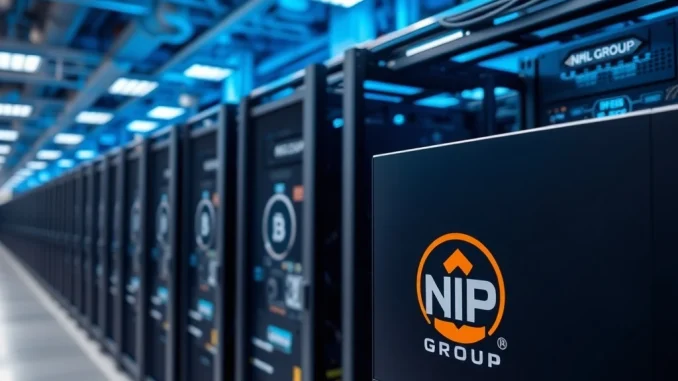
In a bold move that signals a major shift in corporate strategy, the global esports organization NIP Group has revealed a stunning financial result from its new venture: mining $14 million worth of Bitcoin in just its first three months of formal operations. This remarkable debut, spanning September to November of last year, immediately catapults the company into the upper echelons of the competitive public Bitcoin mining sector in the United States. The announcement provides a compelling case study on diversification, technological adoption, and the evolving revenue models for entertainment and gaming companies in the digital asset era.
NIP Group’s Bitcoin Mining Operations Analyzed
The core of NIP Group’s announcement rests on two pivotal metrics: revenue and hash rate. Firstly, the company generated approximately $14 million in Bitcoin revenue during its initial operational quarter. Secondly, and perhaps more significantly for its long-term prospects, NIP Group disclosed a current mining capacity of 9.66 exahashes per second (EH/s). According to industry data cited by Decrypt, this hash rate solidly positions NIP among the top 20 publicly listed Bitcoin mining firms in the competitive U.S. market. This achievement is not merely a footnote; it represents a rapid and calculated entry into a capital-intensive industry.
To contextualize this hash rate, 9.66 EH/s represents a substantial amount of computational power dedicated to securing the Bitcoin network and discovering new blocks. For comparison, this capacity would have represented a significant portion of the network’s total hashrate just a few years ago. The company’s ability to deploy this level of infrastructure so quickly suggests substantial pre-planning, significant capital expenditure, and strategic partnerships in energy procurement and hardware acquisition.
The Strategic Pivot from Esports to Crypto Infrastructure
NIP Group’s foray into Bitcoin mining is a textbook example of strategic business diversification. Traditionally known for its elite esports teams in games like Counter-Strike and VALORANT, the company is leveraging its core competencies in technology, global fan engagement, and digital-native operations to build a parallel, infrastructure-based revenue stream. This move mirrors a broader trend where companies adjacent to the tech and gaming sectors seek exposure to Bitcoin’s potential as a digital store of value and a source of operational income.
Furthermore, the timing of this operational launch is crucial. The period from September to November of last year coincided with a relative stabilization in Bitcoin’s network difficulty and a period of consolidation in its price, following the significant market downturn earlier in the year. Launching during this phase may have allowed NIP Group to secure mining hardware at more favorable prices and to establish operations before the next major market cycle. The $14 million revenue figure demonstrates an effective capture of value during this window, highlighting proficient operational execution.
Expert Analysis on Public Mining Competitiveness
Industry analysts note that breaking into the top 20 of U.S. public miners is an increasingly difficult feat. The sector has matured rapidly, dominated by firms like Marathon Digital, Riot Platforms, and CleanSpark, which have engaged in an aggressive arms race for hash rate and energy efficiency. For a new entrant like NIP Group to immediately rank among these established players indicates a serious, well-funded commitment. It suggests the company is not merely “dipping a toe” into crypto but is making a strategic, long-term capital allocation to become a significant player in digital asset infrastructure.
The capital required for such an endeavor is substantial. Building a 9.66 EH/s operation involves procuring tens of thousands of state-of-the-art ASIC miners, securing long-term, low-cost power contracts—often in regions with abundant renewable or stranded energy—and constructing or leasing industrial-scale data center facilities. NIP’s success in this short timeframe points to robust project management and access to significant financing, potentially leveraging its existing corporate balance sheet or raising dedicated capital for the mining venture.
Implications for the Broader Bitcoin Mining Landscape
NIP Group’s entry adds a new dimension to the public Bitcoin mining ecosystem. Traditionally, the space has been populated by companies founded solely for the purpose of mining. The arrival of a major brand from the global esports and entertainment industry could signal a new wave of diversification. Other gaming, media, or tech firms with strong balance sheets and high energy tolerance for their existing operations (like server farms) may see mining as a logical adjacent business.
This diversification also brings potential benefits to the Bitcoin network itself. A more heterogeneous group of public miners, with different corporate backgrounds and risk profiles, can contribute to network security and decentralization. However, it also raises questions about energy sourcing and environmental, social, and governance (ESG) reporting. As a public-facing brand with a young demographic, NIP Group will likely face scrutiny regarding the sustainability of its mining operations, pushing it toward transparent reporting on energy mix, similar to pressures faced by other public miners.
| Metric | NIP Group Result | Industry Context |
|---|---|---|
| Initial Revenue (3 months) | $14 Million | Strong debut for a new entrant |
| Hash Rate Capacity | 9.66 EH/s | Top 20 among U.S. public miners |
| Operational Launch | Q3 Last Year | Period of market consolidation |
| Core Business | Global Esports | Unusual diversification into infrastructure |
The company’s announcement was notably light on specific operational details that are critical for full analysis. Key data points still outstanding include:
- Energy Sourcing: The mix of power (renewable vs. traditional) and the geographic locations of its mining facilities.
- Hardware Efficiency: The specific models of ASIC miners deployed and their joules-per-terahash (J/TH) efficiency rating.
- Bitcoin Holdings: Whether the $14 million in BTC was sold for operational costs or is being held on the corporate treasury balance sheet.
- Future Roadmap: Planned hash rate expansion targets and capital expenditure plans for the coming year.
Conclusion
The revelation that NIP Group mined $14 million in BTC during its inaugural quarter is a significant development with layered implications. It successfully demonstrates a rapid and effective execution of a complex industrial plan, immediately establishing the esports firm as a serious contender in the public Bitcoin mining arena. This strategic pivot highlights the continuing convergence of gaming, technology, and cryptocurrency infrastructure. As NIP Group continues to scale its 9.66 EH/s operation, its progress will be closely watched as a bellwether for whether other digital-native companies follow suit, further blurring the lines between content creation and foundational blockchain infrastructure. The move secures a new, potentially counter-cyclical revenue stream for NIP while contributing hash rate to the world’s most secure decentralized network.
FAQs
Q1: How significant is a 9.66 EH/s hash rate for a Bitcoin miner?
A1: It is a very substantial capacity. As of early 2025, this hash rate would place a mining company firmly within the top tier of publicly listed operators in North America, representing a multi-hundred-million-dollar infrastructure investment and granting meaningful influence over block discovery on the Bitcoin network.
Q2: Why would an esports company like NIP Group get into Bitcoin mining?
A2: For strategic diversification. Bitcoin mining provides a tangible, infrastructure-based asset that can generate revenue independent of tournament winnings, sponsorships, and media rights. It leverages the company’s tech expertise and offers exposure to Bitcoin as a potential digital asset on its balance sheet.
Q3: Does mining $14M in BTC mean NIP made $14M in profit?
A3: Not necessarily. The $14 million figure represents the approximate U.S. dollar value of the Bitcoin mined (revenue). Profit would be this revenue minus all operational costs, including electricity, hardware depreciation, facility leasing, labor, and maintenance. The announcement did not disclose profitability metrics.
Q4: What are the main challenges NIP Group will face as a new public miner?
A4: Key challenges include managing volatile Bitcoin prices and network difficulty, securing reliable and low-cost energy contracts long-term, navigating increasing regulatory scrutiny, maintaining hardware efficiency against newer models, and addressing ESG concerns from stakeholders and its community.
Q5: How does this affect the broader Bitcoin mining industry?
A5: It introduces a well-known brand from a different sector, potentially increasing mainstream visibility and competition for resources like energy and hardware. It may encourage other non-traditional companies to consider mining, leading to a more diverse and corporate mining landscape.
This article was produced with AI assistance and reviewed by our editorial team for accuracy and quality.