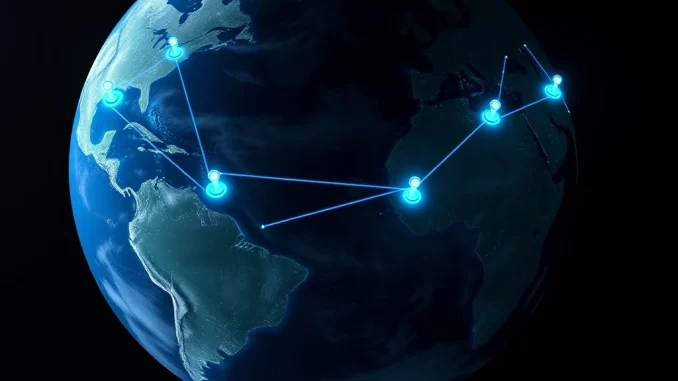
Zagreb, Croatia — March 5, 2026: The concept of the network state has evolved from tech manifesto to tangible, if controversial, global experiments. First articulated by former Coinbase CTO Balaji Srinivasan in 2022, this model of a digitally-native, globally-dispersed community crowdfunding physical territory is now being stress-tested from Honduras to Montenegro. As of early 2026, these projects face critical questions about practical governance, legal recognition, and their potential to reshape societal organization beyond traditional borders.
Defining the 2026 Network State: Beyond Digital Nomads
In 2026, a network state is not merely an online community but a political project. Srinivasan’s original definition—a highly-aligned online community with collective action capability that crowdfunds global territory and seeks diplomatic recognition—now drives several well-funded initiatives. The core differentiator from past libertarian experiments is its intentional use of blockchain technology for governance, record-keeping, and economic transactions, aiming to create a society organized around a shared principle rather than geographic accident.
Technology proponents envision a dashboard-traceable citizenry, but critics see a potential digital oligarchy. The movement gained significant momentum after the 2023 Zuzalu gathering in Montenegro, a month-long intentional community experiment guided by Ethereum co-founder Vitalik Buterin. That event, while inconclusive, demonstrated both the appeal and the profound logistical challenges of translating online alignment into offline coexistence.
Three Frontline Experiments Testing the Concept
Several projects now serve as live case studies, each with distinct approaches and varying degrees of success. Their progress in 2026 offers the first real data on the network state’s viability.
- Liberland: Founded in 2015 on a disputed Danube River island, this Czech-led project claims sovereignty under terra nullius. It maintains an active online community and uses the Liberland Merit token for governance. However, its primary challenge remains physical: Croatian border guards consistently prevent sustained habitation, highlighting the fierce resistance from established states to new territorial claims.
- Próspera: Operating within Honduras’s ZEDE (Zones of Economic Development and Employment) framework on Roatán Island, Próspera is arguably the most legally-advanced experiment. Backed by $50 million from investors like Peter Thiel and Balaji Srinivasan, it offers a low-tax, contract-based governance model. Its 2026 struggle is social legitimacy, facing opposition from local residents in Crawfish Rock who fear land grabs and a community that “respects no government, no rules, no law,” as activist Rosa Daniela stated.
- Liberstad: This Norwegian private-city project, founded on anarcho-capitalist principles, functions as a physical compound where the cryptocurrency City Coin (CITY) is the sole medium of exchange. Its success is moderate but contained; it demonstrates how a network state-like entity can operate on private property with a small, committed member base, but offers no clear path to broader diplomatic recognition.
Expert Skepticism: The Governance Reality Check
While the concept intrigues the tech elite, scholars and veteran developers question its foundational premises. Erik Zhang, founder of NEO, argues that “no state can be held together by a single value alone.” He contends that nation-states are messy because they balance education, healthcare, justice, and culture—contradictions network states will eventually face. “Contradictions don’t disappear,” Zhang warns, “they just explode later.”
Academic analysis is equally cautious. Joel Garrod, a sociologist at St. Francis Xavier University, characterized the network state in a 2024 paper as a “likely-to-fail libertarian exit project.” He notes that its foundational text aligns with a broader struggle to establish a global property regime, suggesting the real impact may be ideological, influencing policy debates rather than creating functioning states.
The Historical Shadow: Network States vs. Company Towns
Critics frequently draw parallels between network states and historical company towns, where economic and governance power concentrated in a single corporate entity. The failed 2021 attempt by Blockchains LLC to create an “innovation zone” in Storey County, Nevada—complete with plans for its own courts and tax authority—serves as a direct cautionary tale. The project collapsed due to water rights issues and political opposition to creating a corporate-governed county.
This historical context raises red flags about power consolidation. Jonathan Ashworth, chief economist at the Association of Chartered Certified Accountants, notes that while host countries might initially welcome investment, any significant success by such ventures “would likely prompt concerns about a loss of power or influence,” especially if they engage in wider political discourse. The specter of entities like the British East India Company, which wielded private military power, looms in the background of these discussions, though no network state proponent advocates such force.
| Experiment | Location | Key Mechanism | 2026 Status |
|---|---|---|---|
| Liberland | Danube River (Croatia/Serbia) | Sovereign claim via terra nullius, blockchain governance | Active online, physically blocked |
| Próspera | Roatán, Honduras | Honduran ZEDE legal framework, private investment | Operating, facing local opposition |
| Liberstad | Lindesnes, Norway | Private property, CITY coin as sole currency | Functional small-scale community |
The Road Ahead: Recognition, Scale, and Conflict
The central unresolved question for 2026 and beyond is diplomatic recognition. No network state experiment holds formal recognition from a UN member state. The path outlined by Srinivasan—from digital community to crowdfunded land to recognition—remains untested at its final, most critical stage. Buterin’s reflection on Zuzalu pointed to another hurdle: the need for clear goals and mechanisms to prevent “zero-sum and unproductive” tribalism between different network states, a challenge traditional diplomacy has grappled with for centuries.
A Movement’s Identity: Exit vs. Influence
The network state movement now faces an internal fork. Is the goal a clean “exit” from traditional systems, as seen in Liberland’s territorial claim? Or is it to influence existing governance models by demonstrating new techno-legal frameworks, as Próspera attempts within a Honduran special zone? This strategic divergence will define the next phase. Projects may increasingly look to partner with smaller nations open to legal innovation, rather than claiming sovereignty outright, a pragmatic shift from revolutionary to evolutionary change.
Conclusion
The network state concept has moved firmly from theory to experimentation by 2026. Real-world examples like Próspera and Liberstad prove that digitally-aligned communities can establish physical footholds and novel governance models. However, they also reveal enduring challenges: intense resistance from existing states and local populations, the complexity of providing full public services, and the unresolved quest for legitimacy. The coming years will test whether these projects can scale beyond niche communities, manage internal contradiction as Zhang predicts, or if their greatest legacy will be injecting radical ideas about sovereignty and governance into the global conversation, rather than successfully exiting the nation-state system.
Frequently Asked Questions
Q1: What exactly is a network state?
A network state is a concept for a political community that starts as a highly-aligned online group, uses crowdfunding to acquire physical territory around the world, and ultimately seeks diplomatic recognition. It relies heavily on digital technology, particularly blockchain, for organization and governance.
Q2: Are there any successful network states in 2026?
Success is debated. Projects like Próspera in Honduras are operational under special economic zone laws, and Liberstad in Norway functions as a private community. None have achieved full diplomatic recognition as sovereign states from the United Nations.
Q3: What is the biggest criticism of the network state model?
Critics argue it is impractical for providing complex public services and managing societal contradictions. Experts like NEO’s Erik Zhang say the model underestimates the messy balance of healthcare, justice, and culture required in real-world governance.
Q4: How is a network state different from a company town?
While both centralize governance around a core entity (a company or a founding principle), network state proponents argue their model is based on voluntary, digital citizenship and aims for full political sovereignty, not just corporate control within an existing nation.
Q5: What role does cryptocurrency play in network states?
Cryptocurrencies and blockchain are often proposed as the foundational tools for governance voting, record-keeping, and as the primary medium of exchange, aiming to create an independent economic system.
Q6: Could network states become a threat to existing countries?
Currently, their scale is too small to be a direct threat. However, economists like Jonathan Ashworth warn that if they grew significantly within a host country, conflicts over legal jurisdiction and political influence would likely arise.