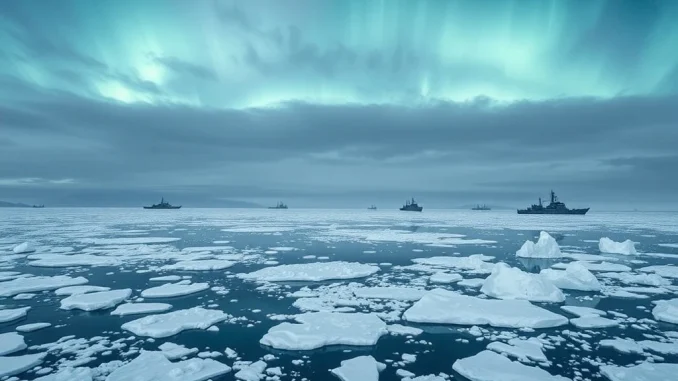
BRUSSELS, Belgium – NATO allies are accelerating critical discussions about establishing a comprehensive Arctic security framework, a strategic move directly aimed at countering expanding Russian and Chinese influence in the resource-rich polar region. This initiative, which gained renewed momentum following recent high-level dialogues, focuses on collective defense and economic security among the seven NATO members with Arctic territories. Consequently, the alliance is prioritizing cooperation with Denmark and the United States to prevent foreign military or economic footholds, particularly in strategically vital Greenland.
NATO Arctic Security Framework Takes Shape
The concept of a formalized Arctic security structure within NATO is not entirely new, but recent geopolitical shifts have injected fresh urgency into the talks. A NATO spokesperson confirmed that discussions among member states are intensifying, building upon earlier proposals. The framework specifically aims to coordinate the defense and surveillance capabilities of the Arctic-rim NATO nations: the United States, Canada, Denmark (via Greenland), Norway, and Iceland, alongside non-Arctic members with significant strategic interests. The primary objective is to ensure a unified, deterrence-based posture.
Furthermore, this collective effort seeks to address several emerging challenges. These challenges include increased Russian military modernization in its Arctic territories and growing Chinese economic investments framed as scientific or infrastructure projects. For instance, Russia has reopened numerous Soviet-era bases and established new ones, while China has declared itself a “near-Arctic state” and pursued polar silk road initiatives. Therefore, NATO’s strategy involves enhancing domain awareness, joint exercises, and infrastructure resilience.
The Greenland Nexus: A Strategic Priority
A central pillar of the proposed framework involves securing Greenland against external coercion. The spokesperson explicitly emphasized NATO’s goal to cooperate with Denmark and the U.S. to block Russian and Chinese attempts to establish any lasting economic or military presence on the island. Greenland’s geographic position offers control over key maritime passages between the Atlantic and Pacific oceans, making it a prize in great power competition.
- Military Significance: Greenland hosts the U.S. Thule Air Base, a critical node for missile warning and space surveillance.
- Resource Wealth: The island possesses vast untapped deposits of rare earth minerals, essential for modern technology and defense systems.
- Chinese Interest: Beijing has previously explored financing airport upgrades and mining projects, raising sovereignty concerns in Copenhagen and Washington.
Accordingly, NATO’s plan likely includes bolstering Denmark’s capacity to monitor and defend Greenlandic territory and waters. This support may involve shared intelligence, surveillance, and reconnaissance (ISR) assets and coordinated diplomatic outreach to Nuuk.
Historical Context and Geopolitical Drivers
The Arctic has transformed from a frozen periphery into a central theater of geopolitical competition, primarily due to climate change and resource economics. Diminishing sea ice is opening new shipping lanes like the Northern Sea Route and facilitating access to hydrocarbon and mineral resources. Russia, with the longest Arctic coastline, has aggressively asserted its claims and militarized its northern flank. Simultaneously, China, despite having no Arctic territory, has invested heavily in polar research, icebreaker fleets, and resource partnerships under its broader Belt and Road Initiative.
NATO’s renewed focus can be seen as a reactive and proactive measure. It reacts to the tangible security challenges posed by Russia’s Arctic brigades and hypersonic missile deployments. Proactively, it aims to set the rules of the road for Arctic development before non-democratic actors do. The alliance walks a delicate line, however, aiming to ensure stability without unnecessarily escalating tensions in a region traditionally marked by low-tension cooperation through the Arctic Council.
| Country/Alliance | Primary Arctic Interest | Recent Key Actions |
|---|---|---|
| Russia | Resource extraction, Northern Sea Route control, strategic bastion for nuclear forces | Reopened 50+ Soviet bases, deployed S-400 systems, conducted large-scale exercises |
| China | Resource security, influence over trade routes, “Polar Silk Road” integration | Built icebreakers, invested in Russian LNG, increased scientific station activity |
| NATO (Core Arctic Allies) | Collective defense, freedom of navigation, rule-based order | Increasing patrols (Norway, Canada), upgrading F-35 capabilities, enhancing undersea surveillance |
| United States | Homeland defense, strategic deterrence, countering peer competitors | Re-established 2nd Fleet, published Arctic Strategy, investing in Coast Guard icebreakers |
Expert Analysis on Alliance Dynamics and Challenges
Security analysts note that crafting a unified NATO Arctic policy involves navigating complex internal politics. Member states possess varying threat perceptions and economic interests. For example, Norway maintains a pragmatic line of communication with Russia on fisheries and search-and-rescue, while Baltic states advocate for a much tougher stance. Similarly, Canada is sensitive about its sovereignty in the Northwest Passage. The proposed framework must balance these views to achieve consensus.
Moreover, the environmental and indigenous dimensions add layers of complexity. Sustainable development and the rights of Arctic indigenous populations are central to regional governance. Any NATO security increase must be communicated as protective and stabilizing, not as a step toward militarization that could provoke an arms race. Experts suggest the most effective approach integrates hard security with support for civil authorities in domains like climate response and disaster relief, thereby building comprehensive resilience.
The Path Forward: Deterrence and Diplomacy
The evolving NATO strategy will likely manifest in several concrete areas. Enhanced rotational deployments of forces and equipment for exercises in Scandinavia and North America are a near certainty. Investment in cold-weather capabilities and specialized training will follow. Additionally, deeper intelligence sharing through NATO’s existing command structure will be crucial for tracking subsurface and aerial activities.
Ultimately, the success of the Arctic security framework will depend on sustained political will and resource allocation from member capitals. It also requires parallel diplomatic engagement to maintain channels for crisis communication with Moscow and to uphold international law, particularly the United Nations Convention on the Law of the Sea (UNCLOS). The alliance’s challenge is to deter aggression and coercion while preserving the Arctic as a zone of peaceful cooperation where possible.
Conclusion
In conclusion, NATO’s intensifying discussions on an Arctic security framework represent a pivotal response to a rapidly changing strategic landscape. By focusing on collective effort among its Arctic allies and specifically safeguarding Greenland, the alliance aims to counterbalance Russian militarization and Chinese economic statecraft. This move underscores the Arctic’s ascent to top-tier geopolitical importance. The developing NATO Arctic security strategy will therefore be a critical determinant of future stability, resource governance, and the balance of power in the High North. Its implementation will test NATO’s cohesion and adaptability in an era of renewed great power competition.
FAQs
Q1: Why is the Arctic suddenly so important for NATO security?
A1: Climate change is making the Arctic more accessible, revealing new shipping routes and vast resources. This accessibility has triggered increased military and economic activity from Russia and China, directly impacting the security of NATO’s northern member states and demanding a coordinated alliance response.
Q2: What specific threats is NATO concerned about in Greenland?
A2: NATO is primarily concerned about strategic coercion. This includes fears that extensive Chinese investment in Greenland’s infrastructure or mining sector could create political leverage or dual-use capabilities. There is also concern about Russian intelligence or hybrid operations aimed at destabilizing the region.
Q3: How many NATO members have territory in the Arctic?
A3: Five NATO members have sovereign territory within the Arctic Circle: the United States (Alaska), Canada, Denmark (Greenland), Norway, and Iceland. Sweden and Finland, now full NATO members, are Arctic states but their territories lie just south of the Arctic Circle.
Q4: Does NATO’s Arctic strategy conflict with the work of the Arctic Council?
A4: NATO states it aims to complement, not conflict with, the Arctic Council’s work on environmental protection and sustainable development. However, the line between security and civil cooperation is blurring, and Russia’s invasion of Ukraine has already suspended the Council’s practical work, creating a more contested environment.
Q5: What role does the United States play in NATO’s Arctic plans?
A5: The United States is a lead actor, providing significant military capabilities, intelligence assets, and strategic weight. U.S. territories (Alaska) and partnerships (with Denmark on Greenland defense) are central to the framework. U.S. leadership and resource commitment are essential for the strategy’s credibility and effectiveness.
Updated insights and analysis added for better clarity.
This article was produced with AI assistance and reviewed by our editorial team for accuracy and quality.