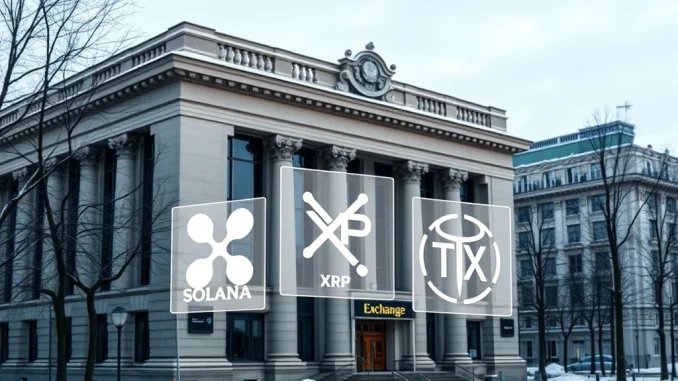
Moscow, Russia – April 2025: In a significant move for regulated digital asset markets, the Moscow Exchange (MOEX) has confirmed plans to launch cash-settled futures contracts for three major cryptocurrencies: Solana (SOL), XRP, and TRON (TRX). This pivotal expansion directly follows the exchange’s established Bitcoin and Ethereum derivatives, marking a strategic deepening of its crypto offerings for qualified institutional and retail investors within the Russian Federation.
Moscow Exchange Broadens Its Crypto Derivatives Suite
The Moscow Exchange, Russia’s largest trading platform for equities, bonds, derivatives, and foreign exchange, is systematically building a comprehensive ecosystem for digital asset exposure. The introduction of Solana, XRP, and TRX futures represents a calculated next phase. Unlike physically settled contracts, these cash-settled futures will allow investors to speculate on or hedge against the price movements of these assets without requiring direct custody of the underlying cryptocurrencies. This structure aligns with regulatory frameworks and reduces operational complexity for traditional financial participants. The exchange has stated that access will be restricted to “qualified investors” as defined by Russian law, which typically entails individuals or entities meeting specific financial sophistication or asset thresholds.
Analyzing the Strategic Crypto Selections
The choice of Solana, XRP, and TRX is not arbitrary; it reflects a deliberate strategy to cater to diverse investor interests and market narratives within a regulated context.
- Solana (SOL): Selected for its reputation as a high-throughput, low-cost blockchain platform often positioned as an alternative to Ethereum for decentralized applications (dApps) and decentralized finance (DeFi). Its inclusion acknowledges the demand for exposure to next-generation smart contract platforms.
- XRP: Represents the digital asset tied to Ripple’s cross-border payment settlement network. Its inclusion is significant, offering exposure to a cryptocurrency with a distinct use case in institutional finance and international transfers, despite its ongoing regulatory history in other jurisdictions.
- TRON (TRX): Chosen for its substantial global user base, particularly in content sharing and entertainment applications. It provides exposure to a blockchain with a focus on the creator economy and stablecoin transactions.
This trio, alongside Bitcoin and Ethereum, creates a more rounded portfolio of crypto derivatives, covering store-of-value, smart contract platform, payments, and entertainment-focused blockchains.
The Regulatory Landscape and Market Context
This development occurs within a specific and evolving Russian regulatory environment. While the legal status of cryptocurrency in Russia has seen periods of debate, the government and central bank have increasingly moved towards a framework of regulation rather than prohibition. The Moscow Exchange, as a state-sanctioned and highly regulated entity, operates at the forefront of this controlled integration. Its foray into crypto derivatives provides a sanctioned, transparent, and audited venue for price discovery and risk management. This contrasts with unregulated offshore exchanges, offering Russian investors a compliant alternative. The move can also be seen as part of a broader financial strategy to modernize the Russian financial infrastructure and retain capital within domestic institutions.
Implications for Investors and the Russian Financial Market
The launch carries several concrete implications. For qualified Russian investors, it provides new tools for portfolio diversification, sophisticated hedging strategies, and leveraged exposure to crypto markets without the technical barriers of direct ownership. For the Moscow Exchange, it represents a competitive product expansion to capture trading volume and attract a new demographic of tech-savvy investors. On a macro scale, it signals Russia’s continued, cautious embrace of digital asset innovation within a controlled, institutional framework. It may also set a precedent for other traditional financial exchanges in emerging markets considering similar product launches. Market analysts will closely watch the trading volumes and open interest of these new contracts as indicators of institutional and sophisticated retail appetite within the region.
Technical Mechanics and Risk Considerations
As cash-settled derivatives, the futures contracts will derive their final settlement price from a recognized index or aggregate of prices from major spot cryptocurrency exchanges. This mechanism isolates the contract from the risks associated with the underlying blockchain’s performance or custody. However, standard derivatives risks remain paramount. Investors must understand the implications of leverage, which can amplify both gains and losses. Margin requirements, contract expiry cycles, and the potential for high volatility in the underlying crypto assets are critical factors. The Moscow Exchange will enforce its standard risk management protocols, including position limits and margin calls, to maintain market integrity.
Conclusion
The Moscow Exchange’s decision to launch Solana, XRP, and TRX futures is a pivotal step in the maturation of cryptocurrency markets within regulated traditional finance. It extends the reach of established financial infrastructure into the digital asset economy, providing Russian investors with regulated, familiar vehicles for exposure. This move underscores a global trend of integration, where major financial institutions and exchanges are progressively building bridges between conventional finance and the crypto ecosystem. The success of these new futures contracts will be a key barometer for the depth and sophistication of demand for diversified crypto derivatives in the Russian market and beyond.
FAQs
Q1: What are cash-settled futures?
Cash-settled futures are derivative contracts where, upon expiration, the profit or loss is settled in cash rather than by delivering the physical underlying asset (in this case, the actual SOL, XRP, or TRX tokens).
Q2: Who can trade these new futures on the Moscow Exchange?
Trading will be restricted to “qualified investors” as defined by Russian law. This classification usually requires meeting certain criteria related to income, assets, or professional experience in financial markets.
Q3: Why did MOEX choose Solana, XRP, and TRX?
The exchange likely selected these assets to diversify its crypto offerings beyond Bitcoin and Ethereum, capturing different segments of the market: smart contract platforms (Solana), payment networks (XRP), and entertainment-focused blockchains (TRON).
Q4: How does this affect the price of SOL, XRP, and TRX?
While derivatives markets can influence spot prices through hedging and speculative activity, the primary impact is increased accessibility and liquidity for these assets within the Russian investment community. Direct price impact is complex and multifaceted.
Q5: Is this a sign of broader crypto adoption in Russia?
Yes, the launch by a premier, state-linked financial institution like the Moscow Exchange indicates a continued, formalized path toward integrating cryptocurrency products into Russia’s regulated financial system, albeit with strict participant controls.
This article was produced with AI assistance and reviewed by our editorial team for accuracy and quality.