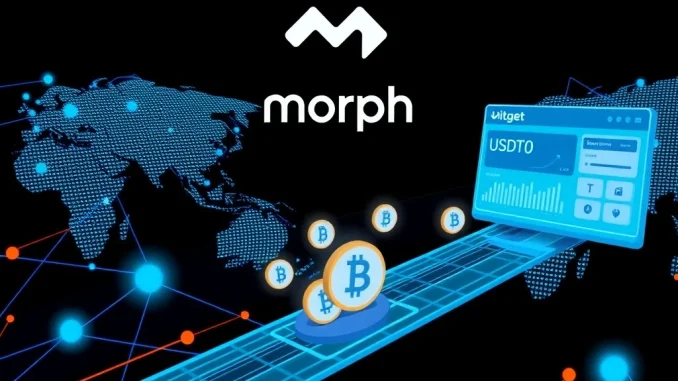
Singapore, April 2025: The Morph blockchain protocol has significantly expanded its real-world USDT0 settlement capabilities on the Bitget cryptocurrency exchange. This strategic development aims to directly enhance liquidity, streamline deposit and withdrawal processes, and provide scalable Layer 2 transaction solutions for a growing global user base. The move represents a concrete step in bridging decentralized finance infrastructure with major centralized trading platforms.
Morph USDT0 Settlement: A Technical Breakdown
The expansion of USDT0 settlement on Bitget is not merely a new trading pair listing. It represents a deeper integration of Morph’s Layer 2 infrastructure with a top-tier exchange’s backend systems. USDT0, a standardized stablecoin representation on the Morph network, allows for the frictionless movement of value that mirrors the US dollar. By enhancing its settlement layer on Bitget, Morph enables the exchange to process user transactions involving this asset with greater finality, speed, and reduced cost. This technical integration handles the critical process of reconciling off-chain exchange balances with on-chain asset ownership, a cornerstone for user trust and operational efficiency. Historically, delays or inefficiencies in this settlement layer have been a pain point for users moving assets between chains and exchanges.
Impact on Liquidity and User Experience
The primary stated goal of this expansion is enhanced liquidity. In practical terms, this means larger volumes of USDT0 can be traded on Bitget with minimal impact on the asset’s price (low slippage). For traders and investors, this translates to better execution prices for their orders. The improvement in seamless deposits and withdrawals addresses a common user complaint in cryptocurrency: the waiting period and uncertainty when moving funds. A robust settlement layer reduces the confirmation times for these transactions, moving them from a multi-block, multi-minute process to a near-instantaneous one. We can analyze the expected impact through core user experience metrics:
- Transaction Finality: Reduced time for a deposit to be credited as available balance.
- Withdrawal Speed: Faster processing of withdrawal requests from the exchange to a user’s private wallet.
- Arbitrage Efficiency: Enables quicker capital movement for arbitrageurs, which helps align prices across different trading venues.
- Cost Predictability: Lower and more predictable network fees for these transfer actions, absorbed or minimized by the efficient Layer 2.
The Layer 2 Scalability Context
This development must be viewed within the broader industry trend toward Layer 2 scaling solutions. Base-layer blockchains like Ethereum often face congestion and high fees during periods of high demand. Layer 2 networks like Morph bundle numerous transactions off-chain before settling a single proof to the main chain. The expansion with Bitget specifically applies this scalability benefit to the exchange’s operations. It allows Bitget to offer its users the economic benefits of Layer 2—low fees and high throughput—for stablecoin transactions without requiring each user to manually bridge assets or understand the underlying technology. This abstraction of complexity is key to mainstream adoption.
Strategic Implications for the Exchange Landscape
Bitget’s decision to deepen its integration with Morph’s USDT0 settlement is a competitive strategic move. Exchanges are increasingly differentiated by their technological partnerships and the quality of their underlying infrastructure, not just their trading fees or token listings. By offering demonstrably faster and cheaper stablecoin movements, Bitget can attract high-volume traders and institutional clients for whom transaction efficiency is paramount. Furthermore, it positions Bitget favorably within the Morph ecosystem, potentially granting it early access to future protocol upgrades or token launches. This follows a pattern seen in recent years where exchanges like Coinbase have developed their own Layer 2 networks (Base) to control the user experience end-to-end. Bitget’s partnership approach offers a different model for achieving similar technical goals.
Conclusion
The expansion of Morph USDT0 settlement on the Bitget exchange is a significant infrastructure upgrade with direct implications for user experience and market efficiency. By leveraging Morph’s Layer 2 capabilities, Bitget can provide its global users with enhanced liquidity, faster deposits and withdrawals, and scalable transaction processing for stablecoin operations. This move underscores the ongoing convergence of centralized and decentralized finance infrastructures, where advanced blockchain scaling solutions become critical backend components for leading trading platforms. The success of this integration will be measured by tangible improvements in transaction metrics and user adoption over the coming quarters.
FAQs
Q1: What is USDT0 on the Morph network?
USDT0 is a standard representation of the USDT (Tether) stablecoin on the Morph Layer 2 blockchain. It is a bridged asset that maintains a 1:1 value peg with the US dollar and is used for transactions within the Morph ecosystem.
Q2: How does this expansion benefit a regular Bitget user?
A regular user will likely experience faster processing times when depositing or withdrawing USDT0 to/from their Bitget account, potentially lower transaction fees for these movements, and access to deeper trading liquidity for the USDT0 pair on the exchange.
Q3: Is USDT0 different from regular USDT?
In value, they are identical (both pegged to $1 USD). Technically, USDT0 exists on the Morph blockchain, while standard USDT exists primarily on networks like Ethereum (as an ERC-20 token) or Tron. They are different “versions” of the same asset on different chains, requiring a bridge to move between them.
Q4: What is a Layer 2 settlement?
Layer 2 settlement refers to the process where transactions are processed on a secondary blockchain (Layer 2) that bundles them together. Periodically, a cryptographic proof of these bundled transactions is submitted to the main blockchain (Layer 1, like Ethereum) for final, secure recording. This makes transactions faster and cheaper.
Q5: Does this mean Bitget is only using Morph for USDT transactions?
The announcement specifically covers the expansion of USDT0 settlement. It indicates a deepened integration for this asset, but Bitget likely uses multiple blockchains and settlement layers for different cryptocurrencies. This makes Morph its preferred Layer 2 solution for this particular stablecoin asset.