In a significant move that intensifies competition in the synthetic voice sector, French artificial intelligence firm Mistral AI has launched Voxtral TTS, a powerful open-source text-to-speech model designed for enterprise deployment and edge computing. Announced on March 26, 2026, this release directly challenges established players like ElevenLabs, Deepgram, and OpenAI by offering a cost-effective, high-performance alternative that operates on devices from smartwatches to servers.
Mistral AI’s Voxtral TTS Enters the Speech Generation Arena
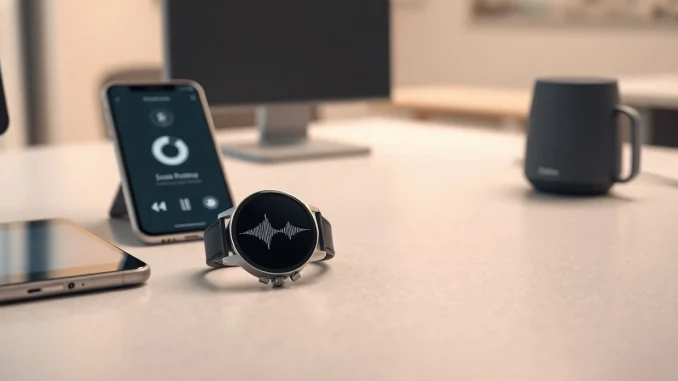
Mistral AI, already renowned for its efficient large language models, has expanded its portfolio with Voxtral TTS. This model supports nine languages: English, French, German, Spanish, Dutch, Portuguese, Italian, Hindi, and Arabic. Pierre Stock, Vice President of Science Operations at Mistral AI, explained the development rationale in an interview with TechCrunch. “Our customers consistently requested a speech model,” Stock stated. “Consequently, we engineered a compact model that fits on edge devices like smartwatches and smartphones. Its cost represents a fraction of market alternatives while delivering state-of-the-art performance.”
The model’s architecture builds upon Mistral’s Ministral 3B framework. This foundation enables seamless language switching without losing vocal characteristics, a critical feature for applications like real-time translation and media dubbing. Furthermore, Voxtral TTS can clone a custom voice from an audio sample shorter than five seconds. It accurately captures subtle accents, speech inflections, intonations, and natural speech irregularities.
Technical Performance and Real-World Applications
Mistral engineered Voxtral TTS for real-time responsiveness, a non-negotiable requirement for interactive voice assistants. The model boasts a Time-To-First-Audio (TTFA) of 90 milliseconds for processing a 500-character input. Additionally, it achieves a Real-Time Factor (RTF) of 6x, meaning it can generate a ten-second audio clip in approximately 1.6 seconds. These metrics position it competitively for live customer service, interactive voice response (IVR) systems, and in-car assistants.
Key Enterprise Use Cases Include:
- Customer Support: Deploying brand-consistent voice agents for 24/7 customer engagement.
- Sales and Marketing: Creating personalized audio content and interactive sales assistants.
- Accessibility Tools: Powering screen readers and communication aids with natural-sounding voices.
- Content Creation: Streamlining audio book production, video game dialogue, and advertisement voiceovers.
The Strategic Shift to a Full Voice AI Suite
This release is not an isolated product launch. Earlier in 2026, Mistral introduced two transcription models: one for batch processing and another for low-latency, real-time audio conversion. Voxtral TTS completes this trio, allowing Mistral to offer enterprises a comprehensive voice AI toolkit. Pierre Stock outlined the company’s broader vision: “We plan to develop an end-to-end platform capable of handling multimodal input streams—audio, text, and image—and producing multimodal output. An end-to-end agentic system that supports audio provides significantly more contextual information.”
This integrated approach could allow businesses to build sophisticated AI agents that understand and respond through multiple mediums simultaneously, a step beyond today’s predominantly text-based chatbots.
Open Source as a Competitive Differentiator
Mistral’s core strategy leverages open-source licensing to attract enterprise adoption. By allowing companies to inspect, modify, and customize the model, Mistral addresses common concerns about vendor lock-in, data privacy, and opaque AI systems. Enterprises in regulated industries like finance and healthcare can fine-tune the model on their proprietary data without sending sensitive information to third-party APIs. This contrasts with the closed, API-driven models offered by competitors like OpenAI’s voice synthesis tools.
The open-source model also fosters a developer community that can contribute improvements, create specialized variants, and build integrations, potentially accelerating innovation and adoption faster than a closed model could achieve independently.
Market Context and Competitive Landscape
The speech synthesis market has experienced rapid growth, driven by demand for conversational AI and digital content. According to industry analyses from late 2025, the global text-to-speech market was projected to exceed $7 billion by 2030. Key competitors include:
- ElevenLabs: Known for highly realistic and emotive voice cloning.
- OpenAI: Offers voice synthesis through its ChatGPT and API services, with strong integration into its AI ecosystem.
- Deepgram: Focuses heavily on speech-to-text but has expanded into text-to-speech with an emphasis on enterprise scalability.
- Amazon Polly & Google Cloud Text-to-Speech: Cloud-based services from major hyperscalers, often bundled with other cloud infrastructure.
Mistral’s entry with a small, efficient, open-source model carves out a distinct niche focused on cost, customization, and edge deployment, areas where larger cloud-first models may be less agile.
Challenges and Future Trajectory
Despite its advantages, Voxtral TTS faces hurdles. The open-source model requires in-house technical expertise for deployment and tuning, which may deter smaller businesses. Furthermore, maintaining audio quality and avoiding misuse, such as generating deceptive deepfake audio, remains an ongoing challenge for all speech synthesis providers. Mistral will need robust documentation and potentially managed service offerings to broaden its appeal.
Looking ahead, the success of Voxtral TTS will likely influence whether other AI companies prioritize open-source releases for foundational voice technology. Its performance could also pressure closed-source competitors to lower prices or offer more flexible licensing terms.
Conclusion
Mistral AI’s launch of the Voxtral TTS speech model marks a pivotal moment in the democratization of voice AI technology. By combining open-source accessibility, multilingual support, and edge-device efficiency, Mistral provides a compelling option for enterprises seeking control and customization. As the company builds toward its vision of a multimodal, end-to-end AI platform, Voxtral TTS establishes a critical beachhead in the competitive speech synthesis market. Its development underscores a broader industry trend where performance, cost, and flexibility are becoming as important as raw audio quality alone.
FAQs
Q1: What is Mistral AI’s Voxtral TTS?
Voxtral TTS is an open-source text-to-speech model released by Mistral AI in March 2026. It generates human-like speech in nine languages and is designed to run efficiently on edge devices like smartwatches and smartphones, as well as in enterprise server environments.
Q2: How does Voxtral TTS differ from OpenAI’s or ElevenLabs’ voice models?
The primary differences are its open-source license, small size optimized for edge computing, and cost structure. Unlike many competitors’ API-based services, Voxtral TTS can be downloaded, modified, and run privately on a company’s own hardware, offering greater data control and customization.
Q3: What are the main technical specifications of Voxtral TTS?
Key specs include a 90ms Time-To-First-Audio, a 6x Real-Time Factor, support for nine languages, and the ability to clone a voice from less than five seconds of audio. It is based on the Ministral 3B architecture.
Q4: What are the intended use cases for this model?
Mistral targets enterprise applications such as AI voice assistants for customer support and sales, real-time translation tools, content creation for dubbing and audiobooks, and accessibility applications like advanced screen readers.
Q5: Why is the open-source aspect significant for businesses?
Open-source allows businesses to audit the code for security, fine-tune the model on their proprietary data without privacy concerns, avoid vendor lock-in, and customize the model for specific industry or regional needs without relying on a third-party’s development roadmap.
This article was produced with AI assistance and reviewed by our editorial team for accuracy and quality.