
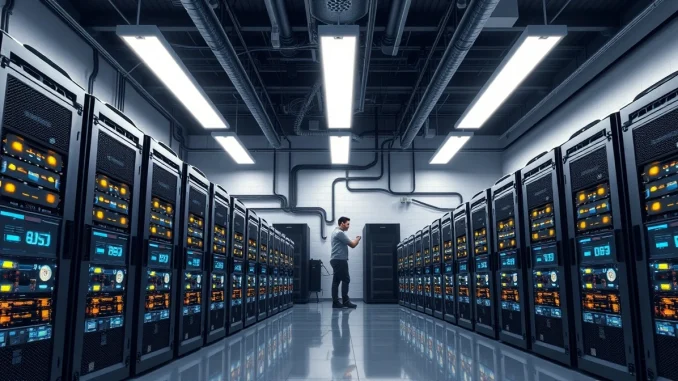
WASHINGTON, D.C. — A new legislative push aims to fundamentally reshape American Bitcoin mining. On March 30, 2026, U.S. Senators Bill Cassidy (R-LA) and Cynthia Lummis (R-WY) introduced the “Mined in America Act.” This bill directly tackles a critical vulnerability: while the U.S. leads in Bitcoin processing power, it remains overwhelmingly dependent on Chinese-made hardware. The proposed law seeks to boost domestic manufacturing, create a certification program, and formally establish a U.S. Strategic Bitcoin Reserve.
The Core of the Mined in America Act
The legislation centers on two primary objectives: reshoring mining equipment production and creating a national digital asset reserve. According to the text released by Senator Cassidy’s office, the bill would establish a voluntary “Mined in America” certification for crypto mining facilities and mining pools. To earn this label, operations must commit to a phased replacement of equipment made by companies tied to “foreign adversaries.” They must also actively support U.S.-based hardware manufacturing.
Also read: Bitcoin Price Faces Pressure as Oil Hits $105, But History Suggests a Complex Link
“Digital asset mining is a big part of our economy. We should be doing it here in America,” Senator Cassidy stated. The bill directs federal agencies, including the National Institute of Standards and Technology (NIST) and the Manufacturing Extension Partnership, to assist American manufacturers. Their goal is to develop more secure and energy-efficient crypto mining equipment.
Perhaps its most significant provision seeks to codify an executive order from former President Donald Trump. That order called for the creation of a Strategic Bitcoin Reserve. This move would formalize Bitcoin as a strategic national asset, similar to the country’s petroleum reserve.
Also read: Uranium Finance Hacker Faces 30 Years for $54M Theft—Funds Spent on Pokémon Cards
A Dominant Position Built on Foreign Hardware
The United States became the world’s leading Bitcoin mining hub after China’s industry ban in 2021. Data from the Cambridge Centre for Alternative Finance shows the U.S. currently hosts about 38% of the global Bitcoin network’s hashrate. That is more than double the share of second-place Russia.
This dominance, however, rests on a fragile foundation. Dennis Porter, CEO of the Satoshi Action Fund, highlighted the stark reality. “Despite America’s dominance in Bitcoin mining hashrate, 97% of Bitcoin mining hardware is manufactured by two Chinese companies, Bitmain and MicroBT,” Porter said. He is a supporter of the new act.
This dependency creates clear national security and supply chain risks. Industry watchers note that control over hardware production translates to potential control over the network itself. The bill’s supporters argue that breaking this foreign reliance is not just an economic issue, but a strategic imperative.
The 2024 Customs Seizure: A Warning Sign
The risks of foreign dependency became tangible in late 2024. The U.S. Customs and Border Protection (CBP) paused shipments of thousands of Bitmain ASIC miners at American ports. The incident lasted for several months, disrupting operations for multiple mining companies.
Luxor Technology, a major Bitcoin mining firm, was among those affected. In March 2025, the company’s Chief Operating Officer, Ethan Vera, explained the situation to Cointelegraph. He stated the miners were seized because officials mistakenly believed they were illegally imported radio frequency devices. The event underscored how regulatory confusion and supply chain bottlenecks could cripple the domestic industry overnight.
This suggests that without domestic manufacturing capacity, the entire U.S. mining sector operates at the mercy of international logistics and geopolitics.
Building a “Virtuous Cycle” for American Mining
Proponents frame the Mined in America Act as a comprehensive solution. Dennis Porter described it as building a “virtuous cycle.” The theory is straightforward: government support spurs domestic hardware manufacturing. Certified mining operations then buy that American-made equipment. These operations, in turn, contribute to grid stability and provide a direct supply of bitcoin to a new federal reserve.
“The Mined in America Act breaks that dependency by building a virtuous cycle of domestic manufacturing, certified mining operations, grid-strengthening energy infrastructure and a pipeline to the Strategic Bitcoin Reserve,” Porter argued.
The implication is a self-reinforcing ecosystem. American manufacturers gain a guaranteed market. Miners gain security and potentially favorable regulatory treatment. The government accumulates a digital asset reserve. What this means for investors is a potential shift in the risk profile of U.S.-based mining stocks, should the bill gain traction.
Political Hurdles and Industry Reaction
The bill faces a challenging path in a divided Congress. Introduced by two Republican senators, it will need bipartisan support to advance. The concept of a federal Bitcoin reserve, in particular, is likely to draw intense debate. Critics may question the use of taxpayer resources to support a specific industry or acquire a volatile asset.
Initial reaction from the mining industry has been cautiously optimistic. Many operators have long cited supply chain insecurity as a major business risk. A domestic source for ASIC miners would solve a critical operational headache. However, some analysts warn that U.S.-made machines could initially carry a higher price tag, potentially impacting profitability.
The bill does not mandate immediate replacement of existing hardware. Instead, it uses the carrot of a desirable certification to encourage a gradual transition. This phased approach may make it more palatable to mining companies with significant sunk costs in current equipment.
Conclusion
The Mined in America Act represents a ambitious attempt to secure the United States’ position in the global Bitcoin ecosystem. It directly addresses the glaring contradiction between America’s mining leadership and its hardware dependency. By linking domestic manufacturing to a national strategic reserve, the bill frames Bitcoin mining as an issue of economic competitiveness and national security. Its fate in Congress will be a key indicator of how seriously U.S. lawmakers view the strategic importance of cryptocurrency infrastructure. The proposal could signal a new, more interventionist phase in American crypto policy, moving beyond mere regulation toward active industrial support.
FAQs
Q1: What is the main goal of the Mined in America Act?
The primary goal is to reduce U.S. reliance on foreign-made Bitcoin mining hardware, primarily from China, by incentivizing domestic manufacturing and creating a certified “Mined in America” standard for mining operations.
Q2: Who introduced the Mined in America Act?
The bill was introduced on March 30, 2026, by U.S. Senators Bill Cassidy (R-LA) and Cynthia Lummis (R-WY).
Q3: What is a Strategic Bitcoin Reserve?
Modeled after the U.S. Strategic Petroleum Reserve, it would be a federally held reserve of Bitcoin. The Act seeks to codify a prior executive order from former President Donald Trump to establish such a reserve.
Q4: Does the bill force mining companies to immediately replace their equipment?
No. Participation in the “Mined in America” certification program is voluntary. Certified facilities would be required to phase out equipment from “foreign adversaries” over time, not immediately.
Q5: What was the 2024 customs incident mentioned in the article?
In late 2024, U.S. Customs and Border Protection temporarily seized thousands of Bitmain ASIC miners at U.S. ports, mistakenly identifying them as illegal radio frequency devices. The months-long delay highlighted supply chain vulnerabilities for U.S. miners.

This article was produced with AI assistance and reviewed by our editorial team for accuracy and quality.




Be the first to comment