NEW YORK, March 15, 2026 — For aspiring cryptocurrency miners wondering if they can still mine Bitcoin on a PC in 2026, the answer delivers sobering clarity. The Bitcoin network’s astronomical difficulty increase, now exceeding 120 trillion hashes, has rendered consumer-grade computer mining economically unviable. According to data from Cambridge University’s Centre for Alternative Finance, the global Bitcoin mining industry consumed approximately 348 terawatt-hours of electricity in 2025, equivalent to Argentina’s annual consumption. This energy-intensive landscape now belongs exclusively to specialized hardware and industrial-scale operations. The era of profitable solo mining on personal computers ended around 2013, but 2026 presents even starker realities for home miners facing unprecedented technological and economic barriers.
The Technical Reality of Bitcoin Mining in 2026
Bitcoin mining today operates on computational scales unimaginable just five years ago. The network’s current hash rate exceeds 700 exahashes per second, according to Blockchain.com’s March 2026 metrics. This represents a 2,800% increase from March 2021 levels. To put this in perspective, the entire Bitcoin network now performs more calculations every second than all Google searches conducted globally in a month. Dr. Sarah Chen, a cryptocurrency researcher at MIT’s Digital Currency Initiative, explains the implications. “A high-end gaming PC with an RTX 5090 GPU might achieve 3-4 gigahashes per second,” Chen states. “At current difficulty levels, that machine would statistically find one Bitcoin block every 8,000 years while consuming $15-20 daily in electricity.” The Bitcoin protocol automatically adjusts mining difficulty every 2,016 blocks, approximately every two weeks, ensuring a consistent 10-minute block time regardless of total network computing power.
This difficulty adjustment mechanism creates what economists call a “computational arms race.” As more miners join the network with increasingly powerful hardware, profitability for less efficient operators diminishes exponentially. The Bitcoin halving event in April 2024 reduced block rewards from 6.25 to 3.125 BTC, further squeezing marginal operations. Mining profitability calculators from platforms like WhatToMine and CryptoCompare now show negative returns for all consumer PC configurations when factoring in electricity costs above $0.12 per kilowatt-hour. Even with free electricity, the statistical probability of a solo PC miner successfully validating a block before specialized mining farms makes the endeavor practically impossible.
Specialized Hardware Dominates the 2026 Mining Landscape
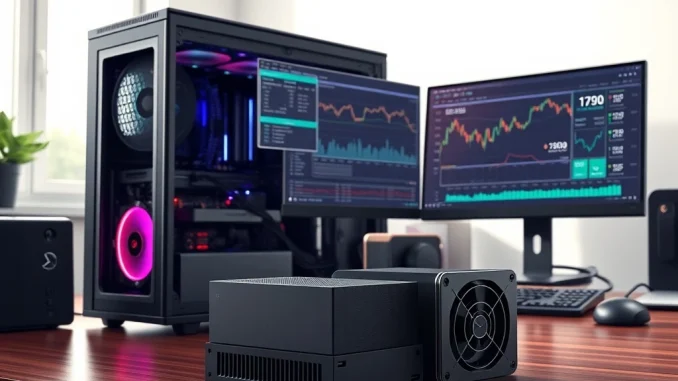
The evolution from CPU to GPU to ASIC mining represents one of technology’s most rapid specialization cycles. Application-Specific Integrated Circuits (ASICs) designed exclusively for Bitcoin’s SHA-256 algorithm now deliver efficiency metrics that consumer hardware cannot approach. Bitmain’s Antminer S21 Hydro, released in late 2025, achieves 335 terahashes per second while consuming just 18 joules per terahash. By comparison, the most efficient consumer GPU available in 2026, NVIDIA’s RTX 5090, manages approximately 0.003 terahashes per second at 300 watts. This represents a 100,000-fold efficiency gap that no software optimization can bridge. Mining operations have consequently consolidated into industrial-scale facilities located near cheap energy sources.
- Energy Efficiency Gap: Modern ASICs operate at 15-25 joules per terahash versus 300-500 joules for consumer GPUs
- Hash Rate Disparity: A single ASIC miner equals the output of 10,000 high-end gaming PCs
- Economic Scale: Industrial mining operations achieve electricity costs below $0.03/kWh versus residential rates averaging $0.15/kWh
Expert Perspectives on Mining Centralization
Industry analysts express concern about the concentration of mining power. According to the Bitcoin Mining Council’s Q4 2025 report, just three mining pools—Foundry USA, AntPool, and ViaBTC—control over 65% of the network’s total hash rate. “This level of consolidation creates potential systemic risks,” warns Michael Saylor, Executive Chairman of MicroStrategy and longtime Bitcoin advocate. “While the protocol remains decentralized in theory, mining infrastructure has followed natural industrial concentration patterns.” The geographical distribution shows similar concentration, with the United States hosting 38% of global Bitcoin mining capacity, followed by China at 21% despite its 2021 mining ban, and Russia at 11%. These operations typically utilize stranded energy resources, including flared natural gas in Texas and hydroelectric power in Sichuan during rainy seasons.
Alternative Approaches for Home Cryptocurrency Enthusiasts
While solo Bitcoin mining on PCs has vanished, several alternatives exist for technologically inclined individuals. Mining pool participation allows combining computational resources with other miners worldwide, though profitability remains negligible for PC-based participants. Cloud mining services lease hash power from industrial operations, but these face scrutiny for potential Ponzi scheme characteristics. More realistically, home miners have shifted attention to alternative cryptocurrencies with different consensus mechanisms. Ethereum’s complete transition to proof-of-stake in 2022 eliminated GPU mining opportunities there, but coins like Monero, Ravencoin, and Ethereum Classic continue supporting GPU mining with varying profitability.
| Cryptocurrency | Algorithm | Estimated Daily Profit (RTX 5090) | Mining Pool Required |
|---|---|---|---|
| Monero (XMR) | RandomX | $0.15 – $0.25 | Yes |
| Ravencoin (RVN) | KAWPOW | $0.10 – $0.18 | Yes |
| Ethereum Classic (ETC) | Etchash | $0.08 – $0.15 | Yes |
| Bitcoin (BTC) | SHA-256 | -$1.50 – -$2.00 | Yes |
The Future of Decentralized Mining and Technological Innovation
Several development teams work on protocols that could restore mining accessibility. Stratum V2, currently in testing, introduces job negotiation protocols that could reduce pool operator dominance. More fundamentally, proposals like “merged mining” allow securing smaller chains while mining Bitcoin, though these face technical implementation challenges. Quantum computing represents another potential disruptor, with theoretical capacity to break current cryptographic assumptions. However, Dr. Chen from MIT cautions against expecting near-term revolutions. “Quantum-resistant algorithms are in development, but practical quantum computers capable of threatening SHA-256 remain decades away,” she notes. “The immediate future involves incremental ASIC improvements and renewable energy integration rather than paradigm shifts.”
Environmental Considerations and Regulatory Responses
Bitcoin mining’s energy consumption continues attracting regulatory attention. The European Union’s Markets in Crypto-Assets (MiCA) regulation, fully implemented in 2025, requires mining operations to disclose energy sources and carbon footprints. Several U.S. states, including New York, have implemented temporary moratoriums on new fossil-fuel-powered mining operations. These developments accelerate the industry’s transition toward renewable energy, which now powers approximately 58% of Bitcoin mining globally according to the Bitcoin Mining Council. This environmental pressure further disadvantages home miners, who typically lack access to industrial-scale renewable infrastructure.
Conclusion
The dream of profitably mining Bitcoin on a PC in 2026 has collided with mathematical and economic realities. Network difficulty increases, specialized hardware dominance, and energy cost disparities have created an environment where consumer mining generates consistent financial losses. While alternative cryptocurrencies offer marginal returns for GPU miners, Bitcoin mining has irrevocably transitioned to industrial-scale operations. This evolution reflects broader technology adoption patterns where early accessibility gives way to professionalization. For most individuals, purchasing Bitcoin directly remains more economical than attempting to mine it. The cryptocurrency landscape continues evolving, but the era of profitable home Bitcoin mining belongs firmly to history rather than 2026’s technological reality.
Frequently Asked Questions
Q1: Can any PC mine Bitcoin profitably in 2026?
No. Even with free electricity, the statistical probability of a consumer PC successfully mining a Bitcoin block before industrial operations makes it practically impossible. All profitability calculators show consistent losses when factoring realistic electricity costs.
Q2: What hardware is needed to mine Bitcoin profitably today?
Modern ASIC miners like Bitmain’s Antminer S21 or MicroBT’s Whatsminer M60S are required. These specialized devices cost $3,000-$6,000 and achieve hash rates 100,000 times greater than consumer GPUs while using significantly less energy per hash.
Q3: How much has Bitcoin mining difficulty increased since 2021?
Bitcoin’s network difficulty has increased approximately 2,800% since March 2021, from around 20 trillion to over 120 trillion. This adjustment occurs automatically every 2,016 blocks to maintain consistent block times as more mining power joins the network.
Q4: Are there any cryptocurrencies that can still be mined profitably on a PC?
Some alternative cryptocurrencies like Monero, Ravencoin, and Ethereum Classic can generate small daily returns ($0.08-$0.25) on high-end GPUs, though profitability depends heavily on electricity costs and requires joining mining pools.
Q5: Why has Bitcoin mining become so centralized in specific countries?
Mining follows cheap electricity. The United States, China, and Russia host most mining operations because they offer abundant, low-cost energy sources including stranded natural gas, hydroelectric power during rainy seasons, and nuclear energy in deregulated markets.
Q6: What are the environmental impacts of Bitcoin mining in 2026?
Global Bitcoin mining consumes approximately 348 TWh annually, comparable to Argentina’s total electricity use. However, the industry’s renewable energy usage has increased to 58%, driven by regulatory pressure and economic incentives to utilize otherwise wasted energy resources.