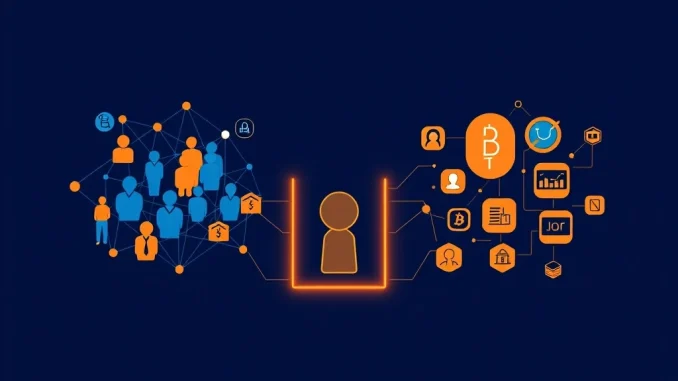
Global, May 2025: In a significant move for the decentralized ecosystem, blockchain identity platform MetYa has announced a strategic partnership with multi-chain wallet provider LF Wallet. This collaboration aims to directly tackle one of Web3’s most persistent challenges: fragmented accessibility. By integrating MetYa’s identity and verification layers with LF Wallet’s cross-chain infrastructure, the alliance seeks to create a more seamless, secure, and utility-driven gateway for users navigating multiple blockchain networks.
MetYa and LF Wallet Partnership Expands Web3 Access
The core objective of the MetYa and LF Wallet partnership is to lower the technical and experiential barriers that often deter mainstream adoption of Web3 technologies. MetYa has established itself by providing decentralized identity solutions that allow users to manage verifiable credentials across different platforms without sacrificing personal data control. LF Wallet, conversely, has focused on building a non-custodial wallet that supports a wide array of blockchain assets and simplifies interactions across various decentralized applications (dApps). The integration of these two services creates a more cohesive user journey. A user can theoretically establish a portable identity with MetYa and use it to seamlessly access services, verify credentials, or execute transactions across the multiple chains supported within their LF Wallet interface. This reduces the need for managing separate identities and keys for each network, a common point of friction.
Driving Real-World Utility Through Multi-Chain Integration
Beyond mere convenience, the partnership explicitly targets real-world utility. The term “multi-chain utility” refers to the practical use of assets and identities across different blockchain environments for tangible purposes. For instance, this could enable scenarios where a user’s verified credentials from MetYa, attesting to professional accreditation or age, are used to access a exclusive DeFi pool on Ethereum, participate in a governance vote on a Polygon-based DAO, and then mint a proof-of-attendance certificate on a Layer-2 solution—all from a single, unified LF Wallet dashboard. The table below outlines the potential utility layers this integration unlocks:
| Utility Layer | MetYa’s Role | LF Wallet’s Role | User Benefit |
|---|---|---|---|
| Identity & Access | Provides verifiable, portable digital identity. | Acts as the access point and key manager. | Single sign-on experience across multiple dApps and chains. |
| Asset Management | Can tokenize identity attributes as assets. | Securely holds and displays multi-chain tokens and NFTs. | Unified view and control of diverse digital assets. |
| Transaction Execution | Can attach identity proofs to transactions. | Facilitates signing and broadcasting across different networks. | Streamlined, context-aware transactions (e.g., KYC-compliant swaps). |
| Credential Use | Issues and manages credential tokens. | Enables credential presentation to dApps on supported chains. | Ability to use reputational or proof-based tokens anywhere. |
Contextualizing the Web3 Accessibility Challenge
The partnership arrives at a critical juncture in blockchain development. The industry has largely moved past the “one-chain-to-rule-them-all” narrative, embracing a multi-chain and modular future. However, this proliferation has created a complex, siloed landscape. Users face steep learning curves, security risks from managing multiple seed phrases, and inconsistent experiences. Historical parallels exist in the early internet, where proprietary online services like CompuServe and AOL eventually gave way to the open, standardized World Wide Web. The MetYa-LF Wallet integration can be viewed as an effort to build the analogous “browser” for Web3—a common interface that abstracts away underlying complexity. By focusing on interoperability between identity and asset layers, they are addressing a foundational requirement for scalable adoption.
The Technical Synergy and Its Implications
From a technical standpoint, the integration likely involves LF Wallet incorporating MetYa’s SDK or smart contract protocols. This would allow the wallet to request and present verifiable credentials stored on a user’s MetYa identity. For the user, this might manifest as a simple “Connect with MetYa” button alongside traditional wallet connection options within a dApp. The implications are broad. For developers, it provides a standardized way to incorporate identity verification without building it from scratch. For institutions exploring blockchain, it offers a clearer compliance path through auditable identity trails. For the everyday user, it promises a more intuitive and trustworthy onboarding process, moving Web3 closer to the seamless experience of Web2 logins.
Analyzing the Broader Market Impact
This type of partnership reflects a maturation in the cryptocurrency sector, where collaboration to solve user experience problems is becoming as important as technological innovation. It places both companies in a competitive landscape focused on aggregation and simplification, competing with other wallet and identity projects striving to become the primary Web3 interface. Success will depend on execution security, the breadth of chain support, and, crucially, adoption by dApp developers who choose to build support for this integrated identity-asset framework. If widely adopted, it could accelerate the development of more sophisticated social and reputational dApps that rely on persistent, cross-platform identity.
Conclusion
The partnership between MetYa and LF Wallet represents a pragmatic step toward a more accessible and useful Web3. By bridging the gap between decentralized identity and multi-chain asset management, the collaboration directly addresses key friction points that have hindered broader adoption. The focus on multi-chain utility shifts the narrative from speculative asset holding to practical application, which is essential for the technology’s long-term viability. While challenges around standardization and widespread developer adoption remain, this alliance underscores a critical industry trend: the future of Web3 will be built not by isolated chains, but by interoperable layers that prioritize the user experience above all.
FAQs
Q1: What is the main goal of the MetYa and LF Wallet partnership?
The primary goal is to expand Web3 access by creating a more seamless user experience. They aim to combine MetYa’s decentralized identity management with LF Wallet’s multi-chain asset support, reducing complexity and enhancing real-world utility for users across different blockchain networks.
Q2: How does this partnership improve Web3 accessibility?
It improves accessibility by allowing users to manage a single, verifiable digital identity (via MetYa) that works across the many blockchains supported by their LF Wallet. This eliminates the need to create and secure separate identities and keys for each network or dApp.
Q3: What does “multi-chain utility” mean in this context?
Here, multi-chain utility refers to the practical use of a user’s assets and verified identity credentials across different blockchain environments. It enables actions like using a proof-of-credential from one chain to access services on another, all from a unified interface.
Q4: Is my data safe with this integrated system?
Both MetYa and LF Wallet are built on non-custodial, decentralized principles. MetYa allows you to control your verifiable credentials without storing personal data on a central server, and LF Wallet does not hold your private keys. The integration is designed to enhance security by reducing the attack surface of managing multiple, separate identities.
Q5: Will existing LF Wallet or MetYa users need to migrate to a new product?
Based on standard industry practice for such partnerships, existing users will likely not need to migrate. The new functionality will be introduced via software updates or new features within the existing LF Wallet application, with opt-in mechanisms for using MetYa’s identity services.