WASHINGTON, D.C. — First Lady Melania Trump presented a humanoid robot as a potential future educator during a White House summit on March 25, 2026, outlining a controversial vision for AI-driven homeschooling that immediately sparked national debate about technology’s role in childhood development.
White House Showcase for Robotic Education
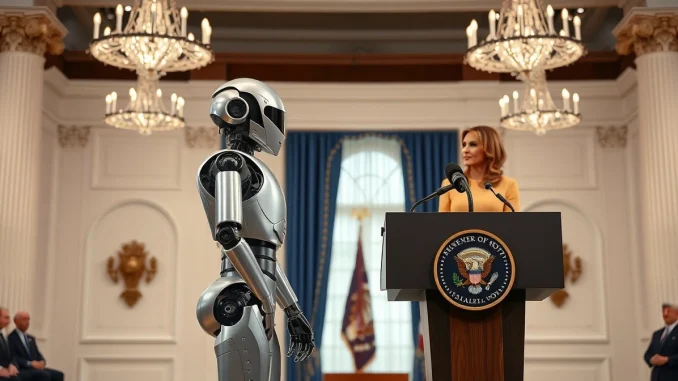
The event, called the “Fostering the Future Together Global Summit,” featured a demonstration by robotics company Figure AI. Consequently, a humanoid machine walked alongside the First Lady before addressing attendees. The robot expressed gratitude for participating in what it called a “historic movement to empower children with technology and education.”
Mrs. Trump then asked the audience to envision a future where humanoid robots named “Plato” serve as primary educators. She described these machines as patient, always available tutors. Furthermore, she claimed they could provide instantaneous access to humanity’s entire knowledge corpus.
“Plato will provide a personalized experience, adaptive to each student’s needs,” the First Lady stated. “Predictably, our children will develop deeper critical thinking and independent reasoning abilities.”
Current Educational Technology Landscape
This proposal emerges amid growing experimentation with AI in education. For instance, the Alpha School network uses artificial intelligence to accelerate learning. Secretary of Education Linda E. McMahon recently visited an Alpha School campus. She praised its approach to preparing students for a technology-driven workforce.
However, experts note significant limitations in current technology. Dr. Patricia Kuhl, co-director of the University of Washington’s Institute for Learning & Brain Sciences, explains the complexity. “Human learning involves social-emotional connections that machines cannot replicate,” she stated in a 2025 interview. “Children learn through responsive interactions, emotional cues, and shared experiences.”
The administration has simultaneously criticized traditional public education. It has promoted private sector involvement in educational innovation. This alignment reflects a broader policy direction emphasizing technological solutions.
Technical Realities Versus Visionary Claims
Robotics experts question the feasibility of humanoid robot educators. Dr. Rodney Brooks, former director of the MIT Computer Science and Artificial Intelligence Laboratory, offered perspective. “Current humanoid robots lack the dexterity, social intelligence, and adaptive reasoning for teaching,” he wrote in a March 2026 analysis. “We are decades away from machines that can genuinely educate rather than simply deliver information.”
Figure AI’s technology, while advanced, remains primarily focused on industrial applications. The company’s demonstration robot showcased basic mobility and speech capabilities. However, these functions differ substantially from the complex cognitive tasks required for teaching.
Educational researchers have documented several critical limitations of AI tutors:
- Social Development: Machines cannot model appropriate social behavior or emotional regulation
- Critical Thinking: AI systems often reinforce existing patterns rather than fostering genuine inquiry
- Adaptability: Current systems struggle with unexpected student questions or learning obstacles
- Equity Concerns: Technology-dependent education may exacerbate existing digital divides
Policy Context and Political Reactions
The summit coincided with another administration announcement. The White House revealed a new technology council staffed by Silicon Valley executives. This parallel development underscores the administration’s focus on private sector partnerships.
Reactions from education stakeholders have been mixed. The National Education Association issued a statement expressing concern. “Technology should support teachers, not replace them,” said President Becky Pringle. “Nothing replaces the human connection between educator and student.”
Conversely, technology advocates welcomed the discussion. “AI can personalize learning in ways overwhelmed classrooms cannot,” argued former Google CEO Eric Schmidt in a recent interview. “We should explore all tools that might improve educational outcomes.”
International leaders attended the summit, indicating global interest. Many countries face teacher shortages and seek technological solutions. However, most nations approach AI in education more cautiously than the vision presented.
Historical Precedents and Implementation Challenges
Previous attempts to revolutionize education through technology provide cautionary tales. In the 1960s, teaching machines promised personalized instruction through programmed learning. These devices failed to account for the complexity of human cognition.
More recently, massive open online courses (MOOCs) promised universal access to elite education. Completion rates remained extremely low, highlighting the importance of human support structures.
Implementation of robot educators would face substantial practical barriers:
| Challenge | Description | Current Status |
|---|---|---|
| Cost | Humanoid robots cost hundreds of thousands of dollars each | Prohibitively expensive for most families |
| Safety | Physical interaction between robots and children requires rigorous testing | No regulatory framework exists |
| Curriculum | Developing adaptive educational content for robots remains experimental | Limited to basic subjects |
| Assessment | Machines cannot adequately evaluate complex student work or creativity | Relies on standardized metrics |
Conclusion
Melania Trump’s robot homeschooling vision represents a provocative proposal at the intersection of education policy and artificial intelligence. While the demonstration captured attention, significant technological, pedagogical, and practical hurdles remain. The debate highlights fundamental questions about how society should integrate emerging technologies into children’s development. Ultimately, the future of education will likely involve blended approaches that combine technological tools with human guidance rather than wholesale replacement of teachers by machines.
FAQs
Q1: What exactly did Melania Trump propose regarding robot educators?
The First Lady suggested a future where humanoid robots named “Plato” could serve as personalized homeschool educators, providing adaptive instruction across all subjects through artificial intelligence.
Q2: Is the technology for robot homeschooling currently available?
No. While companies like Figure AI have developed advanced humanoid robots, the cognitive capabilities, social intelligence, and educational programming required for genuine teaching remain largely theoretical and face significant technical barriers.
Q3: How have education experts responded to this proposal?
Responses are mixed. Some technology advocates see potential for personalized learning, while most educational researchers emphasize the irreplaceable role of human teachers in social-emotional development and critical thinking cultivation.
Q4: What are the main concerns about robot homeschooling?
Primary concerns include: the high cost of technology potentially exacerbating educational inequality; the inability of machines to foster social development; limitations in handling complex, creative, or unexpected learning situations; and the lack of regulatory frameworks for child-robot interaction.
Q5: Has the Trump administration promoted other educational technology initiatives?
Yes. The administration has supported AI-driven school models like Alpha School, established a technology council with Silicon Valley executives, and generally emphasized private sector involvement in educational innovation while criticizing traditional public education approaches.
Updated insights and analysis added for better clarity.
This article was produced with AI assistance and reviewed by our editorial team for accuracy and quality.