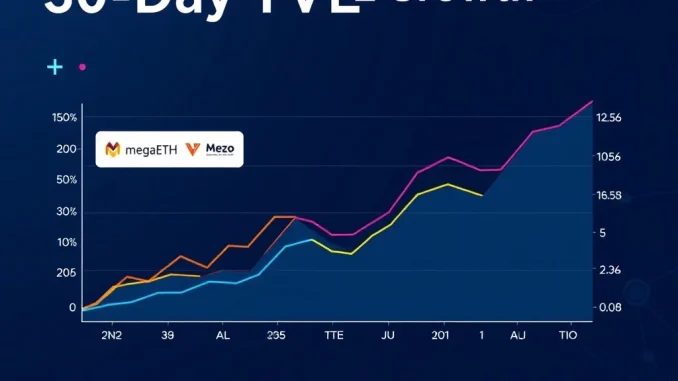
Global, May 2025: A new data visualization from analytics platform CryptoDep has captured a significant shift in the decentralized finance (DeFi) ecosystem, revealing that the MegaETH TVL growth rate has dramatically outpaced broader market trends over the past month. The chart, which tracks 30-day changes in Total Value Locked (TVL), highlights not only MegaETH’s surge but also substantial gains for networks like Mezo and Shibarium, indicating a pronounced rotation of capital across the blockchain landscape. This movement provides a real-time snapshot of developer and investor sentiment, shifting away from a period of consolidation towards targeted deployment in specific Layer 2 and application-specific chains.
Analyzing the CryptoDep TVL Growth Chart
CryptoDep’s chart serves as a critical benchmark for measuring economic activity within DeFi protocols. Total Value Locked represents the aggregate amount of user funds deposited into smart contracts for services like lending, borrowing, and liquidity provisioning. A sharp 30-day increase in TVL, as observed with MegaETH, typically signals one or more of the following: the successful launch of new, attractive yield opportunities, a migration of users from a competing network, or a broader vote of confidence in the chain’s underlying technology and security. The current data suggests a confluence of these factors is at play. Unlike price action, which can be speculative, sustained TVL growth is often viewed by analysts as a more fundamental indicator of organic usage and utility.
The Leading Networks in the Current Liquidity Rotation
The CryptoDep data identifies clear winners in this latest phase of capital allocation. The rotation appears strategic, moving liquidity towards networks that offer distinct technological or economic propositions.
- MegaETH: This Ethereum Layer 2 scaling solution has reportedly seen the most pronounced TVL spike. Analysts attribute this to the recent mainnet launch of its proprietary “HyperRollup” technology, which promises significantly lower transaction fees and faster finality than its predecessors. Several major DeFi protocols announced deployments on MegaETH in April, creating an immediate demand for liquidity.
- Mezo: Positioned as a Bitcoin Layer 2 for DeFi, Mezo’s growth underscores a growing trend of bringing programmable finance to the Bitcoin ecosystem. Its rising TVL likely reflects capital flowing from Bitcoin holders seeking yield opportunities without selling their BTC, utilizing new bridging and wrapping mechanisms.
- Shibarium: The Shiba Inu ecosystem’s dedicated blockchain has posted strong gains, indicating robust activity within its community-driven dApps and meme token projects. This growth highlights how established communities can drive tangible economic activity on their native chains.
This pattern indicates that liquidity is not flooding the entire market uniformly but is being selectively deployed based on specific network advancements and use-case narratives.
Historical Context and Market Cycles
Liquidity rotations of this nature are not unprecedented in DeFi’s short history. Similar movements were observed in the summer of 2020 during the “DeFi Summer,” when liquidity rapidly migrated to pioneering yield farming protocols on Ethereum. Later, in 2021, substantial TVL rotated to alternative Layer 1 chains like Avalanche and Solana during periods of high Ethereum gas fees. The current rotation differs in its focus on Layer 2 solutions and Bitcoin-based finance, reflecting a maturing market that is optimizing for scalability and tapping into the largest cryptocurrency’s native capital. This evolution suggests a market that is learning from past congestion and cost issues, applying those lessons to new technological infrastructures.
The Mechanics and Implications of TVL Migration
The movement of tens or hundreds of millions in TVL is a complex process with clear technical and economic triggers. It often begins with incentivized programs, such as liquidity mining campaigns, where a network or protocol offers token rewards to users who deposit assets. Developers also play a key role by deploying popular, audited codebases of established protocols (like Uniswap or Aave forks) onto new chains, creating familiar venues for liquidity. The implication of this rotation is twofold. For the receiving networks, it validates their technology stack and funds further development. For the networks losing relative TVL share, it can serve as a signal to innovate or improve user incentives. Crucially, this churn promotes healthy competition and technological progress across the sector.
Expert Perspective on Sustainable Growth
Industry observers caution that while sharp 30-day TVL gains are noteworthy, sustainability is key. “A rapid influx of TVL driven primarily by high, token-emitting incentives can be fleeting,” notes a researcher from a blockchain analytics firm. “The networks that will retain this capital are those that can convert mercenary farmers into long-term users by providing a genuinely superior experience—lower costs, faster transactions, and unique applications.” The coming months will test whether the current leaders like MegaETH can build a durable ecosystem beyond the initial incentive phase, fostering native innovation and retaining user loyalty.
Conclusion
The latest CryptoDep chart provides a compelling, data-driven narrative of dynamic change within decentralized finance. The standout MegaETH TVL growth, supported by strong performances from Mezo and Shibarium, illustrates a sophisticated liquidity rotation towards networks solving specific scalability and accessibility challenges. This movement is a hallmark of a maturing DeFi landscape where capital actively seeks efficiency and new frontiers, moving beyond single-chain dominance. For participants and observers, these TVL trends offer invaluable insight into where developer energy and user adoption are converging, signaling the next potential focal points for blockchain innovation and economic activity.
FAQs
Q1: What does TVL mean in DeFi?
Total Value Locked (TVL) is a core metric in decentralized finance that measures the total amount of user capital deposited into a protocol’s or network’s smart contracts. It is used as an indicator of the scale, usage, and overall health of a DeFi ecosystem.
Q2: Why is MegaETH’s TVL growing so quickly?
MegaETH’s rapid TVL growth is primarily attributed to the recent launch of its upgraded scaling technology and the subsequent migration of several major DeFi applications to its network, offering users lower fees and faster transactions, which are accompanied by initial liquidity incentive programs.
Q3: What is a liquidity rotation in crypto?
A liquidity rotation refers to the large-scale movement of capital (TVL) from one set of blockchain networks or DeFi protocols to another. This is often driven by new technological offerings, more attractive yield opportunities, or shifts in market sentiment towards different narratives.
Q4: How reliable is TVL as a metric?
TVL is a useful directional metric for gauging activity and capital commitment, but it should be analyzed critically. It can be inflated by double-counting (when the same asset is used across multiple protocols) or by high, unsustainable token emissions that attract short-term capital.
Q5: What is the difference between Layer 1 and Layer 2 TVL?
Layer 1 TVL refers to value locked on a base blockchain like Ethereum or Bitcoin. Layer 2 TVL refers to value locked on secondary scaling networks built on top of a Layer 1, such as MegaETH (for Ethereum) or Mezo (for Bitcoin). Layer 2s aim to increase transaction speed and reduce cost while inheriting the security of the underlying Layer 1.