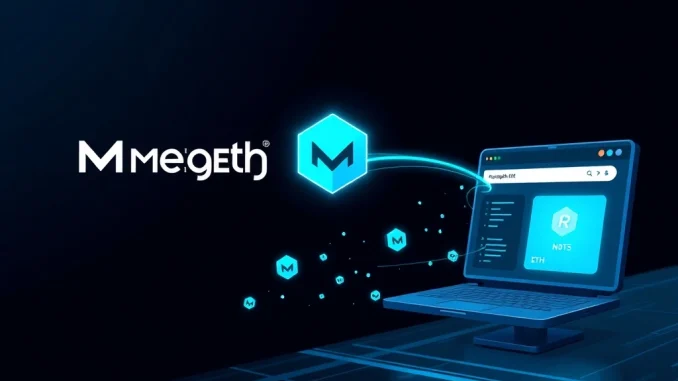
Global, May 2025: The non-fungible token (NFT) ecosystem has taken a significant step forward with the official integration of MegaETH, a high-performance Ethereum Layer 2 scaling solution, onto the Rarible marketplace. This technical deployment enables what developers term “real-time” NFT trading, directly addressing long-standing challenges of network congestion and high transaction costs on the Ethereum mainnet. The move signals a broader industry shift towards prioritizing user experience and scalability as the digital collectibles market matures.
MegaETH and Rarible: A Technical Partnership for Scalable NFTs
The core announcement centers on MegaETH going live on Rarible’s platform. MegaETH represents a specific approach to Ethereum scaling, often categorized as an optimistic rollup or a similar Layer 2 architecture. These solutions process transactions off the main Ethereum chain (Layer 1) before bundling and submitting a cryptographic proof of the results. This process dramatically increases transaction throughput and reduces associated fees, known as gas costs. Rarible, a community-centric NFT marketplace founded in 2020, has integrated MegaETH’s technology stack. Consequently, users can now list, buy, sell, and transfer NFTs using MegaETH, experiencing finality speeds measured in seconds rather than minutes and paying minimal transaction fees. This integration is not merely an added payment option; it is a fundamental upgrade to the marketplace’s trading engine.
The Evolution of Ethereum Scaling and NFT Market Dynamics
To understand the significance of this launch, one must examine the historical context of Ethereum scaling. Since the NFT boom of 2021, platforms like OpenSea and Rarible have struggled with the limitations of Ethereum’s base layer. During peak demand, gas fees could exceed hundreds of dollars, making small-value trades economically unviable and creating a poor user experience. The industry response has been a multi-year “Layer 2 summer,” with various solutions like Arbitrum, Optimism, and zkSync competing for developer and user adoption. MegaETH enters this landscape with a focus on ultra-high performance and low latency. Its integration with Rarible provides a tangible use case, moving beyond theoretical benchmarks to actual user benefits. For collectors and traders, this means the ability to engage in rapid, low-cost bidding wars, instant portfolio adjustments, and seamless cross-platform interactions without the constant burden of exorbitant network fees.
Architectural Implications for Creators and Collectors
The technical implications are profound for both sides of the NFT economy. For digital artists and creators, lower minting and transaction costs lower the barrier to entry. They can experiment with larger collections or more complex interactive metadata without pricing out their audience. For collectors, especially those engaged in high-frequency trading or portfolio management, the reduction in friction is transformative. The “real-time” aspect promoted by MegaETH could enable new market mechanics, such as dynamic pricing models and instant royalty distributions to creators, which were previously hampered by slow and costly settlement times. This shift aligns with a broader Web3 trend of abstracting away blockchain complexity to foreground user experience.
Comparative Analysis: Layer 2 Solutions for NFTs
The NFT marketplace landscape now features several Layer 2 integrations. A brief comparison highlights where MegaETH on Rarible positions itself.
| Marketplace | Primary Layer 2 | Key Focus | Transaction Finality |
|---|---|---|---|
| Rarible | MegaETH | High-speed, real-time trading | Seconds |
| OpenSea | Arbitrum, Polygon | Multi-chain liquidity, brand reach | Minutes to Hours |
| Blur | Native L2 (Blast) | Pro-trader tools, liquidity aggregation | Minutes |
This table illustrates a strategic differentiation. While other platforms prioritize multi-chain support or specialized trader features, the Rarible-MegaETH partnership explicitly targets raw transaction speed and cost reduction as its primary value proposition. The success of this strategy will depend on network security, developer adoption, and the seamless bridging of assets between Layer 2 and Layer 1.
The Road Ahead: Security, Adoption, and Interoperability
Every Layer 2 solution involves security trade-offs, typically relying on the security of the Ethereum mainnet but introducing new trust assumptions in their fraud-proof or validity-proof systems. MegaETH’s long-term success will hinge on rigorous, battle-tested security audits and a transparent operational model. Furthermore, adoption is a two-sided network effect. The utility of MegaETH on Rarible increases as more users, creators, and even other applications build on the same Layer 2, creating a synergistic ecosystem. Finally, interoperability—the easy movement of NFTs and funds between MegaETH, other Layer 2s, and Ethereum mainnet—will be critical. Clunky bridging processes can negate the user experience benefits, making this a key area for ongoing technical development.
Conclusion
The integration of MegaETH onto the Rarible marketplace marks a pivotal moment in the technical maturation of the NFT sector. By directly tackling the dual problems of high cost and low speed, this partnership aims to unlock a new phase of utility and accessibility for digital assets. The move underscores a clear industry trajectory: the future of mainstream NFT trading will be built on scalable, user-friendly Layer 2 infrastructures like MegaETH. While challenges around security and broad ecosystem adoption remain, this launch provides a concrete benchmark for what performant, low-friction NFT commerce can look like on Ethereum.
FAQs
Q1: What is MegaETH?
MegaETH is a high-performance Ethereum Layer 2 scaling solution. It processes transactions off the main Ethereum chain to provide faster speeds and significantly lower fees, then securely batches these transactions back to Ethereum for final settlement.
Q2: How does using MegaETH on Rarible benefit me as a user?
Users benefit from drastically reduced transaction costs (gas fees) and near-instant trade confirmations. This makes buying, selling, and minting NFTs more affordable and allows for a faster, more responsive trading experience.
Q3: Do I need to bridge my assets to use MegaETH on Rarible?
Yes, to trade on the MegaETH layer, you will need to bridge your Ethereum (ETH) and any NFTs from the Ethereum mainnet (or another chain) to the MegaETH network. Rarible’s interface will typically guide users through this process.
Q4: Is my NFT less secure on a Layer 2 like MegaETH?
Security models vary, but reputable Layer 2s like MegaETH derive their ultimate security from the Ethereum mainnet. They use cryptographic proofs to ensure the correctness of transactions batched to Layer 1. The risk profile is different but generally considered secure for most users when the technology is properly audited and implemented.
Q5: Can I move my NFT from MegaETH back to the Ethereum mainnet?
Yes, this is possible through a bridging process. However, it usually involves a delay (ranging from minutes to days, depending on the technology) and may incur a separate transaction fee. This process is essential for interoperability between layers.
Updated insights and analysis added for better clarity.
This article was produced with AI assistance and reviewed by our editorial team for accuracy and quality.