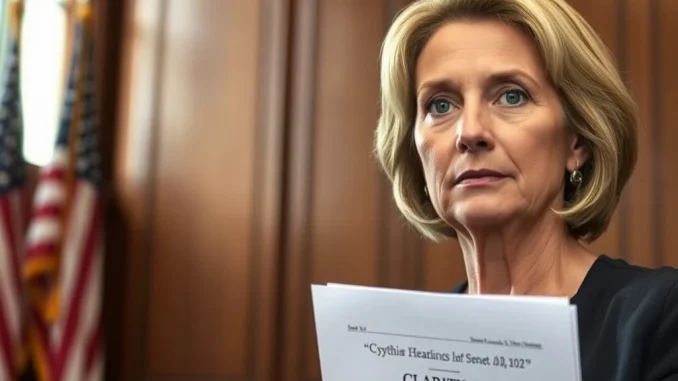
WASHINGTON, D.C. — March 18, 2026: In a pivotal move that could redefine everyday cryptocurrency use, Wyoming Senator Cynthia Lummis has forcefully revived the debate over a de minimis tax exemption for small digital asset transactions. This push comes as the U.S. Senate remains gridlocked over the broader CLARITY Act, a comprehensive digital asset market structure bill. Lummis, in a CNBC interview this week, confirmed that both the House Ways and Means and Senate Finance committees are actively considering a $300 exemption per transaction. This policy aims to remove capital gains tax reporting burdens when using cryptocurrencies like Bitcoin (BTC) for minor purchases, effectively treating them more like dollar bills for daily spending.
Lummis’s Last-Minute Push for Crypto Tax Relief
Senator Lummis, a Republican member of the Senate Banking Committee, is championing this exemption despite announcing she will not seek re-election, with her term concluding in January 2027. Her urgency stems from a standalone bill she introduced in July 2025, which proposed exempting crypto transactions under $300 from capital gains taxes, with an annual cap of $5,000. “We’re trying to figure out the appropriate way to decide when a sale—for example of Bitcoin—should be subject to capital gains and when it should be allowed to be used as a simple means of exchange the same way we use the US dollar,” Lummis stated during her television appearance. This effort directly addresses a major friction point identified by crypto advocates: the current tax reporting requirement for any gain, no matter how small, discourages the use of digital assets for routine payments.
The political context is critical. The broader CLARITY Act, which passed the House of Representatives in July 2025, is currently stalled in the Senate Banking Committee. Lummis revealed that her Democrat colleagues are still not voting “yes” on the package. Consequently, the committee’s chair, South Carolina Senator Tim Scott, postponed a crucial markup session scheduled for January 2026 indefinitely. This delay followed public criticism from Coinbase CEO Brian Armstrong, who said the exchange could not support the legislation “as written” due to concerns over its treatment of tokenized equities. Lummis’s strategy appears to be to advance popular, discrete provisions like the tax exemption, potentially building momentum for the larger bill.
Potential Impacts of a De Minimis Crypto Tax Exemption
If enacted, a $300 de minimis exemption would have immediate and tangible effects on the cryptocurrency ecosystem, particularly for retail users and merchants. First, it would significantly reduce the accounting complexity and compliance costs for individuals who wish to use crypto for small, everyday purchases like coffee, groceries, or online subscriptions. Second, it could accelerate merchant adoption by providing clearer, more favorable tax treatment for customer payments settled in digital assets. Finally, it would represent a major philosophical shift in U.S. policy, legally recognizing certain cryptocurrencies as a potential medium of exchange, not solely as property for investment.
- Boost to Everyday Utility: By removing the tax-reporting barrier for sub-$300 transactions, cryptocurrencies like Bitcoin and stablecoins could see a surge in use for actual commerce, moving beyond speculative trading.
- Regulatory Clarity for Merchants: Businesses accepting crypto would have a bright-line rule, simplifying their bookkeeping and making digital asset payments more attractive to implement.
- Political Compromise Pathway: The exemption is a less controversial element of the larger regulatory package and could serve as a bipartisan victory, unlocking negotiations on more contentious issues like stablecoin regulation and securities definitions.
Expert Perspectives on the Legislative Stalemate
Financial policy experts note that the Senate impasse reflects deeper divisions. “The CLARITY Act is a complex piece of legislation trying to reconcile decades of securities law with a novel technology,” says Dr. Sarah Bloom, a former Treasury official and fintech scholar at the Brookings Institution. “It’s not surprising that specific provisions, like those governing tokenized real-world assets, are causing friction. Isolating a provision like the de minimis exemption, which has clear consumer benefits, might be a savvy legislative tactic.” Meanwhile, industry reactions are mixed. While Armstrong’s critique centered on tokenized equities, other industry groups, like the Blockchain Association, have continued to lobby for the bill’s passage, arguing comprehensive framework is urgently needed. The association’s CEO, Kristin Smith, recently told a Senate panel that “piecemeal approaches create uncertainty,” but acknowledged that progress on any front is welcome.
Broader Context: The Long Road to Crypto Market Structure
The current debate sits within a multi-year struggle to establish clear rules for the digital asset industry in the United States. The CLARITY Act itself is the successor to earlier, failed attempts like the FIT for the 21st Century Act. The core disputes have consistently revolved around jurisdictional turf wars between the SEC and CFTC, the definition of a security versus a commodity in the crypto context, and now, the novel challenge of tokenized traditional assets. The table below outlines key differences between the stalled Senate bill and the active House-passed version on contentious points.
| Issue | House-Passed CLARITY Act (2025) | Senate Banking Committee Draft |
|---|---|---|
| Primary Regulator for Crypto Commodities | Grants the CFTC clear spot market authority over digital assets deemed commodities. | Proposes a joint certification process between SEC and CFTC, creating potential for delay. |
| Treatment of Tokenized Equities | Largely defers to existing securities laws, requiring full SEC registration. | Includes potential exemptions for certain blockchain-based equity tokens, a point of contention for Coinbase. |
| Stablecoin Issuance | Creates a federal framework for payment stablecoins, pre-empting state laws. | Similar framework but with stricter reserve and operational requirements for non-bank issuers. |
What Happens Next: Timeline and Political Pressure
The immediate next step is unclear, as the Senate Banking Committee has not rescheduled its markup session. However, external pressure is mounting. Last week, President Donald Trump took to social media to urge banking groups to “make a good deal” with the crypto industry, adding that banks could not hold the CLARITY Act “hostage.” This presidential intervention signals that digital asset policy will remain a high-profile issue. Observers are now watching whether Senator Lummis can attach her de minimis tax proposal to must-pass legislation, such as a government funding bill later in the year, using it as a vehicle for a policy win. Her impending retirement adds a “lame-duck” dynamic, potentially freeing her to broker deals without electoral concerns.
Industry and Public Response to the Tax Exemption Idea
Within the crypto community, the proposed tax exemption has been met with widespread approval. User advocacy groups argue it’s a common-sense measure already employed in countries like Portugal and Germany. “Taxing someone for buying a pizza with Bitcoin they held for a year is absurd and kills innovation,” stated a spokesperson for the DeFi Education Fund. Conversely, some tax policy purists and certain Democratic lawmakers express concern about creating a special carve-out that could be exploited or that reduces tax revenue. The Biden administration has not issued a formal Statement of Administrative Policy on the specific exemption, though it has generally supported a comprehensive regulatory approach over piecemeal fixes.
Conclusion
Senator Cynthia Lummis’s revival of the crypto tax exemption debate represents a strategic pivot in the stalled fight over U.S. digital asset regulation. By focusing on a popular, consumer-friendly policy like the $300 de minimis threshold, she aims to create a tangible win that could also break the logjam surrounding the larger CLARITY Act. The proposal directly addresses a major practical barrier to cryptocurrency functioning as a true medium of exchange. With the Senate Banking Committee’s markup indefinitely postponed and President Trump applying public pressure, the fate of both the exemption and the comprehensive market structure bill remains uncertain. The coming months will reveal whether this targeted approach can succeed where broader legislation has faltered, potentially setting a new precedent for how crypto policy advances in a divided Congress.
Frequently Asked Questions
Q1: What is a de minimis tax exemption for cryptocurrency?
A de minimis exemption would allow individuals to not report or pay capital gains taxes on very small cryptocurrency transactions, typically those under a set dollar amount like $300. It’s designed to make using crypto for everyday purchases practical by removing complex tax accounting for minor gains.
Q2: Why is Senator Lummis pushing this now if she’s leaving Congress?
As a retiring senator, Lummis may have more freedom to broker compromises without electoral pressure. She is also a long-time crypto advocate seeking to cement a policy legacy. Her push aims to salvage a key pro-consumer element from the stalled broader market structure bill.
Q3: What is the current status of the CLARITY Act in the Senate?
As of March 2026, the CLARITY Act is stalled in the Senate Banking Committee. A key markup session was postponed indefinitely after industry criticism, and the committee chair has not set a new date. Democrats on the committee have not yet provided the votes needed to advance it.
Q4: How would a $300 crypto tax exemption affect the average person?
For the average person, it would mean they could use Bitcoin or other cryptocurrencies to buy items worth less than $300 without having to calculate and report any capital gain or loss on that specific transaction to the IRS, greatly simplifying the process.
Q5: How does President Trump’s recent comment affect the legislation?
President Trump’s public urging for banks to “make a deal” increases political pressure on all parties involved. It signals that the White House views this as a priority and could encourage negotiations, though it doesn’t directly change the legislative process in the Senate.
Q6: Could the tax exemption pass on its own, separate from the larger bill?
Yes, it’s possible. Popular, discrete provisions like tax exemptions are often attached to larger, must-pass legislation (like budget bills) as amendments. This is a potential path forward if the comprehensive CLARITY Act remains deadlocked.