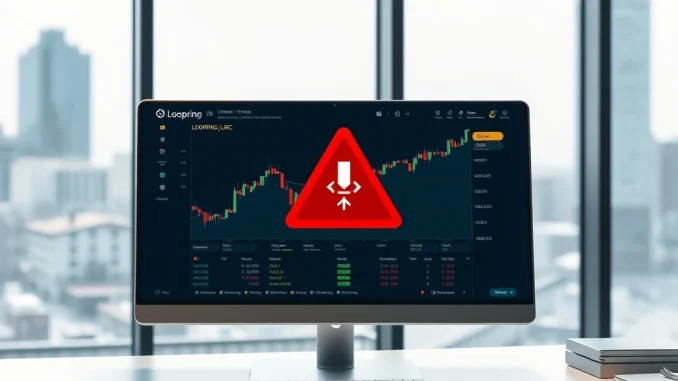
Loopring Delisting Watchlist: Upbit, Bithumb, Korbit Issue Critical Warning on LRC
Seoul, South Korea: In a significant regulatory move, three of South Korea’s largest cryptocurrency exchanges—Upbit, Bithumb, and Korbit—have simultaneously placed the Loopring (LRC) token on a delisting watchlist. This critical action follows a coordinated review that identified insufficient disclosure of material information and shortcomings in the project’s business progress. The decision sends a powerful signal about the evolving compliance standards within one of the world’s most active crypto markets and places immediate pressure on the Loopring project to address the exchanges’ concerns.
Loopring Delisting Watchlist: The Official Announcements
On a coordinated timeline, Upbit, Bithumb, and Korbit published nearly identical notices regarding Loopring (LRC). The exchanges did not act in isolation; their decisions stem from a shared framework established by the Korea Financial Intelligence Unit (KoFIU) and the Digital Asset Exchange Association (DAXA). This framework mandates regular project reviews. The core findings for LRC centered on two major failings. First, the exchanges cited a lack of adequate disclosure regarding information that could materially affect the token’s value. Second, they identified specific shortcomings during an assessment of the project’s business progress and development milestones. The watchlist status is not an immediate delisting but a formal warning. It initiates a monitoring period, typically lasting several weeks to months, during which the project team must provide satisfactory explanations and evidence of corrective action. Failure to comply will likely result in the termination of LRC trading pairs on these platforms.
Understanding South Korea’s Strict Delisting Criteria
The move against Loopring is not arbitrary but follows a strict, publicly available set of criteria that South Korean exchanges must enforce. These rules have tightened considerably since the implementation of the Travel Rule and the establishment of DAXA. The primary grounds for a delisting warning include:
- Insufficient Disclosure: Projects must proactively report significant events, including changes in leadership, major partnerships, protocol upgrades, security incidents, and legal challenges. The exchanges determined LRC’s disclosures were lacking.
- Business Progress Shortcomings: Exchanges evaluate whether a project is meeting its published roadmap, maintaining active development, and growing its user base or total value locked (TVL). Stagnation can trigger a review.
- Security Concerns: While not cited for LRC, repeated smart contract vulnerabilities or hacks are immediate red flags.
- Legal and Regulatory Issues: Investigations or sanctions from regulators in any major jurisdiction can prompt action.
This regulatory environment makes South Korean exchanges among the most stringent globally, often acting as a bellwether for project legitimacy.
The Immediate Impact on Loopring (LRC) and Its Holders
The announcement triggered immediate market repercussions. The price of LRC experienced notable volatility, reflecting investor uncertainty. For existing holders on these exchanges, the immediate effect is operational. Trading continues for now, but the watchlist status may affect margin trading pairs, new deposits, or promotional activities. Investors face a decision: hold and hope the project rectifies the issues, transfer tokens to a private wallet for self-custody, or sell. Historically, projects that successfully address exchange concerns see stabilized prices, while those that fail face severe liquidity crunches in the Korean market. The situation also impacts Loopring’s broader reputation, potentially affecting its integrations and partnerships outside of South Korea.
Loopring’s Technology and Business Context
To understand the exchanges’ concerns, one must examine Loopring’s proposition. Founded in 2017, Loopring is a protocol for building decentralized exchanges (DEXs) and payment systems on the Ethereum blockchain, utilizing zkRollup technology to enable faster and cheaper trades. Its native LRC token is used for governance, fees, and staking within the ecosystem. Despite its pioneering technology, the competitive landscape has intensified. The rise of alternative Layer 2 solutions like Arbitrum and Optimism, along with native zkRollup rivals such as zkSync, has increased pressure. Exchanges may be scrutinizing whether Loopring’s development pace and market adoption are keeping up with its ambitious roadmap and fierce competition. Business progress, in this context, could refer to metrics like protocol revenue, unique active wallets, or the growth of projects built on its infrastructure.
A Historical Perspective: Previous Delistings in South Korea
The delisting watchlist is a well-established process in South Korea. Previous cases provide a blueprint for potential outcomes. In 2021, multiple exchanges delisted dozens of tokens deemed “low-quality” following regulatory pressure. More recently, projects like Waves (WAVES) faced warnings due to issues with its algorithmic stablecoin. The process typically follows a public notice, a response period from the project, a final review by the exchange, and then either a withdrawal of the warning or an official delisting announcement. The coordinated action across Upbit, Bithumb, and Korbit indicates the concerns are considered serious and consensus-driven, reducing the chance of a reprieve based on a single exchange’s assessment.
What Happens Next: The Path Forward for LRC
The onus is now squarely on the Loopring development team and its foundation. The immediate next steps are highly procedural. The team must formally engage with each exchange’s compliance department, submitting detailed documentation to address the cited shortcomings. This likely involves:
- Providing a comprehensive disclosure report covering all material information.
- Presenting verifiable evidence of ongoing development activity and business milestones.
- Possibly committing to more frequent and transparent communication channels with the exchanges.
The exchanges will then re-evaluate. A successful response could lead to the removal of the watchlist status, often with little fanfare. An unsatisfactory response will lead to a final delisting notice, specifying the date trading will cease and the deadline for users to withdraw their tokens. The entire process underscores the shift from a wild-west crypto environment to one demanding corporate-grade transparency and accountability.
Conclusion
The placement of Loopring (LRC) on the delisting watchlist by Upbit, Bithumb, and Korbit is a critical event that highlights the maturation and strict compliance of South Korea’s cryptocurrency ecosystem. It serves as a stark reminder to all blockchain projects that listing on a major exchange is not a permanent right but a privilege contingent on continuous disclosure, development, and business progress. For investors, the situation reinforces the importance of understanding exchange-specific rules and the non-technical risks associated with token investments. The coming weeks will be decisive for Loopring, testing its ability to meet rigorous regulatory expectations and maintain its presence in a key global market.
FAQs
Q1: What does a “delisting watchlist” mean for Loopring (LRC)?
A delisting watchlist is a formal warning from an exchange. It means the exchange has identified compliance or project health issues and is giving the project team a specified period to address them. Trading continues during this monitoring period, but failure to resolve the issues will result in the token being permanently delisted.
Q2: Can I still buy or sell LRC on Upbit, Bithumb, or Korbit?
Yes, as of the announcement, trading for LRC continues on these exchanges. However, the watchlist status may lead to restrictions on certain services like new deposits or margin trading. Users should monitor official exchange notices for any changes.
Q3: What should I do if I hold LRC on one of these exchanges?
You have several options. You can hold your tokens on the exchange while monitoring the situation, transfer them to a private, self-custody wallet for safety, or sell them. If a delisting occurs, the exchange will announce a final withdrawal deadline, so it is crucial not to leave tokens on the platform past that date.
Q4: What specific information did Loopring fail to disclose?
The exchanges’ notices are typically broad, citing “insufficient disclosure of material information.” This could encompass unreported changes in core team members, delays or cancellations of major roadmap items, security incidents, legal proceedings, or significant financial changes within the founding organization.
Q5: Has this happened to other cryptocurrencies before?
Yes, the delisting watchlist process is a standard compliance tool in South Korea. Several tokens have gone through this process in recent years. Some successfully addressed the concerns and remained listed, while others were ultimately delisted. The coordinated action by the top three exchanges, however, indicates a high level of consensus on the severity of the issues.
Related News
- Bybit Unlocks Exciting GORK/USDT Perpetual Contract Trading with 12.5x Leverage
- Metaplanet Bitcoin Strategy: The Critical 5% Stock Gain Needed for Massive BTC Treasury Expansion
- Aave Wants to Launch a Rival to MakerDAO’s DAI Stablecoin
Related: Arthur Hayes HYPE Accumulation: Decoding the $1 Million On-Chain Transaction
Related: Crypto Presale Analysis: Five Projects Attracting Early Interest Amid Stalled Market Caps
Related: Kalshi Prediction Markets Stun Experts by Matching Federal Reserve Survey Accuracy