
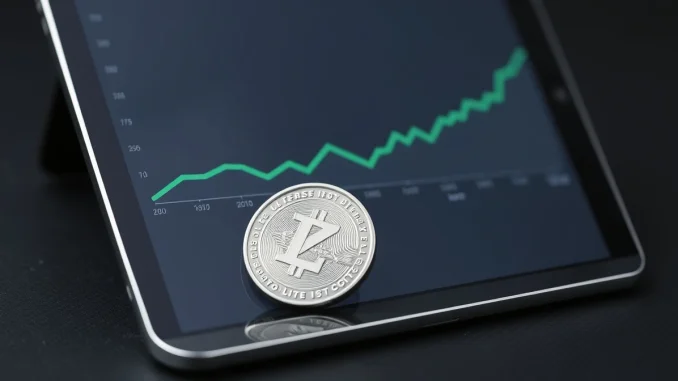
As of March 29, 2026, Litecoin (LTC) continues to hold its position as a major digital asset, often cited as a reliable testbed for Bitcoin’s innovations. Predicting its price path through the end of the decade requires examining its technical foundations, adoption metrics, and the broader crypto market’s evolution. This analysis projects potential LTC price trajectories for 2026 to 2030 based on verifiable data and established market patterns.
Litecoin Price Prediction: The Foundation of Analysis
Forecasting cryptocurrency prices is not an exact science. However, analysts use several core methodologies. Technical analysis studies historical price charts and trading volume. On-chain analysis examines blockchain data like active addresses and transaction counts. Fundamental analysis assesses the network’s utility, development activity, and market position. For Litecoin, its long history provides a substantial dataset. Since its 2011 launch, LTC has demonstrated resilience through multiple market cycles. Its correlation with Bitcoin remains high, often above 0.8. This relationship is a primary factor in any long-term Litecoin price prediction. Market data from CoinMarketCap shows LTC consistently ranking among the top 20 cryptocurrencies by market capitalization for years.
Also read: Pi Network Price Prediction: Analyzing the Uncertain Path to a 2026 Mainnet and Beyond
Key Drivers for LTC’s Value Through 2030
Several specific factors will likely influence the Litecoin forecast. The continued development of the MimbleWimble Extension Block (MWEB) for enhanced privacy is one. Adoption by payment processors and merchants remains a critical utility metric. According to a 2025 report by blockchain analytics firm IntoTheBlock, Litecoin’s use for actual transactions, rather than pure speculation, has seen gradual growth. The network’s security, derived from its strong proof-of-work mining ecosystem, is another strength. However, regulatory developments concerning proof-of-work assets pose a universal risk. Industry watchers note that Litecoin’s fate is also tied to Bitcoin’s. A successful Bitcoin ETF or broader institutional adoption of Bitcoin would likely create a positive ripple effect across major proof-of-work coins like LTC.
The Halving Cycle Factor
Litecoin undergoes a “halving” event approximately every four years, where the block reward for miners is cut in half. The next halving is projected for mid-2027. Historical data indicates that halving events can create supply-side shocks that have preceded significant price rallies in prior cycles, though past performance never guarantees future results. The 2023 halving was followed by a period of consolidation before the broader market upturn in 2025. Analysts will closely monitor miner activity and hash rate stability around the 2027 event for clues about network health and potential price pressure.
Also read: Decentraland (MANA) Price Analysis 2026: Critical Factors That Could Drive Value Toward $1
Litecoin Price Prediction 2026
The outlook for 2026 builds on the market conditions established in late 2025 and early 2026. If broader macroeconomic conditions favor risk assets and cryptocurrency adoption continues its current trajectory, LTC could see sustained interest. Technical analysis of the LTC/USD chart identifies several key resistance and support levels that will dictate the short-term trend. A report from Arcane Research in February 2026 suggested that Litecoin’s relative strength against Bitcoin could be a bellwether for altcoin season momentum. A conservative estimate for 2026 would see LTC testing levels significantly above its 2024 lows, contingent on positive market sentiment and no major regulatory setbacks.
Litecoin Forecast for 2027-2030
Looking further ahead, the Litecoin price prediction for 2027-2030 incorporates longer-term trends. The 2027 halving will be a focal point. If demand remains steady or grows while new coin issuance slows, basic economic principles suggest upward price pressure could follow. The implication is that the years following a halving have historically been strong for LTC. By 2030, the success of layer-2 solutions and cross-chain interoperability will be important. Litecoin must maintain its relevance as a fast, low-cost payment network. If it succeeds, its value could reflect that utility. If it fails to innovate, it may be overtaken by competitors. What this means for investors is a need to monitor adoption metrics, not just price charts.
Potential Price Range Scenarios (2026-2030):
- Bull Case: Widespread payment adoption, successful MWEB integration, and a sustained crypto bull market could push LTC to new all-time highs.
- Base Case: Steady growth correlated with Bitcoin, maintaining its current market position with moderate gains tied to overall crypto market expansion.
- Bear Case: Increased regulatory pressure on proof-of-work, loss of market share to newer blockchains, or a prolonged crypto winter could suppress prices.
Risks and Challenges to the Forecast
No Litecoin price prediction is complete without acknowledging the risks. The cryptocurrency market is notoriously volatile. Regulatory changes in major economies like the United States or the European Union could impact all digital assets. Technological obsolescence is a constant threat. While Litecoin has evolved, the pace of blockchain innovation is rapid. Competition from other fast-payment coins and central bank digital currencies (CBDCs) could also erode LTC’s use case. Security, while a strength, is not absolute. A major network breach, though unlikely, would have severe consequences. Investors should weigh these factors against the potential rewards.
Conclusion
This Litecoin price prediction for 2026 through 2030 outlines a path based on current data, historical cycles, and identifiable growth drivers. LTC’s future value will be determined by its ability to maintain network security, increase real-world adoption, and handle an evolving regulatory and competitive environment. While ambitious price targets often circulate, a measured analysis suggests Litecoin’s performance will be closely linked to Bitcoin’s and the overall health of the digital asset sector. Monitoring on-chain metrics and development progress will provide more reliable signals than speculation alone.
FAQs
Q1: What is the most important factor for Litecoin’s price?
The most consistent factor is its correlation with Bitcoin’s price movement. Broader crypto market sentiment and Bitcoin’s performance heavily influence LTC. Its own adoption as a payment method is a secondary, significant driver.
Q2: How does the Litecoin halving affect the price?
The halving reduces the rate of new LTC creation. Historically, this reduction in new supply, if met with steady or increasing demand, has created conditions for price increases in the 12-18 months following the event. However, it is not an automatic guarantee.
Q3: Can Litecoin reach $500 again?
Litecoin surpassed $500 in its 2021 bull run. For it to reach or exceed that level again, it would require a massive influx of capital into the crypto market, significant new adoption, and a favorable macroeconomic environment for risk assets. It is withwhen it comes to possibility but not a certainty.
Q4: Is Litecoin a good long-term investment?
Litecoin is one of the most established cryptocurrencies with a long track record. As with any crypto asset, it carries high volatility and risk. Its long-term success depends on maintaining its technological edge and utility. Diversification is always recommended.
Q5: What are Litecoin’s main advantages over competitors?
Litecoin offers faster block times and lower transaction fees than Bitcoin, making it more suitable for small payments. It has a proven, secure network operating for over a decade and strong brand recognition within the crypto space.

This article was produced with AI assistance and reviewed by our editorial team for accuracy and quality.




Be the first to comment