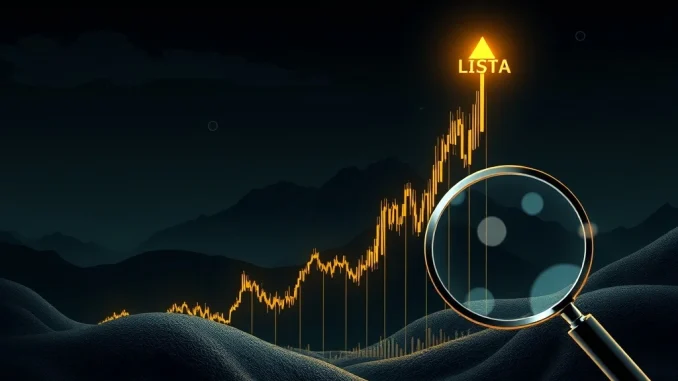
The cryptocurrency market is a realm of exhilarating highs and sudden, often perplexing, shifts. Recently, all eyes have been on LISTA, a digital asset that experienced a remarkable 14.7% LISTA price surge within a mere 24 hours. While such rapid gains might spark excitement, this particular surge has left many analysts scratching their heads, as it occurred without any apparent underlying market catalysts or significant news. What drives such enigmatic movements in the volatile world of digital assets?
Unpacking the LISTA Price Surge: A Closer Look
LISTA, a token whose specific utility often remains under the radar for many, saw its value jump to $0.35, marking a substantial 14.7% increase based on the latest HTX market data. Although it later settled slightly to $0.3358, the rapid ascent caught the attention of traders and observers alike. This sudden uptick unfolded amidst a backdrop of mixed global financial conditions, including a notable rise in the Osaka Nikkei 225 Next Index. However, it’s crucial to note that no direct correlation or causal link was established between the traditional equity market’s performance and LISTA’s digital asset surge. This detachment from broader market trends is often a hallmark of highly speculative crypto movements.
Decoding Speculative Trading in Digital Assets
The primary driver behind LISTA’s recent price action appears to be pure speculative trading. In the cryptocurrency landscape, where regulation can be less stringent and information flow less transparent than traditional markets, assets can be highly susceptible to short-term trading dynamics. This often involves traders buying an asset not because of its fundamental value or an anticipated product launch, but solely on the expectation that its price will rise further, allowing them to sell for a quick profit.
Key characteristics of speculative trading in digital assets include:
- Liquidity Shifts: Even small amounts of capital moving into or out of a low-liquidity asset can trigger significant price swings.
- Herd Mentality: When one asset starts to move, others might jump in, fearing they’ll miss out (FOMO – Fear Of Missing Out), amplifying the initial movement.
- Lack of Fundamental Basis: The absence of clear news, development updates, or partnerships means the price action isn’t supported by underlying growth.
- Short-Term Focus: Traders are looking for rapid gains, not long-term investment.
This kind of activity is common across various digital assets, making them attractive to high-risk tolerance investors but equally dangerous for those seeking stability.
The Enigma of Absent Market Catalysts: Why the Silence?
Perhaps the most intriguing aspect of the LISTA rally is the complete absence of discernible market catalysts. Typically, a price surge of this magnitude is accompanied by:
- Corporate Updates: News of a major partnership, a new product launch, or significant technological advancements.
- Regulatory Changes: Favorable regulatory news that could boost adoption or reduce operational risks.
- Macroeconomic Shifts: Broader economic trends that might drive investors towards riskier assets, though this usually impacts the entire market, not just a single token.
- Significant On-Chain Activity: A noticeable increase in transactions, unique active addresses, or large whale movements.
- Institutional Involvement: Public announcements of major funds or institutions acquiring the asset.
In LISTA’s case, none of these factors were present. There were no official statements from the LISTA project team, no major ecosystem news, and no significant changes in on-chain metrics to suggest a fundamental shift in its utility or adoption. This silence leaves the rationale for the rally entirely open to interpretation, pointing strongly towards an isolated, niche-driven speculative event rather than a systemic shift in investor sentiment for the token. The mention of the Osaka Nikkei 225 Next Index’s rise, while coincidental in timing, was explicitly stated as unrelated, further emphasizing the isolated nature of LISTA’s surge.
Navigating Crypto Volatility: What Investors Need to Know
The LISTA price surge serves as a potent reminder of the inherent crypto volatility that defines the digital asset market. While the allure of quick gains is strong, such rapid, unexplained movements carry significant risks. For investors, understanding and navigating this volatility is paramount.
Here are some actionable insights:
- Do Your Own Research (DYOR): Before investing in any digital asset, thoroughly research its fundamentals, team, technology, use case, and community. Don’t rely solely on price charts.
- Beware of FOMO: The fear of missing out can lead to impulsive decisions. A sudden surge without clear reasons is often a red flag, not an invitation to jump in.
- Risk Management: Only invest what you can afford to lose. Volatile assets can experience equally rapid crashes.
- Monitor Trading Volume and Liquidity: A price surge accompanied by low trading volume can indicate a “pump and dump” scheme or a highly illiquid market easily manipulated by a few large orders.
- Look for Sustained Trends: A true long-term trend is usually backed by fundamental developments and sustained trading activity, not just a 24-hour spike.
The fact that the LISTA surge was not accompanied by significant changes in on-chain activity or institutional involvement further reinforces the notion that it was likely a short-term, speculative play.
Broader Trends and the LISTA Price Surge Context
It’s worth noting that the cryptocurrency market frequently sees such isolated surges. Binance Square highlighted a similar 14% surge in $TIA around the same time, underscoring a broader trend of rapid price fluctuations within the sector. However, the timing of the $TIA surge—occurring a day after LISTA’s movement—suggests distinct market forces were at play for each token, rather than a single overarching catalyst affecting both. This emphasizes the fragmented nature of the crypto market, where different tokens can react to different, often opaque, stimuli.
Analysts consistently caution against overinterpreting such rallies. Without sustained follow-through activity and unchanged fundamental metrics, these movements often dissipate as quickly as they appear. The Osaka Nikkei 225 Next Index’s 48,165.98-point level on July 24, while a significant event in traditional equities, was specifically attributed to broader equity market trends and not linked to digital asset performance. This separation highlights the unique, often isolated, dynamics of the crypto world.
Conclusion: A Reminder of Crypto’s Wild Side
The recent LISTA price surge is a vivid illustration of the cryptocurrency market’s inherent unpredictability and the power of speculative trading. While it might excite some, the absence of clear market catalysts and fundamental backing should serve as a cautionary tale. Investors are urged to exercise extreme prudence, focusing on assets with transparent fundamentals and avoiding the allure of quick, unexplained gains. In a market defined by crypto volatility, understanding the difference between genuine growth and speculative bubbles is key to long-term success. Always prioritize informed decision-making over impulsive reactions to short-term price movements.
Frequently Asked Questions (FAQs)
Q1: What caused the recent LISTA price surge?
A1: The recent 14.7% LISTA price surge appears to be primarily driven by speculative trading activity rather than any clear fundamental market catalysts, corporate updates, or significant macroeconomic shifts. There were no official statements or on-chain data changes to explain the movement.
Q2: Is the LISTA surge a sign of a long-term trend?
A2: Analysts caution against viewing this as a long-term trend. The lack of sustained follow-through activity, unchanged fundamental metrics, and absence of clear catalysts suggest it was a niche-driven speculative event, not indicative of systemic sentiment shifts or sustained growth.
Q3: How does speculative trading impact digital assets like LISTA?
A3: Speculative trading can cause rapid and significant price swings in digital assets, especially those with lower liquidity or less transparent fundamentals. Traders buy based on anticipated short-term price increases, not intrinsic value, leading to high volatility and potential “pump and dump” scenarios.
Q4: What are “market catalysts” in the context of cryptocurrency?
A4: Market catalysts are specific events or news that typically drive price movements. In crypto, these can include major partnerships, new product launches, significant technological upgrades, favorable regulatory news, increased institutional adoption, or substantial on-chain activity. The LISTA surge lacked these.
Q5: How does LISTA’s surge compare to other recent crypto movements?
A5: The article notes a similar 14% surge in $TIA around the same time, indicating a broader trend of rapid price fluctuations in the sector. However, the timing difference suggests distinct market forces were at play for each token, emphasizing the fragmented nature of crypto market dynamics.
Q6: What should investors do when a token like LISTA surges without clear reasons?
A6: Investors should exercise extreme caution. It’s crucial to conduct thorough due diligence, avoid impulsive decisions driven by FOMO, and only invest what they can afford to lose. Monitoring subsequent trading patterns for consolidation or continued volatility, and prioritizing assets with transparent fundamentals, is advised.