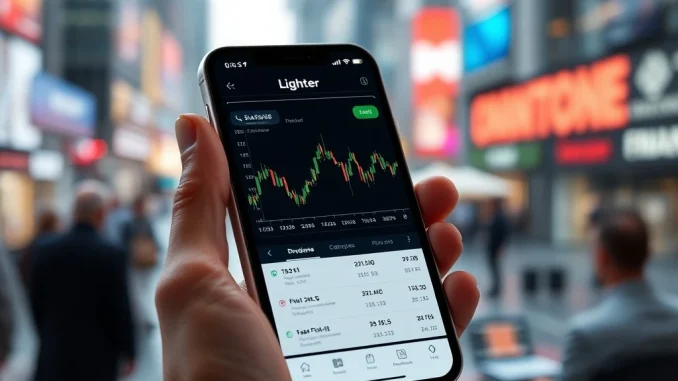
In a significant move for decentralized finance, the perpetual futures exchange Lighter has officially launched its comprehensive mobile trading application. This pivotal development, reported by CryptoBriefing, marks a strategic expansion for the platform as it brings its full suite of trading products directly to users’ smartphones. Consequently, traders can now access spot markets, perpetual futures contracts, real-world assets (RWAs), and pre-market assets from iOS and Android devices. This launch directly addresses the growing demand for on-the-go access to sophisticated DeFi tools, potentially reshaping mobile trading dynamics.
Lighter Mobile App Ushers in New Trading Era
The launch of the Lighter mobile trading app represents a calculated response to clear market trends. Mobile trading volumes have surged across traditional and crypto markets for several years. Major centralized exchanges reported over 60% of client activity originating from mobile devices in 2024, according to industry analytics firm Chainalysis. Therefore, Lighter’s development directly targets this user behavior shift. The application consolidates multiple asset classes into a single interface. Users can seamlessly transition between trading Bitcoin spot pairs and engaging with leveraged perpetual futures contracts on Ethereum. Furthermore, the inclusion of real-world assets like tokenized treasury bills expands the platform’s utility beyond pure cryptocurrency speculation.
Technologically, the app likely leverages secure, non-custodial wallet integration, a standard for reputable decentralized exchanges. This ensures users maintain control of their private keys while trading. The engineering team faced the challenge of compressing the complex order books and charting tools of a desktop perpetual futures platform into a mobile-friendly format. Early app store descriptions highlight features like real-time price alerts, one-click order execution, and portfolio tracking. These features are essential for competing in the crowded mobile finance sector.
Understanding the Perpetual Futures and RWA Market Context
Lighter’s core offering, perpetual futures, allows traders to speculate on asset prices without an expiry date, using leverage. This market has seen explosive growth, with aggregate open interest across all crypto platforms exceeding $50 billion in late 2024, as per data from Coinglass. Meanwhile, the real-world asset (RWA) sector has emerged as a major narrative. Tokenization of assets like bonds, real estate, and commodities on blockchain networks surpassed $10 billion in total value locked by early 2025, according to DeFiLlama. Lighter’s app uniquely bridges these two high-growth areas. It provides a single venue for both speculative derivatives and exposure to more stable, yield-generating traditional assets.
Features and Competitive Analysis of the New Platform
The Lighter mobile app enters a competitive landscape dominated by established players. A comparison of key features illustrates its market position:
| Platform | Asset Types | Key Mobile Feature | Leverage Offered |
|---|---|---|---|
| Lighter (New App) | Spot, Perpetuals, RWAs, Pre-Market | All-in-one DeFi suite | Up to 50x (on perps) |
| Exchange A | Spot, Perpetuals | Advanced charting | Up to 100x |
| Exchange B | Spot, RWAs | Simple savings products | N/A |
Lighter’s primary differentiator is its multi-asset integration. Unlike many competitors specializing in one vertical, it aggregates several. The inclusion of pre-market assets is particularly notable. This allows trading of tokens before their official listing on major spot exchanges, a feature typically reserved for advanced desktop platforms. Security protocols are paramount. The app presumably employs industry-standard measures like biometric login, encrypted local data storage, and direct blockchain settlement to mitigate mobile-specific risks such as device theft or insecure networks.
Potential Impact on Decentralized Trading and User Adoption
The launch carries significant implications for the broader DeFi ecosystem. Firstly, it democratizes access to complex financial instruments. Previously, trading perpetual futures or RWAs often required a desktop computer and multiple connected wallets. Now, these actions are possible anywhere. This accessibility could drive a new wave of retail user adoption into DeFi derivatives. Secondly, it pressures other decentralized exchanges to accelerate their own mobile development. The race for mobile market share in DeFi is intensifying.
From a liquidity perspective, migrating users to mobile could increase overall platform engagement. Higher engagement typically correlates with higher trading volumes and liquidity depth. However, the move also introduces challenges. Regulatory scrutiny on mobile financial apps, especially those offering leveraged derivatives, is increasing globally. Lighter must navigate varying jurisdictional rules regarding app store listings and derivative trading promotions. The company’s approach to compliance, likely through geofencing and KYC integrations for certain features, will be critical for its sustained growth.
Expert Insight on Mobile-First DeFi Strategy
Industry analysts view this launch as an inevitable evolution. “The future of trading is unquestionably mobile-first,” stated Maria Chen, a fintech analyst at Digital Asset Research, in a recent report. “Exchanges that fail to offer a robust, secure mobile experience risk obsolescence. Lighter’s move to consolidate perpetual futures with emerging asset classes like RWAs on mobile is a forward-thinking consolidation play.” This sentiment echoes broader technology adoption curves where mobile devices become the primary computing interface for most global users. The success of the app will hinge not just on features but on reliability, speed, and user experience during high volatility periods when trading activity spikes.
Conclusion
The launch of the Lighter mobile trading app is a strategic milestone for the decentralized exchange. By bringing spot, perpetual futures, real-world assets, and pre-market trading to iOS and Android, Lighter addresses a fundamental demand for accessible, comprehensive DeFi tools. This development reflects broader trends toward mobile dominance and asset tokenization. While competitive and regulatory hurdles remain, the app’s success could accelerate the convergence of traditional and decentralized finance, making sophisticated trading strategies available to a significantly wider audience. The Lighter mobile app launch therefore represents more than a product update; it signals a shift in how users interact with the future of financial markets.
FAQs
Q1: What can I trade on the new Lighter mobile app?
The Lighter app allows trading across four main categories: standard spot cryptocurrency pairs, perpetual futures contracts with leverage, tokenized real-world assets (RWAs) like bonds, and pre-market assets before their official exchange listings.
Q2: Is the Lighter mobile app non-custodial?
As a decentralized exchange, Lighter typically operates on a non-custodial model. This means the mobile app almost certainly integrates with self-custody wallets, allowing users to retain control of their private keys and funds while trading through the application’s interface.
Q3: How does mobile trading for perpetual futures work?
The app provides a mobile-optimized interface for the perpetual futures market. Users can view order books, place limit or market orders, set stop-losses, and manage leverage—all functionalities adapted from the desktop platform to be executed securely from a smartphone.
Q4: What are the security features of a DeFi trading app like this?
Key security features include biometric authentication (fingerprint/Face ID), encrypted local storage, secure connections to blockchain nodes, and the fundamental non-custodial architecture that prevents the exchange from holding user assets directly.
Q5: Why is the inclusion of Real-World Assets (RWAs) significant?
RWAs represent the tokenization of traditional financial assets on blockchain. Their inclusion in the Lighter app bridges DeFi with traditional finance, offering users exposure to potentially less volatile, yield-generating assets like government securities alongside speculative crypto derivatives, all in one portfolio.
Updated insights and analysis added for better clarity.
This article was produced with AI assistance and reviewed by our editorial team for accuracy and quality.