Global, May 2025: A notable divergence is defining the current cryptocurrency landscape. While broader market sentiment remains cautious, specific digital assets built on deflationary economics and tangible value are recording significant gains. Leading this charge are UNUS SED LEO (LEO), the utility token of the iFinex ecosystem, and a growing cohort of gold-backed tokens. This trend signals a potential maturation in investor strategy, shifting focus from pure speculative growth toward assets with defined utility, scarcity mechanisms, and real-world collateral.
UNUS SED LEO and Gold Tokens Lead Market Gains
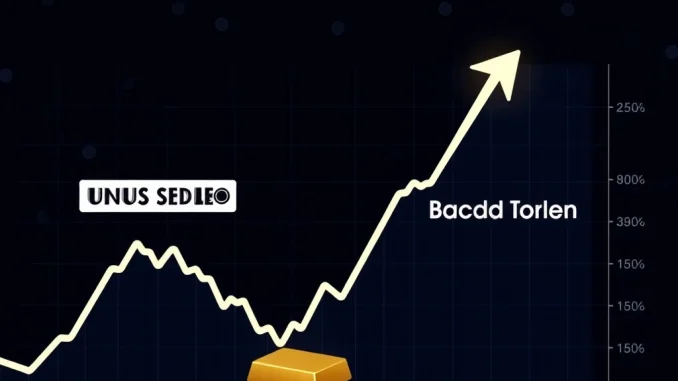
The performance of UNUS SED LEO and major gold-pegged cryptocurrencies like PAX Gold (PAXG) and Tether Gold (XAUT) has notably outpaced that of major cryptocurrencies like Bitcoin and Ethereum over recent weeks. Market data from multiple exchanges shows consistent upward price movement and increased trading volumes for these assets, even during periods of lateral or negative movement for the wider market. This divergence is not merely a short-term fluctuation but appears rooted in fundamental characteristics that resonate with current macroeconomic and sector-specific concerns. Analysts point to a flight toward perceived safety and predictable tokenomics as key drivers.
The Mechanics of Deflationary Utility Tokens
UNUS SED LEO’s market performance is intrinsically linked to its unique economic model. Unlike inflationary cryptocurrencies or those with unlimited supply, LEO operates on a deflationary mechanism through token burns. iFinex, the parent company of Bitfinex, commits to using at least 27% of its consolidated monthly revenue to repurchase and permanently destroy (burn) LEO tokens from the circulating supply. This process, verifiable on the blockchain, creates a continuous reduction in total supply, applying upward pressure on the token’s value if demand remains constant or increases. The token’s primary utility is to provide users of Bitfinex and other iFinex services with tangible benefits, including fee discounts. This creates a direct feedback loop: more platform revenue leads to more burns, enhancing the token’s scarcity and potentially its value for holders who use the platform.
- Supply Reduction: Periodic, verifiable burns permanently remove tokens from circulation.
- Revenue-Linked Model: Burn rate is tied directly to the financial performance of the underlying ecosystem.
- Practical Utility: The token provides real-world benefits (fee reduction) on a major trading platform.
Historical Context of Asset-Backed Digital Tokens
The concept of backing a digital asset with a physical commodity is not new but has gained substantial traction since the launch of the first regulated gold tokens in 2019. These tokens represent a direct evolution from traditional commodity trading and gold-backed exchange-traded funds (ETFs) into the digital realm. Each token is typically redeemable for a specific amount of physical gold, such as one fine troy ounce, which is held in audited, insured vaults. This structure merges the divisibility, borderless transferability, and 24/7 market access of cryptocurrencies with the historical stability and intrinsic value perception of gold. The recent surge indicates investors are leveraging this hybrid model as a hedge against both crypto market volatility and broader fiat currency inflation concerns.
The Rise of Real-World Asset (RWA) Tokenization
Gold tokens are the most prominent current example of a broader movement known as Real-World Asset (RWA) tokenization. This involves creating digital tokens on a blockchain that represent ownership of physical assets, which can range from precious metals and real estate to government bonds and invoices. The market for tokenized RWAs has grown exponentially, with gold products constituting a significant portion. The appeal lies in transparency, reduced custodial friction, and fractional ownership. For the crypto-native investor, these assets provide a way to maintain capital within the digital asset ecosystem while allocating a portion to a non-correlated, stable store of value. The table below outlines key characteristics of the leading models gaining traction.
| Asset Type | Primary Mechanism | Key Example | Investor Appeal |
|---|---|---|---|
| Deflationary Utility Token | Supply reduction via revenue burns | UNUS SED LEO (LEO) | Scarcity, platform utility, ecosystem alignment |
| Commodity-Backed Token | 1:1 redemption for physical asset | PAX Gold (PAXG), Tether Gold (XAUT) | Tangible collateral, inflation hedge, stability |
Analyzing the Shift in Investor Psychology
The concurrent rise of these two distinct asset classes points to a calculated shift in investor priorities within the digital asset space. Following cycles of extreme volatility and high-profile failures of purely algorithmic or speculative projects, a segment of the market is demonstrating increased risk awareness. Investors are actively seeking assets with clear, auditable fundamentals. For LEO, the fundamental is a transparent burn schedule linked to real revenue. For gold tokens, the fundamental is audited physical collateral. This represents a move away from narratives based solely on future potential and toward assets with demonstrable, present-day economic models or backing. It reflects a desire for predictability and asset preservation alongside growth.
Market Implications and Future Trajectory
The outperformance of deflationary and asset-backed tokens could have several implications for the broader cryptocurrency market. First, it may encourage other projects to adopt or emphasize transparent tokenomic models with clear utility and scarcity mechanisms. Second, it validates the growing sector of tokenized RWAs, likely accelerating the development of tokens backed by other commodities and financial instruments. However, these assets are not without their own considerations. Gold tokens carry custodial risk related to the vaults holding the physical metal and require trust in the issuer’s redemption guarantees. Deflationary models like LEO’s are inherently tied to the success and regulatory standing of their parent ecosystem. Their performance remains correlated to the health of the underlying business.
Conclusion
The recent crypto market gains led by UNUS SED LEO and gold tokens highlight a pivotal evolution in digital asset investment. This trend underscores a growing appetite for assets combining the technological advantages of blockchain with sound economic principles—whether through engineered digital scarcity or tangible collateral. It suggests a maturing market where fundamental analysis is becoming as crucial as technological speculation. As the sector continues to develop, the divergence between purely speculative assets and those with deflationary utility or real-world backing may become a defining feature of the cryptocurrency landscape, offering investors distinct pathways for portfolio strategy and risk management.
FAQs
Q1: What makes UNUS SED LEO a deflationary token?
UNUS SED LEO is deflationary because its issuing company, iFinex, uses a significant portion of its monthly revenue to permanently buy back and burn (destroy) LEO tokens from circulation, reducing the total supply over time.
Q2: How are gold-backed cryptocurrencies different from owning physical gold?
Gold-backed crypto tokens are digital representations of physical gold held in vaults. They offer easier divisibility, faster transfer, and direct trading on crypto exchanges but introduce counterparty risk with the token issuer/custodian, unlike holding physical gold directly.
Q3: What is the primary utility of the LEO token?
The primary utility of LEO is to provide users of Bitfinex and other iFinex-related services with discounts on trading fees, creating direct demand linked to platform activity.
Q4: Are gold-backed tokens considered a safe haven within crypto?
They are often perceived as a relative safe haven compared to more volatile, non-collateralized cryptocurrencies because their value is pegged to physical gold, a traditional safe-haven asset. However, they still carry risks specific to the digital token structure and issuer.
Q5: Can the supply of a gold-backed token increase?
Yes, the supply of a gold-backed token can increase, but only if the issuer acquires more physical gold to serve as collateral for the newly minted tokens, maintaining the 1:1 peg. The supply is not algorithmically fixed like Bitcoin’s.