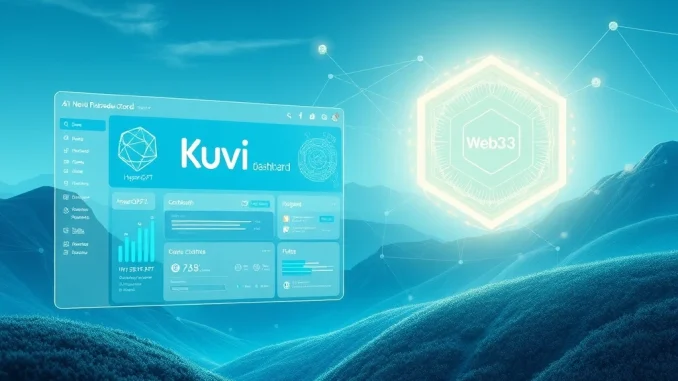
Global, May 2025: The convergence of artificial intelligence and decentralized technology enters a new, pivotal phase. Kuvi, a platform specializing in Web3 infrastructure, has formally announced its integration with HyperGPT, a leading decentralized AI marketplace. This strategic partnership aims to develop a new class of autonomous AI agents designed specifically for intent-based automation within Web3, decentralized finance (DeFi), and on-chain financial execution. This move signals a fundamental shift from manual, command-driven interactions in blockchain ecosystems to a future where user intent is directly translated into complex, secure, and autonomous on-chain actions.
Kuvi HyperGPT Integration: Decoding the Strategic Partnership
The collaboration between Kuvi and HyperGPT represents more than a simple technical handshake. It is a deliberate fusion of specialized expertise. Kuvi brings to the table its deep-rooted infrastructure for navigating and interacting with diverse blockchain networks. The platform has established itself as a facilitator for complex cross-chain operations and smart contract interactions. HyperGPT, conversely, contributes its robust, decentralized framework for accessing and orchestrating advanced AI models. Its marketplace aggregates AI capabilities, from natural language processing to predictive analytics, in a permissionless manner. The integration’s core objective is to leverage HyperGPT’s AI engine to power Kuvi’s operational layer, thereby creating agents that can understand high-level user goals—or “intents”—and autonomously devise and execute the necessary blockchain transactions to fulfill them.
The Mechanics of Intent-Based Automation in Web3
Intent-based automation marks a departure from the current transaction-centric model. Today, a user must specify every step: approve a token, swap on a DEX, bridge to another chain, and then deposit into a yield farm. An intent-based system, powered by advanced AI agents, changes this dynamic. A user would simply express a goal, such as “optimize the yield on my ETH holdings across Layer 2 networks.” The AI agent then takes over. It analyzes real-time on-chain data, assesses gas fees, evaluates protocol risks and APYs, and constructs an optimal, multi-step transaction bundle. This bundle is presented to the user for approval before being submitted as a single, cohesive action. This process dramatically reduces complexity, saves time, and minimizes the potential for user error, a significant barrier to mainstream DeFi adoption.
Historical Context: The Evolution of Blockchain Interaction
The journey to this point has been incremental. The first era of blockchain was defined by command-line interfaces and manual wallet interactions. The rise of user-friendly wallets and decentralized applications (dApps) marked the second era, bringing graphical interfaces but still requiring granular user control. The emerging third era, which this integration accelerates, is defined by abstraction and agency. Here, the interface becomes a conversational or declarative prompt, and the underlying complexity is managed by autonomous systems. This evolution mirrors the development of the traditional web, which progressed from static HTML pages coded by hand to dynamic, app-like experiences powered by sophisticated backend logic.
Technical Architecture: How AI Agents Execute On-Chain
The proposed architecture for these AI agents involves several critical, interlocking components. First, a natural language understanding module, likely fine-tuned from large language models (LLMs) available via HyperGPT, interprets the user’s intent. Second, a planning and reasoning engine accesses real-time data oracles for market prices, liquidity, and network conditions. Third, a security and simulation layer models the proposed transaction path to identify potential risks, slippage, or smart contract vulnerabilities before any live execution. Finally, an execution layer, built on Kuvi’s infrastructure, handles the signing and broadcasting of the validated transaction bundle. This multi-stage process ensures that autonomy does not come at the cost of security or user sovereignty.
The potential applications are vast and transformative:
- DeFi Portfolio Management: Agents could continuously rebalance assets, harvest rewards, and shift positions between protocols based on predefined risk parameters or market signals.
- Cross-Chain Asset Orchestration: Seamlessly moving liquidity to where it is most needed or most productive across different blockchains without user intervention.
- On-Chain Compliance and Reporting: Automatically generating tax reports or compliance audits by interpreting transaction histories across wallets and chains.
- Proactive Security: Monitoring for suspicious activity or protocol exploits and executing pre-approved defensive actions, like moving funds to a cold wallet.
Implications for Decentralized Finance and User Experience
The implications of this technological shift are profound. For the average user, it promises a radical simplification of Web3 interaction, potentially lowering the barrier to entry to a level comparable with traditional fintech apps. For sophisticated users and institutions, it offers powerful tools for optimizing complex, multi-faceted strategies at a speed and scale impossible manually. However, this autonomy also raises important questions about trust, liability, and the very definition of “decentralization.” If a user delegates significant decision-making to an AI agent, who is responsible if a bug or a flawed market prediction leads to a loss? The answer likely lies in transparent agent logic, user-set constraints, and robust insurance mechanisms built into the protocols themselves—challenges the industry must now address.
The Competitive Landscape and Future Trajectory
The Kuvi-HyperGPT partnership places them at the forefront of a competitive race. Other projects are exploring similar concepts, often described as “intent-centric” or “solver network” architectures. The success of this integration will depend not only on its technical prowess but also on its ability to foster a vibrant ecosystem of third-party developers who can build specialized AI agents for niche use cases on top of the platform. The long-term trajectory suggests a future where the most valuable layer in Web3 may not be the blockchain itself, nor the individual dApp, but the intelligent agency layer that sits between the user and the entire on-chain universe.
Conclusion: A Paradigm Shift Towards Autonomous Web3
The integration of HyperGPT’s AI capabilities into the Kuvi platform is a definitive step toward a more intelligent and autonomous Web3 ecosystem. By focusing on intent-based automation for DeFi and on-chain execution, this collaboration tackles one of the most persistent challenges in the space: complexity. While technical and philosophical hurdles remain, the move signals a clear industry direction. The future of blockchain interaction will be less about manually executing transactions and more about clearly defining goals, delegating the operational complexity to secure, transparent, and capable AI agents. The Kuvi HyperGPT integration is a concrete blueprint for building that future, promising to reshape how individuals and institutions interact with decentralized finance and the broader Web3 landscape.
FAQs
Q1: What is the primary goal of the Kuvi and HyperGPT integration?
The primary goal is to develop autonomous AI agents that can execute complex, multi-step on-chain actions based on a user’s high-level intent, rather than requiring manual step-by-step transaction commands.
Q2: How does “intent-based automation” differ from using a regular DeFi app?
In a regular DeFi app, you manually perform each discrete action (e.g., approve, swap, deposit). With intent-based automation, you state a desired outcome (e.g., “earn yield on this asset”), and an AI agent autonomously researches, plans, and executes the necessary series of transactions across protocols to achieve it.
Q3: Are these AI agents fully autonomous, and do they control user funds?
No. The architecture is designed for user sovereignty. The agent proposes a plan of action based on the user’s intent and current market data. The user must review and approve the bundled transaction before it is signed and executed from their non-custodial wallet. The agent does not have independent control over funds.
Q4: What are the main security considerations for this technology?
Key considerations include ensuring the AI’s planning logic is transparent and auditable, simulating transactions to detect potential exploits or excessive slippage before live execution, and allowing users to set strict constraints (like maximum loss tolerances) that the agent cannot violate.
Q5: Could this technology make DeFi more accessible to mainstream users?
Yes, absolutely. By abstracting away the technical complexity of interacting with multiple smart contracts and blockchains, intent-based AI agents can provide a user experience similar to traditional finance apps, significantly lowering the learning curve and risk of error for non-expert users.
Updated insights and analysis added for better clarity.
This article was produced with AI assistance and reviewed by our editorial team for accuracy and quality.