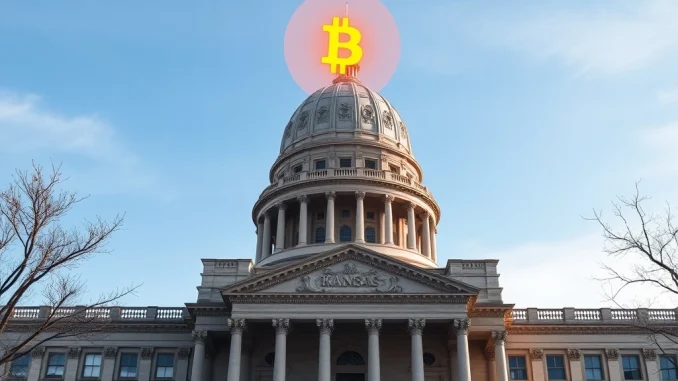
TOPEKA, Kansas – February 2025. A groundbreaking legislative proposal to establish a strategic Bitcoin reserve for the state of Kansas has advanced to the Senate Committee on Financial Institutions, marking a significant development in state-level cryptocurrency policy. This Kansas Bitcoin reserve bill represents one of the most concrete attempts by a U.S. state to formally integrate Bitcoin into its treasury management framework, according to reporting from The Block. The legislation specifically mandates that all staking rewards and airdrop proceeds from unclaimed digital assets flow into this dedicated reserve, while simultaneously prohibiting the state treasurer from depositing BTC into the general fund.
Understanding the Kansas Bitcoin Reserve Legislation
The proposed bill, formally introduced in the Kansas Senate, creates a legal mechanism for the state to accumulate and hold Bitcoin separately from traditional currency reserves. Consequently, the legislation establishes clear parameters for asset acquisition. Specifically, it designates two primary sources for the reserve: proceeds from cryptocurrency staking activities conducted by or on behalf of the state, and assets received from airdrops of unclaimed digital property. Furthermore, the bill contains a crucial restriction that prevents the commingling of Bitcoin with other state funds, thereby creating a distinct financial vehicle.
This legislative move follows a growing trend of states exploring digital asset integration. For instance, Texas and Wyoming have previously enacted laws friendly to cryptocurrency businesses and blockchain innovation. However, Kansas’s proposal is distinct because it focuses directly on state treasury management rather than industry regulation. The bill’s referral to the Senate Committee on Financial Institutions indicates it will undergo detailed scrutiny regarding fiscal responsibility, custody solutions, and market volatility risks.
Strategic Implications for State Treasury Management
The creation of a strategic Bitcoin reserve carries profound implications for public finance. Primarily, it introduces a non-traditional asset class into a government’s balance sheet. Proponents argue that Bitcoin, with its finite supply and decentralized nature, could serve as a hedge against inflation and currency devaluation over the long term. Conversely, critics highlight the asset’s notorious price volatility, which could introduce significant budget uncertainty. The bill’s requirement to segregate BTC from the general fund is a deliberate risk-management feature, insulating core budgetary operations from crypto market fluctuations.
Moreover, the mandate to capture staking rewards and airdrop proceeds reflects an understanding of the unique income-generating mechanisms within the crypto ecosystem. Staking involves participating in a proof-of-stake blockchain network to validate transactions and earn rewards. An airdrop is a distribution of cryptocurrency tokens or coins, often for free, to numerous wallet addresses. By claiming these proceeds from unclaimed assets, the state essentially positions itself to benefit from network growth and community distributions. This approach demonstrates a nuanced policy crafted with specific crypto-economic principles in mind.
Expert Analysis on Fiscal Policy Innovation
Financial policy analysts note that this bill represents a bold experiment in state-level fiscal strategy. “The Kansas proposal moves beyond symbolic acceptance of cryptocurrency and into the practical realm of asset management,” observes a researcher from the Brookings Institution, citing a 2024 report on state digital asset adoption. The expert emphasizes that successful implementation would require robust security protocols for cold storage, clear valuation methodologies for accounting, and a transparent governance framework for buying or selling decisions. Historically, state treasuries have been conservative, focusing on liquidity and capital preservation through instruments like Treasury bonds and money market funds. Introducing a volatile, digital asset requires a fundamental shift in risk tolerance and technical expertise.
Additionally, the legislation could set a precedent for how states handle unclaimed or abandoned digital property. As cryptocurrency ownership becomes more widespread, questions about escheatment laws—state laws governing unclaimed property—have grown more pressing. Kansas’s bill provides one potential answer: directing these assets into a dedicated development fund rather than liquidating them immediately for flat currency. This timeline of policy evolution shows a clear shift from outright skepticism to structured integration over the past five years.
Legal and Regulatory Hurdles Ahead
The bill’s path through the Kansas Senate committee process will involve several key considerations. Committee members will likely examine the proposal’s alignment with existing state investment policies, which often restrict public funds to highly-rated, low-risk instruments. They will also scrutinize the practicalities of custody. Who will hold the private keys to the state’s Bitcoin? Will the treasury department hire specialized staff or contract with a qualified custodian? These operational questions are paramount for security and auditability.
Another major area of debate will be the definition and identification of “unclaimed digital assets.” Establishing a legal and technical process to determine when a cryptocurrency asset is abandoned—given the pseudonymous nature of blockchain wallets—presents a novel challenge for the state’s administrative machinery. The table below outlines the core components and associated challenges of the proposed reserve:
| Bill Component | Description | Key Challenge |
|---|---|---|
| Reserve Creation | Establishes a dedicated state fund for holding Bitcoin. | Legal authority under the state constitution and existing finance laws. |
| Funding Source: Staking | Mandates staking rewards be added to the reserve. | Requires the state to engage in active network validation, posing operational and security risks. |
| Funding Source: Airdrops | Claims proceeds from airdrops of unclaimed assets. | Defining “unclaimed” and creating a mechanism to identify and claim these assets. |
| Segregation Clause | Prohibits mixing BTC with the state’s general fund. | Ensuring clean accounting and reporting for a separate asset class. |
| Custody & Security | Implies the need for secure storage solutions. | Mitigating the risk of theft or loss of private keys, a non-issue with traditional cash. |
National observers will monitor the committee hearings closely, as the outcome could influence similar proposals in other state legislatures. The debate will inevitably touch on broader themes of financial innovation, fiduciary duty, and the state’s role in an increasingly digital economy.
Potential Economic Impact and National Context
If enacted, the Kansas Bitcoin reserve could have several economic effects. Proponents suggest it could:
- Attract cryptocurrency businesses and talent to the state by signaling a forward-looking regulatory environment.
- Diversify the state’s revenue streams through potential long-term appreciation of the held asset.
- Position Kansas as a policy leader in the integration of traditional finance and digital assets.
However, the immediate fiscal impact might be minimal, depending on the volume of unclaimed assets and the returns from staking. The true significance is symbolic and strategic, setting a framework for future accumulation. This move occurs within a national context where the federal government has yet to establish comprehensive cryptocurrency regulations for public entities. Therefore, states like Kansas are effectively pioneering their own paths, creating a potential patchwork of approaches across the country.
Conclusion
The referral of the Kansas Bitcoin reserve bill to the Senate Committee on Financial Institutions initiates a critical phase of deliberation for a pioneering piece of state financial legislation. This proposal to create a strategic Bitcoin reserve, funded by staking rewards and airdropped unclaimed assets, represents a tangible step toward integrating digital assets into public treasury management. While the path forward involves navigating substantial legal, operational, and financial risk questions, the bill itself is a notable marker of how cryptocurrency concepts are moving from the fringe into mainstream policy discussions. The committee’s analysis and eventual decision will provide valuable insights into the readiness of state governments to hold digital assets directly, potentially shaping the landscape of public finance for years to come.
FAQs
Q1: What is the main purpose of the Kansas Bitcoin reserve bill?
The bill’s primary purpose is to legally establish a dedicated state fund, separate from the general fund, to accumulate and hold Bitcoin. It aims to capture value from crypto-specific activities like staking rewards and airdrops from unclaimed assets for the state’s benefit.
Q2: How would the state acquire Bitcoin for this reserve?
According to the proposed legislation, the reserve would be funded through two main channels: rewards earned from staking cryptocurrency (participating in network validation) and proceeds from cryptocurrency airdrops that are associated with unclaimed or abandoned digital assets.
Q3: Why does the bill prohibit putting Bitcoin in the general fund?
This segregation is a risk-management measure. Bitcoin’s price is highly volatile compared to traditional state revenues like taxes. Keeping it separate protects the state’s primary operating budget from sudden swings in the cryptocurrency’s market value.
Q4: What happens next for this legislation?
The bill has been referred to the Kansas Senate Committee on Financial Institutions. The committee will hold hearings, possibly amend the text, and then vote on whether to recommend it to the full Senate for a vote. It must pass both the Senate and House and be signed by the governor to become law.
Q5: Are other states considering similar Bitcoin reserve policies?
While several states have passed laws friendly to cryptocurrency businesses, a direct proposal for a state treasury-held Bitcoin reserve is novel. However, the concept of state-level digital asset adoption is gaining attention, and Kansas’s legislative process is likely being watched closely by policymakers in other states.
Updated insights and analysis added for better clarity.
This article was produced with AI assistance and reviewed by our editorial team for accuracy and quality.