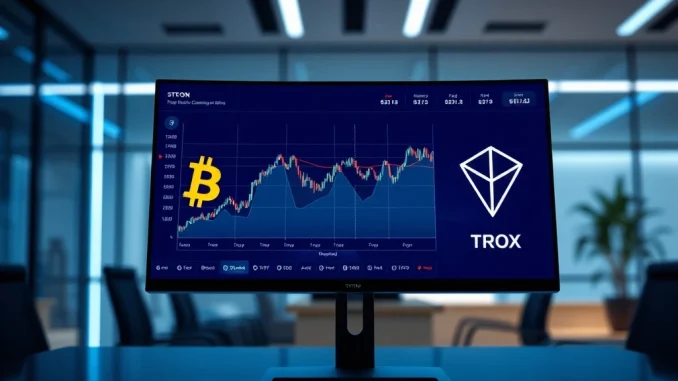
Singapore, May 2025: In a significant development for the cryptocurrency sector, Tron founder Justin Sun has revealed plans to allocate between $50 million and $100 million from the Tron treasury to purchase Bitcoin (BTC). This strategic announcement, made in an exclusive statement to CoinDesk, signals a major shift in treasury management strategy for one of blockchain’s most prominent ecosystems and has immediately captured the attention of market analysts and investors worldwide.
Justin Sun’s Bitcoin Purchase Plan: A Detailed Breakdown
The core of the announcement is straightforward yet profound. Justin Sun, the founder of the Tron blockchain and a well-known figure in digital assets, stated his intention to direct the Tron DAO Reserve—the decentralized autonomous organization that manages the network’s treasury—to acquire a substantial position in Bitcoin. The planned allocation ranges from a minimum of $50 million to a maximum of $100 million. This move represents a deliberate diversification of the treasury’s assets, which have historically been heavily weighted in Tron’s native token, TRX, and stablecoins like USDD. By adding Bitcoin, the treasury aims to incorporate an asset widely regarded as a digital store of value with a different risk and correlation profile compared to other crypto assets. The execution timeline and specific purchase mechanisms were not disclosed, but such a sizable order will likely be executed over time to minimize market impact.
Context and Implications for the Tron Treasury
This decision does not occur in a vacuum. It follows a broader trend among blockchain projects and public companies to hold Bitcoin on their balance sheets. To understand the scale, we can examine the current state of the Tron treasury. Public blockchain data shows the treasury holds significant sums in various digital assets. Adding $100 million in Bitcoin would substantially alter its composition.
Potential Impact on Treasury Composition:
- Diversification: Reduces over-reliance on the ecosystem’s own token (TRX) and associated stablecoins.
- Risk Management: Introduces an asset with a long-term track record and high liquidity, potentially stabilizing the treasury’s value during market volatility.
- Strategic Signaling: Demonstrates confidence in Bitcoin’s long-term value proposition, aligning Tron with a foundational crypto asset.
The move can also be seen as a hedge. While Tron’s ecosystem thrives on high-throughput, low-cost transactions for decentralized applications and stablecoin transfers, Bitcoin serves a more foundational role as decentralized digital gold. Holding BTC may provide the treasury with a stabilizing asset that is less correlated with the performance of the specific smart contract platform sector.
Historical Precedents and Market Reactions
Justin Sun is no stranger to making large-scale market moves. His history includes participating in high-profile token sales, strategic acquisitions like BitTorrent, and active engagement in decentralized finance (DeFi). However, a planned treasury allocation of this magnitude into Bitcoin is a notable evolution. Market reaction to the news was measured but positive, with analysts noting it could encourage other blockchain foundations to consider similar diversification strategies. Historically, announcements of large corporate or institutional Bitcoin purchases have often provided short-term bullish sentiment for the BTC price, though the long-term effects depend on broader market conditions.
Expert Analysis: Why Bitcoin and Why Now?
From a strategic finance perspective, this decision involves several calculated considerations. First, Bitcoin’s maturation as an institutional asset class makes it a more palatable holding for a entity like a DAO treasury. Regulatory clarity, though evolving, has improved for Bitcoin compared to other crypto assets. Second, macroeconomic factors such as inflation concerns and currency debasement narratives, while not explicitly cited by Sun, form a backdrop that makes Bitcoin’s fixed supply attractive to long-term holders. Third, for the Tron ecosystem, this could be a step towards greater financial legitimacy and stability, potentially making its treasury operations more resilient. It is not an impulsive trade but a strategic allocation that suggests a long-term horizon.
Comparison to Other Treasury Strategies:
| Entity | Bitcoin Holdings (Approx.) | Announcement Date | Stated Rationale |
|---|---|---|---|
| MicroStrategy | ~200,000 BTC | Ongoing since 2020 | Primary treasury reserve asset |
| Tesla (Historical) | ~10,000 BTC | 2021 | Diversification, store of value |
| Block (Square) | ~8,000 BTC | 2020, 2021 | Long-term investment |
| Tron DAO Reserve (Planned) | ~1,400-2,800 BTC (at $70k/BTC) | 2025 | Treasury diversification, strategic allocation |
This table places Tron’s planned purchase in the context of other notable corporate accumulators, highlighting its significant scale within the crypto-native project space.
Potential Consequences for the Crypto Market
The immediate consequence is a demonstration of demand. A $100 million purchase, while a fraction of Bitcoin’s daily trading volume, represents tangible, verifiable demand from a credible entity. More importantly, it may set a precedent. Other layer-1 and layer-2 blockchain projects with sizable treasuries might face questions from their communities about why they are not adopting a similar strategy. This could lead to a wave of similar announcements, creating a new source of institutional demand for Bitcoin from within the cryptocurrency industry itself. Conversely, it might also lead to discussions about the opportunity cost—whether capital is better deployed growing the core ecosystem versus holding a reserve asset.
Conclusion
Justin Sun’s plan for a $50 to $100 million Bitcoin purchase for the Tron treasury is a strategically significant development. It moves beyond speculative trading and represents a deliberate treasury management decision aimed at diversification, risk mitigation, and long-term value preservation. This action underscores the evolving maturity of crypto-native organizations as they adopt sophisticated financial strategies once reserved for traditional corporations. The move will be closely watched for its execution, its impact on the Tron ecosystem’s financial health, and its potential to influence broader trends in how blockchain projects manage their substantial treasury assets. The Justin Sun Bitcoin purchase plan matters because it reflects a deeper convergence between the innovative world of blockchain platforms and the timeless principles of sound financial stewardship.
FAQs
Q1: How much Bitcoin does Justin Sun plan to buy?
Justin Sun, on behalf of the Tron DAO Reserve, plans to acquire between $50 million and $100 million worth of Bitcoin (BTC). The exact number of coins will depend on the purchase price at the time of acquisition.
Q2: Why would the Tron treasury buy Bitcoin?
The primary reasons are likely treasury diversification and risk management. By adding Bitcoin, the treasury reduces its reliance on its native TRX token and associated stablecoins, gaining exposure to an asset widely considered a digital store of value with a different market correlation.
Q3: Has this purchase happened yet?
As of the announcement in May 2025, the purchase is a stated plan or intention. The actual buying process may occur over time to minimize market impact, and its completion will be verifiable on the public Bitcoin blockchain.
Q4: How does this compare to other companies buying Bitcoin?
While smaller than the multi-billion dollar holdings of firms like MicroStrategy, a $100 million allocation is significant, especially for a crypto-native project. It places Tron’s treasury strategy in a similar category to other institutions seeking Bitcoin as a long-term reserve asset.
Q5: What does this mean for the price of TRX or Bitcoin?
While large purchases can create upward price pressure, the direct market impact of a $100 million order on Bitcoin’s vast market is typically limited. The greater significance is the strategic signal it sends, which can influence market sentiment and potentially encourage similar actions by other entities.
This article was produced with AI assistance and reviewed by our editorial team for accuracy and quality.