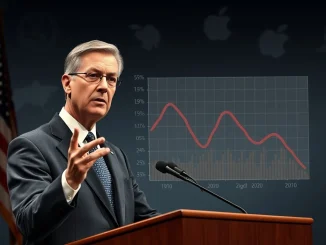
In the dynamic world of finance, statements from key economic figures often send ripples across global markets. For cryptocurrency investors, understanding these macroeconomic shifts is vital. Federal Reserve Chair Jerome Powell recently delivered a significant assessment regarding the potential impact of tariffs on inflation. This statement offers a crucial perspective on the stability of the US economy and the future direction of monetary policy. Investors keenly watch such pronouncements. They provide insights into the central bank’s thinking.
Jerome Powell’s Calming Outlook on Tariffs Inflation
Federal Reserve Chair Jerome Powell recently articulated the central bank’s stance on how tariffs might affect price stability. He stated that while tariffs could potentially increase inflation, this effect would be temporary. Specifically, Powell estimated that tariffs might cause inflation to rise by an additional 0.2 to 0.4 percentage points. However, he emphasized that this would constitute a “one-off event.” This means the inflationary pressure would not persist over the long term. Consequently, it would not fundamentally alter the broader inflation trajectory. Such a measured outlook aims to temper market concerns.
This assessment from the head of the Federal Reserve offers important clarity. It suggests that policymakers view tariff-induced price increases as distinct from broader, more persistent inflationary trends. Therefore, the Fed might not need to adjust its monetary policy aggressively in response to these specific pressures. This nuanced understanding is crucial for market participants. It helps them interpret the Fed’s future actions accurately. Furthermore, it influences investor sentiment across various asset classes.
Understanding Tariffs and Their Economic Impact
Tariffs are essentially taxes imposed on imported goods and services. Governments implement them for various reasons. These include protecting domestic industries or generating revenue. However, tariffs also carry economic consequences. When a country imposes tariffs, the cost of imported goods typically rises. Importers often pass these increased costs onto consumers. This process directly contributes to what economists refer to as tariffs inflation.
The impact of tariffs can be complex. Here are some key points:
- Direct Price Increases: Consumers pay more for goods subject to tariffs.
- Supply Chain Disruptions: Businesses may seek new, potentially more expensive, suppliers.
- Reduced Trade: Tariffs can decrease the volume of international trade.
- Retaliatory Measures: Other countries might impose their own tariffs, escalating trade tensions.
Ultimately, these factors can affect economic growth. They also influence employment levels. Therefore, policymakers must carefully weigh the benefits and drawbacks of imposing such trade barriers. Their decisions have wide-ranging effects on the global economy.
The Federal Reserve’s Mandate and Inflation Control
The Federal Reserve operates with a dual mandate established by Congress. This mandate guides all its policy decisions. Firstly, the Fed aims to achieve maximum sustainable employment. Secondly, it strives for price stability. Price stability generally translates to keeping inflation at a moderate and predictable level. The Fed typically targets an annual inflation rate of 2 percent. This target helps anchor inflation expectations.
Monitoring inflation is a continuous and complex task for the Fed. They analyze a wide array of economic data. These include the Consumer Price Index (CPI) and the Personal Consumption Expenditures (PCE) price index. Powell’s statement about tariffs inflation reflects this careful analysis. It distinguishes between transient price shocks and more enduring inflationary pressures. The Fed’s assessment is critical. It determines whether a policy response is necessary. Therefore, this distinction informs crucial monetary policy decisions. It impacts the overall health of the US economy.
Why a “One-Off Event”? Analyzing Inflation Dynamics
Jerome Powell’s description of tariffs as a “one-off event” for inflation is rooted in specific economic principles. A “one-off event” implies a temporary price increase that does not lead to a sustained rise in the overall price level. Several factors contribute to this assessment. Firstly, businesses might absorb some of the tariff costs. They could reduce profit margins rather than passing everything to consumers. Secondly, companies often adapt by finding alternative suppliers not subject to tariffs. This diversification can mitigate long-term price increases. Moreover, consumers might shift their purchasing habits. They could opt for cheaper, untariffed goods. This behavior helps to cap price rises.
Furthermore, the Fed differentiates between headline inflation and core inflation. Headline inflation includes volatile items like food and energy. Core inflation excludes them. Tariff effects often resemble a supply shock. These typically impact specific goods rather than broad demand. Consequently, while tariffs can cause an initial jump in prices, their effect tends to dissipate. They do not necessarily create the conditions for a persistent inflationary spiral. This understanding is key to the Federal Reserve’s strategy. It informs their cautious approach to any adjustments in monetary policy. The goal remains long-term price stability for the US economy.
Broader Implications for the US Economy
The imposition of tariffs, even with a temporary inflationary impact, carries broader implications for the US economy. Trade policies influence various sectors. They affect everything from manufacturing to agriculture. For instance, industries reliant on imported components might face higher production costs. This could reduce their competitiveness. Conversely, domestic industries protected by tariffs might experience a boost. However, this often comes at the expense of consumer prices. Additionally, retaliatory tariffs from other nations can harm U.S. exporters. This creates uncertainty for businesses and investors alike.
Consumer spending patterns can also shift. Higher prices for certain goods may lead consumers to delay purchases. They might also seek out less expensive alternatives. Business investment decisions are also sensitive to trade policy. Companies may postpone expansion plans amid trade uncertainties. Ultimately, the cumulative effect of tariffs can influence GDP growth. It can also impact employment levels. Therefore, the Fed’s careful assessment helps to manage expectations. It also provides a framework for understanding these complex economic interactions. The overall health and resilience of the US economy depend on navigating these challenges effectively.
Monetary Policy and Future Federal Reserve Decisions
Jerome Powell’s assessment that tariffs inflation is a “one-off event” holds significant weight for future monetary policy decisions. If the inflationary impact is truly temporary, the Federal Reserve would likely avoid making significant adjustments to interest rates solely based on tariff-related price spikes. Raising interest rates to combat temporary inflation could unnecessarily slow economic growth. It might also increase unemployment. The Fed aims to avoid such unintended consequences. Their approach is data-dependent and forward-looking. They prioritize sustained economic health.
Instead, the Fed will continue to monitor a broader range of economic indicators. These include labor market data, wage growth, and long-term inflation expectations. Their decisions on interest rates and other policy tools will reflect the overall economic outlook. They will not be swayed by transient factors. This cautious and comprehensive approach is a hallmark of the Federal Reserve’s strategy. It seeks to balance price stability with maximum employment. Ultimately, the goal is to foster a robust and stable US economy. This benefits businesses and consumers alike.
Navigating Economic Uncertainties: A Forward Look
The global economic landscape remains complex. Numerous factors beyond tariffs influence inflation and economic stability. Energy prices, geopolitical events, and supply chain resilience all play significant roles. Wage growth, for instance, is a key indicator the Federal Reserve watches closely. Persistent wage increases could signal more entrenched inflationary pressures. Therefore, the Fed’s vigilance extends beyond just trade policy. They continuously analyze a multitude of economic forces.
Jerome Powell’s comments provide valuable guidance. They reassure markets that the Fed understands the nature of current inflationary pressures. They also signal a commitment to stable monetary policy. However, economic forecasts are never certain. The Fed must remain flexible. It must be ready to adapt to new data. For investors, particularly those in the volatile cryptocurrency market, understanding the Fed’s framework is paramount. It helps in making informed decisions. It also allows for better risk management in an ever-evolving financial environment. The stability of the US economy hinges on these careful considerations.
Conclusion: A Steady Hand Amidst Trade Tensions
Jerome Powell’s assertion regarding tariffs inflation provides a crucial anchor for market expectations. By characterizing the potential price increases as a “one-off event,” the Federal Reserve signals confidence. It suggests that these specific trade policies are unlikely to derail the broader goal of price stability. This measured perspective helps to mitigate unwarranted market panic. It also reinforces the Fed’s commitment to a predictable monetary policy. As the US economy navigates ongoing trade discussions and global uncertainties, the Fed’s steady hand remains a vital force. Their clear communication helps ensure economic resilience. It supports sustained growth for all stakeholders.
Frequently Asked Questions (FAQs)
Q1: What exactly did Jerome Powell say about tariffs and inflation?
Federal Reserve Chair Jerome Powell stated that tariffs could cause inflation to rise by an additional 0.2 to 0.4 percentage points. However, he emphasized that this would be a “one-off event,” meaning the effect would be temporary and not lead to persistent inflation.
Q2: Why does the Federal Reserve consider tariff-induced inflation a “one-off event”?
The Fed views it as a one-off event because tariff impacts are typically supply-side shocks affecting specific goods. Businesses may absorb costs, find alternative suppliers, or consumers may shift purchases. This prevents a sustained, broad-based inflationary spiral that would require a significant monetary policy response.
Q3: How do tariffs generally affect the US economy?
Tariffs increase the cost of imported goods, leading to higher prices for consumers (tariffs inflation). They can also disrupt supply chains, reduce trade volumes, and provoke retaliatory tariffs from other countries, potentially impacting GDP growth and employment in various sectors of the US economy.
Q4: What is the Federal Reserve’s primary goal regarding inflation?
The Federal Reserve’s primary goal regarding inflation, as part of its dual mandate, is to maintain price stability. This typically means aiming for a moderate and predictable annual inflation rate of 2 percent over the long term, thereby anchoring inflation expectations.
Q5: How might Powell’s statement influence future monetary policy decisions?
If the Fed truly believes tariffs inflation is temporary, it is less likely to adjust interest rates or other monetary policy tools specifically in response to these tariff-related price increases. Instead, the Fed will continue to focus on broader economic indicators and long-term inflation trends.