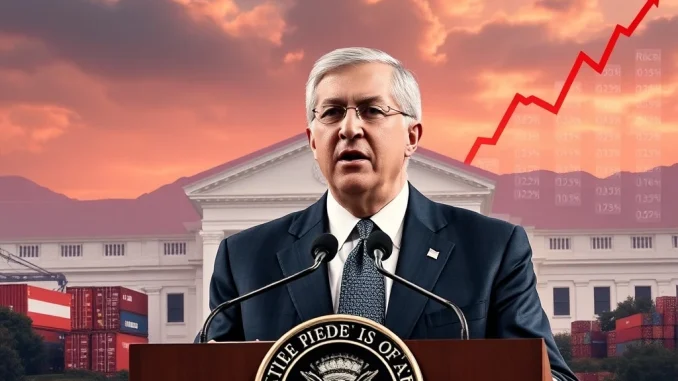
Understanding the nuances of global economic shifts is paramount for investors, including those in the cryptocurrency space. Federal Reserve Chair Jerome Powell recently offered a crucial perspective on a pressing economic concern: the impact of tariffs on inflation. He stated that any price pressures stemming from these trade policies are likely to be temporary. This assessment provides a vital lens through which to view the broader economic landscape.
Understanding Tariff Inflation and Its Dynamics
Tariffs represent taxes imposed on imported goods. When a country levies tariffs, it aims to make foreign products more expensive. Consequently, domestic goods become more competitive. However, tariffs can also increase the cost of imported raw materials. This directly impacts manufacturers. They often pass these higher costs onto consumers. This process can lead to what is known as tariff inflation.
Powell’s remarks came during a discussion on the economic outlook in Warwick, Rhode Island. He acknowledged that inflation has remained slightly elevated. Despite this, he expressed confidence in the Fed’s current position. His statement suggests that the central bank views the underlying economic fundamentals as strong. It also implies that tariff-related price hikes are not a long-term threat to price stability.
Historically, trade disputes have sometimes caused economic volatility. Tariffs can disrupt supply chains. They can also create uncertainty for businesses. Therefore, Powell’s assessment offers a calming influence. It suggests that these specific pressures are transient. The market often reacts strongly to inflation concerns. Thus, this perspective is significant.
Jerome Powell’s Stance on Price Pressures
Jerome Powell elaborated on the Fed’s analysis. He believes that the economy possesses mechanisms to absorb and adjust to tariff-induced costs. For instance, businesses may find alternative suppliers. They might also absorb some costs themselves. Additionally, consumers may shift their purchasing habits. These adaptations help to mitigate sustained price increases. This prevents a permanent rise in the overall inflation rate.
The Fed carefully monitors a range of economic indicators. These include consumer spending, wage growth, and global trade data. Powell’s comments reflect this comprehensive analysis. He suggests that the broader economic environment remains stable. This stability allows for temporary price fluctuations without triggering a spiral of sustained inflation. This nuanced view helps to manage market expectations effectively.
Moreover, the Fed’s primary mandate includes maintaining price stability. Therefore, any perceived threat to this stability receives immediate attention. Powell’s reassurance indicates that current tariff-driven pressures do not constitute such a long-term threat. This outlook can bolster investor confidence. It reduces fears of a runaway inflationary environment.
The Federal Reserve’s Strategic Positioning
The Federal Reserve plays a critical role in managing the nation’s economy. It uses monetary policy tools to achieve its dual mandate. This includes maximizing employment and maintaining price stability. Interest rates are its primary instrument. By adjusting these rates, the Fed influences borrowing costs. This impacts economic activity.
Powell highlighted the Fed’s favorable position. This assessment follows its recent interest rate cut in September. Such a move is typically aimed at stimulating economic growth. It can also serve as a buffer against potential economic headwinds. The Fed’s proactive stance demonstrates its commitment to supporting economic expansion. It also aims to counteract any negative impacts from global trade tensions.
The central bank continually assesses domestic and international economic conditions. This includes geopolitical events and trade policies. Its decisions are data-driven. They aim to guide the economy towards sustainable growth. The Fed’s independence allows it to make decisions based purely on economic factors. This fosters trust in its policy direction.
Significance of the Recent Interest Rate Cut
The September interest rate cut was a significant policy adjustment. It signaled the Fed’s readiness to support the economy. This was particularly true amid global slowdown concerns. Lower interest rates make borrowing cheaper for businesses and consumers. This encourages investment and spending. Ultimately, it boosts economic activity.
Powell’s statement about the Fed being in a ‘favorable position’ is key. It implies that the rate cut has provided sufficient stimulus. It also suggests that the Fed has room to maneuver if needed. This flexibility is crucial in an uncertain global economic climate. It allows the Fed to respond effectively to new challenges. The market generally reacts positively to such strategic positioning.
Furthermore, the rate cut can act as an insurance policy. It protects against downside risks. These risks might include a deeper impact from trade disputes. Or perhaps a more pronounced global economic deceleration. This strategic move helps to maintain market liquidity. It also supports overall financial stability. Thus, the Fed aims to keep the economy on a steady path.
Broader Economic Outlook and Market Confidence
The overall economic outlook remains a key focus for investors. Powell’s optimistic assessment regarding tariff-driven inflation is a positive signal. It suggests that major economic disruptions are not anticipated. A stable economic environment is generally conducive to investment across various asset classes. This includes traditional markets and emerging sectors like cryptocurrency.
Investor confidence is intrinsically linked to economic stability. When central bank leaders project a stable outlook, it reassures markets. It encourages long-term planning and investment. Conversely, uncertainty can lead to market volatility. It can also cause capital flight. Powell’s message aims to foster a sense of predictability and control over economic variables.
For cryptocurrency markets, macro-economic stability is often a silent but powerful driver. While crypto assets can sometimes decouple, they are not immune to global economic sentiment. A robust and stable traditional economy can provide a supportive backdrop. It allows for greater risk appetite. This can indirectly benefit innovative assets like digital currencies. Therefore, understanding the Fed’s perspective is vital for all market participants.
In conclusion, Federal Reserve Chair Jerome Powell’s comments offer a reassuring perspective. He believes that tariff-driven inflation will likely be temporary. This assessment underscores the Fed’s confidence in the economy’s resilience. It also highlights the effectiveness of its recent monetary policy adjustments. The central bank remains vigilant. It stands ready to navigate evolving economic conditions. This approach aims to ensure long-term price stability and sustainable growth.
Frequently Asked Questions (FAQs)
Q1: What did Jerome Powell say about tariff-driven inflation?
Federal Reserve Chair Jerome Powell stated that any price pressures resulting from tariffs are likely to be temporary. He made these remarks while discussing the economic outlook in Warwick, Rhode Island.
Q2: Why does Powell believe tariff inflation will be temporary?
Powell’s assessment suggests that the economy has mechanisms to adjust to tariff-induced costs. This includes businesses finding alternative suppliers, absorbing costs, or consumers shifting habits, preventing sustained price increases.
Q3: What is the Federal Reserve’s role in managing inflation?
The Federal Reserve aims to maintain price stability as part of its dual mandate. It uses monetary policy tools, primarily interest rates, to influence borrowing costs and manage inflation, guiding the economy towards sustainable growth.
Q4: How does an interest rate cut affect the economy?
An interest rate cut makes borrowing cheaper for businesses and consumers, encouraging investment and spending. This stimulates economic growth and can act as a buffer against potential economic slowdowns.
Q5: How does the economic outlook influence cryptocurrency markets?
While cryptocurrency markets can be volatile, they are not entirely immune to global economic sentiment. A stable and robust traditional economy, as indicated by a positive economic outlook, can foster greater investor confidence and risk appetite, indirectly benefiting digital assets.
Q6: What is the significance of the Fed being in a ‘favorable position’?
Powell’s comment implies that the recent interest rate cut has provided sufficient stimulus to the economy. It also suggests that the Fed has room for further policy adjustments if needed, offering crucial flexibility in an uncertain global economic climate.