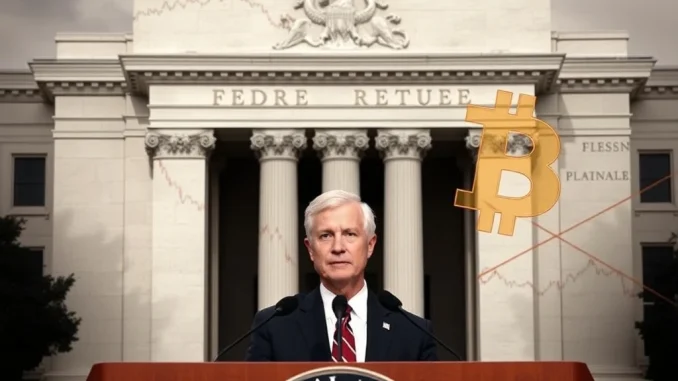
For cryptocurrency enthusiasts, signals from central bankers often hold significant weight. Recently, Federal Reserve Chair Jerome Powell made a pivotal statement. He explicitly declined to comment on specific asset prices, including Bitcoin. This occurred during a speech at the National Association for Business Economics (NABE) in Philadelphia. This refusal highlights the Fed’s careful approach to market communication. It also raises questions about the perceived inflation link between traditional and digital assets. Understanding this stance is crucial for anyone navigating the complex world of finance.
Jerome Powell’s Stance on Specific Asset Prices
During his recent address, Jerome Powell faced direct questions. He was specifically asked about the relationship between rising inflation and the valuations of assets. These assets included both gold and Bitcoin. Powell, however, firmly stated his position. He would not offer opinions on individual asset price movements. This policy reflects a long-standing tradition among central banks globally. They aim to maintain impartiality within financial markets. His comments came amidst growing public interest in cryptocurrencies. Many investors increasingly view them as potential hedges against economic uncertainty.
This statement by the head of the Federal Reserve is not new. Central bankers generally avoid endorsing or criticizing particular investments. Such actions could inadvertently manipulate markets. They could also lead to accusations of favoritism. Therefore, Powell’s response was entirely consistent. It aligns with the Fed’s established communication strategy. This strategy prioritizes stability and transparency. It avoids direct influence on speculative asset valuations.
Understanding the Federal Reserve’s Neutrality Principle
The Federal Reserve operates with a clear and vital mandate. Its primary goals include maximizing sustainable employment and maintaining price stability. To effectively achieve these objectives, the Fed must remain scrupulously neutral. Directly commenting on specific asset prices could disrupt market dynamics significantly. It might also create unfair advantages or disadvantages for certain asset classes. Such commentary could be misinterpreted. It might even be seen as a form of official guidance.
Consider the potential consequences. If the Fed were to praise Bitcoin, it could trigger a speculative rally. Conversely, a critical remark could cause a sharp decline. Both scenarios contradict the Fed’s role. Their role is to manage the broader economy. It is not to guide individual investment choices. Therefore, Powell’s refusal was consistent with established central bank protocols. This approach ensures the Fed’s credibility. It also prevents undue influence on the investment decisions of millions.
The Ongoing Debate: Bitcoin and the Inflation Link
The discussion around Bitcoin as an inflation link has intensified significantly. Especially during periods of increased monetary expansion. Proponents often argue that Bitcoin’s finite supply makes it a strong hedge. They frequently compare it to digital gold. The total number of Bitcoins is capped at 21 million. As fiat currencies potentially devalue due to inflation, Bitcoin could theoretically retain its value. This narrative has gained traction among a segment of investors.
However, critics present a different perspective. They point to Bitcoin’s inherent volatility. Its price can fluctuate wildly over short periods. This makes it, in their view, an unreliable store of value during inflationary times. Unlike gold, which has thousands of years of history as a value store, Bitcoin is relatively new. Its long-term performance under various economic conditions is still being observed. Powell’s non-commentary does not validate either viewpoint. Instead, it underscores the Federal Reserve’s policy. The central bank focuses on broad economic indicators. It avoids specific market forecasts or endorsements.
Bitcoin Price Volatility and Broader Economic Factors
Bitcoin price movements are notoriously dynamic. They respond to a variety of factors. These include technological developments, regulatory news, and shifting market sentiment. Global macroeconomic conditions also play a crucial role. Interest rate changes, for instance, can impact investor appetite for risk assets. Bitcoin, being a high-risk, high-reward asset, often reacts strongly.
While some investors look for clues from central banks, Powell’s recent statement reaffirms the Fed’s position. They will not offer guidance on specific digital assets. This means investors must conduct their own thorough research. Understanding market risks is paramount. Furthermore, regulatory frameworks for cryptocurrencies are still evolving. This adds another layer of complexity. The lack of direct central bank commentary means greater responsibility for individual investors.
Implications for Investors in the Cryptocurrency Market
Powell’s statement carries significant implications for investors. It clearly signals that the Federal Reserve will likely not intervene directly. They will not comment on the intrinsic value of Bitcoin or other cryptocurrencies. This places the onus squarely on investors. They must evaluate risks independently. They cannot expect official guidance on these assets.
Furthermore, it suggests a continued hands-off approach. At least regarding direct commentary on specific digital asset prices. This stance could foster a more mature market environment. In such an environment, participants rely on fundamental analysis. They do not depend on central bank endorsements. Investors should therefore:
- Conduct extensive due diligence: Research projects, teams, and use cases.
- Understand market cycles: Recognize that crypto markets are volatile.
- Monitor regulatory developments: Keep abreast of new laws and guidelines.
- Diversify portfolios: Do not put all capital into one asset class.
The absence of official commentary from the Federal Reserve forces a greater degree of self-reliance. It encourages critical thinking. This approach can ultimately lead to more robust investment strategies. It moves away from speculation driven by official statements.
The Broader Regulatory Landscape for Digital Assets
Beyond the Federal Reserve’s specific stance, the broader regulatory landscape for digital assets is rapidly evolving. Governments worldwide are grappling with how to classify and oversee cryptocurrencies. Different jurisdictions are adopting varied approaches. Some are embracing innovation. Others are focusing on consumer protection and financial stability.
For instance, central banks are exploring Central Bank Digital Currencies (CBDCs). These could fundamentally alter the financial system. However, CBDCs are distinct from decentralized cryptocurrencies like Bitcoin. The Fed’s non-commentary on Bitcoin does not preclude its interest in CBDC research. This complex interplay of innovation, regulation, and central bank policy shapes the future of finance. Investors need to stay informed about these developments. They are crucial for understanding potential market shifts.
In conclusion, Federal Reserve Chair Jerome Powell reiterated a key principle. The Fed will not comment on specific asset prices. This includes both gold and Bitcoin. His statement during the NABE speech reinforced the central bank’s commitment to neutrality. While the debate over the inflation link and Bitcoin price continues, investors should note this position carefully. The Federal Reserve will focus on its broader economic mandates. Market participants, therefore, should rely on independent analysis. This ensures informed decision-making in the evolving financial landscape. The Fed’s stance promotes a market where individual responsibility is paramount.
Frequently Asked Questions About Powell, Bitcoin, and the Fed
- What exactly did Jerome Powell say about Bitcoin?
Jerome Powell, the Federal Reserve Chair, stated he would not comment on specific asset prices. This included Bitcoin and gold. He made this statement during a speech at the National Association for Business Economics (NABE). - Why did Powell decline to comment on specific asset prices?
The Federal Reserve maintains a policy of neutrality. Commenting on specific asset prices could influence markets unfairly. It could also undermine the Fed’s credibility. Their role is to manage broad economic conditions, not to guide individual investment decisions. - Is Bitcoin considered an inflation hedge by the Federal Reserve?
The Federal Reserve has not officially endorsed or rejected Bitcoin as an inflation hedge. Powell’s non-commentary indicates the Fed avoids taking a stance on specific assets. The debate over Bitcoin’s effectiveness as an inflation hedge continues among economists and investors. - How does the Federal Reserve’s stance impact cryptocurrency investors?
The Fed’s neutral stance means cryptocurrency investors cannot expect official guidance or validation for their investments. This places a greater responsibility on individual investors. They must conduct their own research and risk assessment. - What is the Federal Reserve’s primary mandate?
The Federal Reserve’s primary mandate involves two key objectives: maximizing employment and maintaining price stability. These goals guide its monetary policy decisions. - Does the Fed’s position mean they don’t acknowledge Bitcoin’s existence?
No, the Fed’s position does not mean they ignore Bitcoin. It signifies a policy of not commenting on its price or value. The Federal Reserve acknowledges the existence of cryptocurrencies. They are actively researching digital assets, including potential Central Bank Digital Currencies (CBDCs).