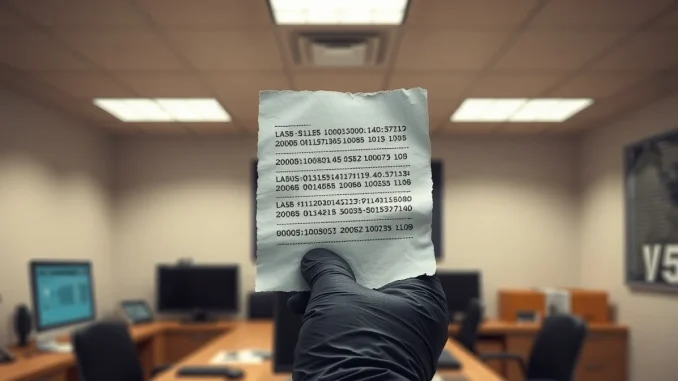
In a landmark case demonstrating evolving law enforcement capabilities, Irish authorities have successfully accessed a cryptocurrency wallet containing 500 Bitcoin, valued at over $35 million, years after the private keys were believed to be permanently lost. The seizure, confirmed on March 24, 2026, by Ireland’s Criminal Assets Bureau (CAB), marks a significant technical and legal achievement in the global pursuit of illicit digital assets.
Bitcoin Wallet Recovery After Years of Inaccessibility
The CAB, with critical support from Europol’s European Cybercrime Centre (EC3), announced it had “gained access to and seized a cryptocurrency wallet” linked to convicted drug dealer Clifton Collins. This development is notable because the private keys, necessary to control the Bitcoin, were printed on a single sheet of A4 paper that disappeared after Collins’s arrest in 2017. Consequently, the assets were considered inaccessible for nearly a decade, a common outcome when cryptographic keys are lost due to the security design of blockchain technology.
Europol hosted operational meetings at its headquarters in The Hague and provided what the CAB described as “highly complex technical expertise and decryption resources.” This international collaboration was vital to the operation’s success. Typically, losing a Bitcoin private key renders the associated funds permanently unrecoverable. The cryptographic principles securing the network make brute-force attacks computationally impossible. Therefore, this recovery suggests specialized methods were employed, though authorities have not disclosed the exact techniques used, citing ongoing investigative protocols.
The Case of the Lost Keys and the Convicted Drug Dealer
The wallet is one of twelve originally containing a total of 6,000 Bitcoin purchased by Clifton Collins using proceeds from his cannabis operation between late 2011 and early 2012. Following a 2017 arrest where police found cannabis in his car, Collins was sentenced to five years in prison. According to reports from The Irish Times and The Guardian, Collins stored the paper containing the wallet keys inside the aluminum cap of a fishing rod case at his rental home.
After his sentencing, a dispute arose over the keys’ whereabouts. Collins claimed the fishing rod case was stolen before his landlord entered the property. However, the landlord stated they cleared out and discarded his belongings. This discrepancy left the Irish state believing the 6,000 Bitcoin, worth hundreds of millions of dollars today, were permanently locked away. Blockchain intelligence platform Arkham continues to list clusters of addresses under the label “Clifton Collins: Lost Keys,” with total holdings still valued at over $391 million as of March 2026.
Technical and Legal Implications of the Seizure
This case sets a powerful precedent for asset recovery units worldwide. It demonstrates that while cryptocurrency offers pseudo-anonymity, it is not impervious to determined, well-resourced law enforcement action. The seizure involved multiple jurisdictions and specialized cybercrime units, highlighting the need for international cooperation in tackling crypto-related crime.
Key challenges in such recoveries include:
- Cryptographic Security: Bitcoin’s design intentionally makes private keys the sole access mechanism.
- Asset Tracing: Following the blockchain trail from purchase to current wallets.
- Jurisdiction: Determining legal authority over digital assets held on a global ledger.
- Technical Expertise: Requiring advanced skills often beyond traditional police units.
The transfer of the 500 Bitcoin to the institutional platform Coinbase Prime on March 24, 2026, confirmed by blockchain data, indicates the state has taken full control. The CAB will likely seek a court order to formally confiscate the assets, after which they may be liquidated, with proceeds entering state coffers.
Broader Context for Crypto Asset Recovery
This Irish case occurs within a broader global trend of law enforcement enhancing its crypto forensic capabilities. Agencies like the U.S. Department of Homeland Security and the UK’s National Crime Agency have established dedicated crypto units. Furthermore, recent legal frameworks, such as the European Union’s Markets in Crypto-Assets (MiCA) regulations, aim to increase transparency and aid in the tracking of illicit flows.
The table below outlines notable similar cases of large-scale crypto seizures by law enforcement:
| Year | Agency | Case | Value Seized (Approx.) |
|---|---|---|---|
| 2022 | U.S. Department of Justice | Bitfinex hack recovery | $3.6 billion |
| 2024 | UK Metropolitan Police | Money laundering operation | $250 million |
| 2025 | Europol (Multi-nation) | Tycoon 2FA phishing takedown | N/A (Service disabled) |
| 2026 | Ireland CAB & Europol | Clifton Collins wallet | $35 million |
These cases collectively signal to criminals that cryptocurrency is not a safe haven for illicit funds. However, they also raise important questions about the limits of state access to private cryptographic keys and the potential application of such techniques in different contexts.
Conclusion
The successful Bitcoin wallet recovery by Irish police and Europol represents a watershed moment in digital asset forfeiture. It proves that with advanced technical resources and cross-border collaboration, law enforcement can overcome significant cryptographic obstacles once thought insurmountable. This case not only recovers substantial criminal proceeds but also serves as a stark deterrent. It underscores a clear message: the perceived anonymity of cryptocurrency is increasingly eroding under the scrutiny of modern financial crime units. As techniques evolve, the balance between individual cryptographic security and state asset recovery will continue to be a critical frontier in law and technology.
FAQs
Q1: How did Irish police recover Bitcoin from a wallet with lost keys?
Irish police, with Europol’s European Cybercrime Centre, used “highly complex technical expertise and decryption resources.” While the exact method is undisclosed, it likely involved advanced cryptographic techniques or forensic analysis to reconstruct or bypass the need for the original paper key, a significant technical achievement given Bitcoin’s security design.
Q2: Who was Clifton Collins, and how did he get the Bitcoin?
Clifton Collins is a convicted drug dealer sentenced in 2017 for growing and selling cannabis. According to police, he used proceeds from his drug operation to purchase 6,000 Bitcoin in late 2011 and early 2012, when prices were a fraction of their current value.
Q3: Why is recovering a lost Bitcoin private key normally considered impossible?
Bitcoin uses public-key cryptography. The private key is a unique, secret number that mathematically proves ownership. Without it, there is no backdoor or central authority to restore access. Guessing the key is computationally infeasible, so lost keys typically mean permanently lost funds.
Q4: What happens to the seized Bitcoin now?
The 500 Bitcoin were transferred to a Coinbase Prime wallet controlled by the state. Ireland’s Criminal Assets Bureau will likely secure a court order for final forfeiture. The state may then liquidate the Bitcoin, converting it to traditional currency that enters government funds.
Q5: Does this mean no Bitcoin wallet is safe from government seizure?
Not necessarily. This case targeted specific assets derived from crime. The recovery was exceptionally difficult and resource-intensive. It demonstrates growing state capability but does not mean arbitrary seizure is possible. Legitimately owned and properly secured wallets remain protected by the same strong cryptography, but the legal barrier to seizure, once assets are identified and linked to crime, is lowering.
Updated insights and analysis added for better clarity.
This article was produced with AI assistance and reviewed by our editorial team for accuracy and quality.