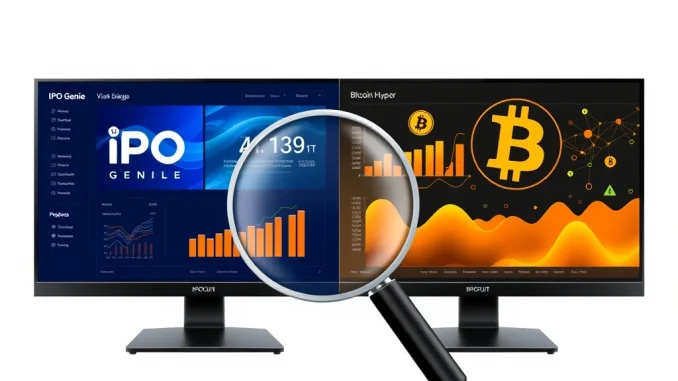
Global, March 2025: The cryptocurrency presale landscape continues to evolve, with projects increasingly differentiating themselves through sophisticated token economic models. Two projects generating discussion among analysts are IPO Genie ($IPO) and Bitcoin Hyper. This analysis provides a detailed, factual comparison of their tokenomics, examining how each structure proposes to deliver value through mechanisms like AI-powered access and private market tokenization. Understanding these frameworks is essential for any informed assessment of their respective growth potential.
Understanding Tokenomics in Modern Crypto Projects
Tokenomics, a portmanteau of ‘token’ and ‘economics,’ refers to the economic system governing a cryptocurrency. It encompasses all factors influencing a token’s value and utility, including its supply, distribution, vesting schedules, and use cases. Since the advent of Bitcoin’s fixed supply model, project designers have created increasingly complex systems aimed at aligning incentives between developers, investors, and users. A project’s long-term viability often hinges on the robustness of its tokenomic design, which must balance initial fundraising, ongoing development, and sustainable ecosystem growth.
IPO Genie ($IPO): Tokenomics Focused on Private Market Access
IPO Genie positions itself as a platform designed to democratize access to private market investments through tokenization. Its native token, $IPO, functions as the gateway and utility asset within this ecosystem. The project’s whitepaper outlines a tokenomic model with several core components. The total token supply is capped, with a significant portion allocated to the presale event to fund platform development and initial liquidity. A dedicated percentage is reserved for ecosystem development, including grants for projects seeking to tokenize on the platform.
The utility of the $IPO token is explicitly tied to platform functionality. Holders may use tokens to pay for transaction fees, participate in governance votes on which private equity or venture debt opportunities are tokenized, and gain tiered access to investment rounds. The project emphasizes an AI-powered screening process for investment opportunities, suggesting the token may also be staked to help train or benefit from these algorithmic models. Vesting schedules for team and advisor tokens are typically structured over multiple years to encourage long-term commitment.
The Mechanics of AI-Powered Access
The ‘AI-powered access’ component of IPO Genie’s model warrants closer examination. In practice, this likely involves using machine learning algorithms to analyze and score private companies seeking funding. Token holders might gain early insights or preferential allocation based on their stake or participation in governance. This creates a direct link between token utility and a perceived value-add: smarter capital allocation. The success of this model depends entirely on the efficacy and transparency of the underlying AI, a factor investors must consider.
Bitcoin Hyper: Tokenomics and the Store of Value Narrative
Bitcoin Hyper, distinct from the original Bitcoin (BTC), presents its own tokenomic structure. While details can vary, projects with ‘Hyper’ in the name often propose mechanisms aimed at enhanced transaction speed, deflationary properties, or novel consensus models. Bitcoin Hyper’s tokenomics may focus on complementing or building upon the original Bitcoin narrative of digital gold. This could involve a similar capped supply but with modified distribution or utility features designed for specific use cases, such as decentralized finance (DeFi) integrations or payment protocols.
Key areas for analysis in Bitcoin Hyper’s model include its inflation schedule, if any, and how new tokens are introduced into circulation. Is it through proof-of-work mining, proof-of-stake validation, or another mechanism? Furthermore, the allocation for presale, liquidity provisioning, and community rewards directly impacts early price stability and long-term decentralization. The project’s growth potential is often framed around its ability to capture a niche within the broader Bitcoin ecosystem or offer technological improvements.
Comparative Analysis: Allocation, Utility, and Vesting
A side-by-side evaluation highlights the divergent philosophies of each project. The table below summarizes typical structural differences based on available documentation and common presale models.
| Tokenomic Feature | IPO Genie ($IPO) Model | Bitcoin Hyper Model |
|---|---|---|
| Primary Value Proposition | Access to tokenized private market assets via AI curation. | Enhanced Bitcoin-like asset with potential speed/utility features. |
| Core Utility | Governance, fee payment, tiered investment access. | Medium of exchange, store of value, possible DeFi collateral. |
| Supply Model | Likely capped with staged release for ecosystem fund. | Often hard-capped, mimicking BTC’s scarcity. |
| Presale Focus | Raising capital to build the platform and seed initial deals. | Raising capital for development, marketing, and exchange listings. |
| Key Risk Factor | Regulatory compliance for security tokenization. | Network security and adoption versus established competitors. |
This comparison shows that IPO Genie builds utility within a closed ecosystem (its platform), while Bitcoin Hyper’s utility is broader but must compete in an open market. The ‘growth potential’ of $IPO is intrinsically linked to the success and regulatory acceptance of its private market platform. In contrast, Bitcoin Hyper’s potential is tied to broader market adoption and technological execution.
Assessing the Private Market Tokenization Thesis
IPO Genie’s bet on private market tokenization taps into a significant trend. Traditional private equity and venture capital have been largely inaccessible to average investors due to high capital requirements and regulatory barriers. Tokenization promises fractional ownership and increased liquidity for these assets. However, this field is heavily regulated. The project’s success depends on navigating securities laws across multiple jurisdictions, which presents both a major hurdle and a potential moat if successfully achieved. The tokenomics must account for legal and operational costs associated with this compliance.
Conclusion: Divergent Paths in a Complex Landscape
This tokenomics comparison reveals that IPO Genie ($IPO) and Bitcoin Hyper represent fundamentally different approaches to value creation in the cryptocurrency presale space. IPO Genie offers a specialized, utility-driven model where token value is derived from access to a specific, high-potential financial service (tokenized private markets). Its growth is contingent on platform adoption and regulatory navigation. Bitcoin Hyper, conversely, follows a more generalized path, aiming to improve upon or complement existing store-of-value or payment cryptocurrencies. Its success depends on technological merit and community adoption in a crowded field. For investors, the choice is not merely about which tokenomics are ‘better’ in a vacuum, but which model more convincingly aligns with a viable, executable long-term vision in the evolving 2025 digital asset landscape. A thorough analysis must extend beyond the presale document to examine the team’s expertise, technical roadmap, and legal strategy.
FAQs
Q1: What is the most critical factor to evaluate in a crypto presale’s tokenomics?
A1: The alignment of incentives is paramount. Examine how the token distribution and release schedule (vesting) balance the needs of early investors, the development team, and the long-term ecosystem. A model that overly favors early insiders with immediate liquidity often leads to significant sell pressure post-launch.
Q2: How does ‘AI-powered access’ actually work in a project like IPO Genie?
A2: It typically involves using artificial intelligence to analyze data from private companies. The AI might score companies on growth potential, financial health, or team strength. Token holders could then use these scores to inform investment decisions or gain access to deals that meet certain algorithmic criteria, theoretically improving investment outcomes.
Q3: What are the main regulatory challenges for private market tokenization?
A3: The primary challenge is that tokenized ownership in a private company is generally considered a security. This subjects the offering to regulations like the SEC’s Regulation D, A, or S in the United States, and similar frameworks globally. Projects must implement strict Know Your Customer (KYC) and Accredited Investor checks, which can complicate the ‘democratization’ narrative.
Q4: Can a token like Bitcoin Hyper truly compete with the original Bitcoin?
A4: Competition occurs on different axes. Bitcoin (BTC) has first-mover advantage, unparalleled brand recognition, and the largest network security. Newer projects like Bitcoin Hyper compete by offering different features, such as faster transactions, lower fees, or programmability. They aim to capture specific use cases or communities rather than directly replacing BTC’s role as digital gold.
Q5: Why is vesting schedule analysis so important for presale participants?
A5: The vesting schedule dictates when large blocks of tokens held by founders, advisors, and early investors become unlocked and potentially sellable. A short or aggressive vesting schedule can flood the market with supply soon after the token lists on exchanges, dramatically impacting price. Long, gradual vesting indicates a commitment to long-term project health.
This article was produced with AI assistance and reviewed by our editorial team for accuracy and quality.