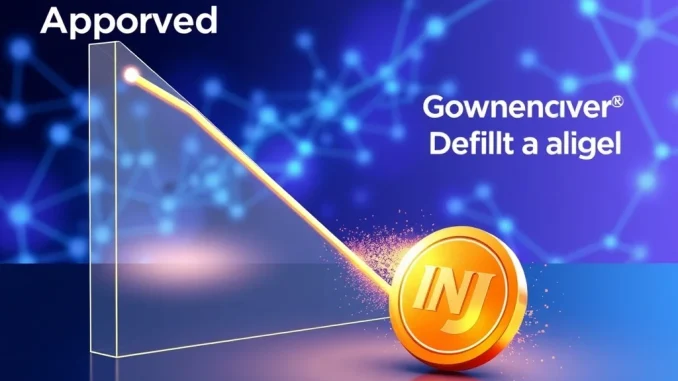
In a decisive move that signals a significant evolution in blockchain tokenomics, the Injective community has overwhelmingly approved a governance proposal to fundamentally alter the economic structure of its native INJ token. This landmark decision, confirmed on March 15, 2025, transitions the cryptocurrency from its current inflationary model to a strictly deflationary framework, permanently limiting new token issuance while dramatically enhancing existing burn mechanisms. The proposal passed with near-unanimous support, securing 99.9% of the community vote according to verified on-chain governance data.
Injective INJ Token Supply Reduction Proposal Details
The approved governance proposal authorizes Injective developers to implement a critical on-chain update to the protocol’s token inflation parameters. This technical adjustment represents a fundamental shift in how the network manages its native cryptocurrency. Specifically, the update will implement a permanent cap on new INJ issuance through algorithmic controls embedded directly in the blockchain’s consensus mechanism. Furthermore, the proposal strengthens existing token burn mechanisms that automatically remove INJ from circulation during specific network activities.
Since its mainnet launch, Injective has already demonstrated a commitment to supply management through its burn mechanics. Network data reveals the protocol has permanently removed approximately 6.85 million INJ tokens from circulation. This existing burn track record provided the community with concrete evidence of the mechanism’s functionality before voting on the more aggressive deflationary shift. The new parameters aim to accelerate this supply reduction trend systematically.
Understanding the Deflationary Crypto Model Transition
The transition to a deflationary model represents a deliberate strategic pivot within the broader cryptocurrency landscape. Unlike traditional inflationary models where new tokens continuously enter circulation, potentially diluting holder value, deflationary models actively reduce the total available supply over time. This economic approach creates inherent scarcity, a principle that often correlates with increased asset valuation in traditional economics, assuming constant or growing demand.
Injective’s move follows a growing trend among layer-1 and layer-2 blockchain protocols to refine their tokenomic structures post-launch. For instance, Ethereum’s implementation of EIP-1559 introduced a similar burn mechanism for its base fee, making ETH somewhat deflationary under certain network conditions. However, Injective’s proposal is more comprehensive, directly targeting and permanently limiting the core inflation schedule rather than just burning transaction fees.
- Supply Cap Implementation: The update will hard-code a maximum supply limit into the protocol.
- Enhanced Burn Triggers: Expanding the network activities that automatically trigger token burns.
- Parameter Adjustment: Modifying the rate and conditions of both issuance and burning.
Expert Analysis of Tokenomic Shifts
Blockchain economists note that such governance decisions reflect the maturing nature of decentralized ecosystems. “Community-led changes to core economic parameters demonstrate a high level of protocol sophistication and holder alignment,” explains Dr. Lena Schmidt, a tokenomics researcher at the Digital Asset Research Institute. “The near-unanimous vote suggests strong consensus on the strategic direction, which is crucial for long-term network stability. Historically, successful supply reduction mechanisms require robust community support to prevent governance forks or ecosystem fragmentation.”
The decision also carries implications for network security. Many proof-of-stake networks, including Injective, use token emissions to reward validators who secure the chain. Reducing new issuance necessitates a careful re-evaluation of validator incentives to ensure network security remains uncompromised. The proposal reportedly includes provisions to maintain sufficient staking rewards through alternative means, potentially reallocating a portion of transaction fees or treasury funds.
Historical Context and Market Impact of Supply Changes
To understand the potential impact of Injective’s decision, it is instructive to examine historical precedents within the cryptocurrency sector. Notable examples of successful supply-limiting mechanisms provide relevant context.
| Protocol | Supply Mechanism Change | Key Outcome |
|---|---|---|
| Bitcoin (BTC) | Fixed supply cap of 21 million | Established scarcity as a core value proposition |
| Binance Coin (BNB) | Quarterly burns until 50% supply destroyed | Created predictable deflationary pressure |
| Ethereum (ETH) | EIP-1559 fee burn mechanism | Shifted to potentially deflationary issuance |
The immediate market reaction to such governance votes often provides insight into investor sentiment. While past performance does not guarantee future results, analogous events in other protocols have frequently preceded periods of increased market attention and volatility. The psychological impact of scarcity should not be underestimated, as it directly influences both trader behavior and long-term holder conviction.
Furthermore, this governance action reinforces Injective’s position within the competitive landscape of decentralized finance (DeFi) and blockchain interoperability. Protocols with clear, community-managed economic policies often attract more institutional and sophisticated retail interest. The transparency of the on-chain vote, verifiable by any network participant, adds a layer of legitimacy that is increasingly valued in the regulatory environment of 2025.
Technical Implementation and Network Upgrade Process
The transition from proposal approval to live implementation involves several technical stages. First, core developers will draft the specific code changes required to modify the inflation parameters within the Injective protocol’s consensus layer. This code will then undergo rigorous auditing by both internal teams and independent third-party security firms to identify any potential vulnerabilities or unintended consequences.
Following successful audits, the updated software will be released to network validators. Validators, who are responsible for running the nodes that process transactions and create new blocks, must then adopt the new software version. Typically, a governance-approved upgrade like this includes a specified block height at which the new rules become active. This coordinated activation ensures all network participants transition simultaneously, maintaining consensus and preventing chain splits.
The upgrade’s success will be measurable through on-chain metrics. Analysts will monitor the new token issuance rate to confirm it aligns with the approved parameters. Similarly, they will track the enhanced burn mechanism’s activity across various network functions like decentralized exchange (DEX) trading, derivatives market fees, and other protocol-specific utilities. This data will provide real-time validation of the economic shift.
The Role of Community Governance in Blockchain Evolution
This event highlights the critical role of decentralized governance in the evolution of blockchain protocols. Injective, like many modern networks, empowers its token holders to propose and vote on changes to the protocol’s core functionality. This process moves beyond simple token holder voting; it represents a sophisticated form of digital stakeholder democracy where economic incentives align with decision-making power.
The overwhelming 99.9% approval rate is particularly noteworthy. Such consensus indicates exceptionally strong alignment between the development team’s roadmap and the community’s economic interests. It also minimizes the risk of contentious hard forks, where dissenting groups might create competing versions of the blockchain. High-approval governance votes generally contribute to ecosystem stability and reduce uncertainty for developers building on the platform.
Conclusion
The Injective community’s decisive approval to reduce the INJ token supply and implement a deflationary model marks a pivotal moment in the protocol’s development. This governance action demonstrates a mature, forward-looking approach to tokenomics, prioritizing long-term scarcity and value accrual mechanisms. By permanently limiting new issuance and enhancing burn functions, Injective aligns its economic model with principles of digital scarcity that have historically underpinned value in the cryptocurrency space. The successful execution of this upgrade will serve as a significant case study for other blockchain communities considering similar economic transformations, reinforcing the power of decentralized governance to enact fundamental protocol changes.
FAQs
Q1: What does a ‘deflationary model’ mean for the INJ token?
A deflationary model means the total circulating supply of INJ tokens will decrease over time. The protocol achieves this by burning (permanently destroying) tokens from circulation at a rate that exceeds the creation of new tokens, creating inherent scarcity.
Q2: How was the governance proposal approved?
The proposal was approved through Injective’s on-chain governance system. INJ token holders cast their votes, and the measure passed with 99.9% support, as recorded immutably on the blockchain.
Q3: What triggers the INJ token burn mechanism?
Token burns are triggered automatically by specific network activities. These typically include a portion of fees generated from trading on Injective’s native decentralized exchange, fees from its derivatives platform, and other protocol-related transactions, as defined by the updated parameters.
Q4: Will reducing new INJ issuance affect network security?
The proposal includes measures to ensure network security remains robust. While staking rewards from new issuance may decrease, the protocol can reallocate other sources of value, such as transaction fees, to validators to maintain sufficient incentives for securing the network.
Q5: How does this change affect existing INJ holders?
For existing holders, the deflationary model aims to increase the scarcity of each token over time, which, all else being equal, could support the value of their holdings. It represents a long-term structural shift in the token’s economics, emphasizing scarcity over inflation.
Updated insights and analysis added for better clarity.
This article was produced with AI assistance and reviewed by our editorial team for accuracy and quality.