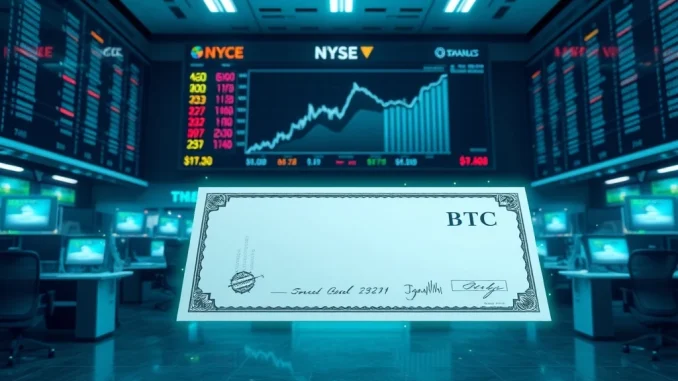
ATLANTA & VICTORIA, SEYCHELLES – March 15, 2026. In a landmark move for financial markets, the Intercontinental Exchange (ICE) has acquired a strategic stake in the cryptocurrency exchange OKX at a staggering $25 billion valuation. This unprecedented investment, confirmed by both companies today, directly aims to build a global platform for trading tokenized versions of New York Stock Exchange equities. Consequently, the deal bridges the world’s largest stock exchange operator with leading blockchain trading infrastructure, signaling a seismic shift in how traditional assets are owned and transferred.
ICE Strategic Investment in OKX Details and Immediate Implications
The transaction grants ICE, the parent company of the New York Stock Exchange, a significant minority position in OKX and includes a seat on the crypto exchange’s board of directors. Financial analysts from Bloomberg Intelligence estimate the cash and stock investment to be in the range of $500 million to $750 million. “This isn’t just a financial investment; it’s an infrastructure partnership,” stated Jeffrey Sprecher, ICE Chairman, in an official press release. “Our goal is to leverage OKX’s global reach and technological stack to create a compliant, institutional-grade venue for tokenized securities.” The partnership will initially focus on creating digital twins of highly liquid U.S. blue-chip stocks, enabling 24/7 trading and settlement potentially within minutes.
This development follows a two-year period of intense regulatory clarification and technological maturation. Previously, in late 2024, ICE had piloted a tokenized U.S. Treasury bond program on its Bakkt platform. Meanwhile, OKX has aggressively expanded its spot and derivatives trading services beyond retail users, securing regulatory approvals in Dubai and the Bahamas. The timeline for the first tokenized stock trades is projected for Q4 2026, pending final regulatory nods from the SEC and other global watchdogs.
Impact on Global Finance and Tokenized Asset Trading
The collaboration fundamentally alters the competitive landscape for both traditional finance (TradFi) and decentralized finance (DeFi). Primarily, it provides a credible, regulated on-ramp for institutional capital seeking exposure to blockchain-based asset representation. A report by Boston Consulting Group projects the tokenized asset market could reach $16 trillion by 2030, and this move positions ICE-OKX at the forefront. The immediate impacts are threefold.
- Market Structure Evolution: Trading hours for major equities could effectively become continuous, challenging the dominance of traditional pre-market and after-hours sessions. Settlement risk, a perennial concern, may be drastically reduced.
- Global Access Redefined: Investors in jurisdictions with limited access to U.S. brokerages could gain exposure to NYSE-listed companies via OKX’s existing global user base, which exceeds 50 million according to their latest transparency report.
- Regulatory Scrutiny Intensifies: The deal will pressure regulators worldwide to accelerate frameworks for security token offerings (STOs) and define clear custody rules for institutional digital assets.
Expert Analysis and Institutional Response
Market reaction has been sharply divided along traditional and crypto-native lines. “This validates the entire thesis of asset tokenization,” said Cathie Wood, CEO of ARK Invest, in a CNBC interview. “ICE would not stake its reputation without absolute confidence in the technology and the regulatory pathway.” Conversely, some traditional finance veterans urge caution. A research note from J.P. Morgan analysts highlighted operational risks, stating, “While the strategic intent is clear, the integration of legacy clearing systems with blockchain rails presents non-trivial challenges. Success hinges on flawless execution.” The SEC has not issued a formal comment but referenced its ongoing work on digital asset securities frameworks in a generic statement to The Wall Street Journal.
Broader Context: The Race for Tokenization Supremacy
The ICE-OKX alliance is not occurring in a vacuum. It represents the most direct challenge yet to other institutional efforts to tokenize real-world assets (RWAs). For instance, BlackRock’s BUIDL tokenized treasury fund on Ethereum has attracted over $1 billion in assets. Similarly, major European banks like Santander and Société Générale have launched euro-denominated bond tokens. The table below contrasts key approaches.
| Initiative | Lead Entity | Asset Focus | Current Scale |
|---|---|---|---|
| ICE-OKX Partnership | Intercontinental Exchange | Tokenized Equities (NYSE) | Announced ($25B Val.) |
| BlackRock BUIDL | BlackRock | U.S. Treasury Bonds | ~$1.1B Assets |
| Santander Digital Bond | Banco Santander | Corporate Bonds (EUR) | Pilot Phase |
| Ondo Finance USDY | Ondo Finance | Yield-Bearing Stablecoins | ~$500M Assets |
What Happens Next: Roadmap and Industry Ripples
The confirmed next step is the formation of a joint technical working group, drawing engineers from ICE’s fixed income data services and OKX’s Web3 wallet and layer-2 development teams. Their first deliverable will be a white paper detailing the proposed technical standard and compliance model, expected by March 2026. Furthermore, ICE’s existing network of over 100 clearing houses and data feeds globally provides a ready-made distribution channel that OKX previously lacked. Industry observers anticipate a wave of similar strategic partnerships, as other major exchanges like CME Group or Deutsche Börse may seek their own crypto allies to avoid being left behind.
Stakeholder and Market Participant Reactions
Reactions from the crypto community have been overwhelmingly positive, viewing it as a long-awaited endorsement from Wall Street’s apex. “This is the ‘Netscape moment’ for on-chain finance,” tweeted a prominent crypto fund manager. However, some decentralized finance purists express concern about increasing centralization and the potential for the partnership to create a “walled garden” that contradicts blockchain’s open ethos. Traditional brokerage firms are monitoring the situation closely; while some see a new revenue stream, others fear disintermediation if clients can trade tokenized stocks directly on a crypto platform.
Conclusion
The ICE investment in OKX at a $25 billion valuation is far more than a headline-grabbing deal. It is a strategic pivot that merges the credibility and scale of traditional market infrastructure with the efficiency and innovation of blockchain technology. The primary goal of expanding global tokenized stock trading now has a formidable champion. Key takeaways include the accelerated timeline for institutional crypto adoption, the impending transformation of equity market mechanics, and the heightened urgency for comprehensive digital asset regulation. Moving forward, the success of this ambitious venture will depend on seamless technical integration, clear regulatory green lights, and ultimately, sustained demand from a new generation of global investors. The race to define the future of asset ownership has entered a decisive new phase.
Frequently Asked Questions
Q1: What does ICE investing in OKX mean for the average stock investor?
In the medium term, it could lead to new ways of accessing U.S. stocks, potentially with faster settlement and 24/7 trading availability through crypto exchanges. However, initial products will likely target institutional and accredited investors first.
Q2: How will tokenized stocks on OKX be different from buying stocks on Robinhood or Fidelity?
The underlying ownership right may be similar, but the representation is different. A tokenized stock is a digital certificate on a blockchain, enabling programmable features, potentially instant cross-border transfer, and integration with other blockchain-based financial services, unlike a traditional brokerage entry.
Q3: When can we expect to actually trade a tokenized Apple or Microsoft stock through this partnership?
Based on official statements, a pilot program for select tokenized equities is targeted for the fourth quarter of 2026, pending regulatory approvals from the U.S. Securities and Exchange Commission and other international bodies.
Q4: Is my money safe if I trade tokenized stocks on a crypto exchange?
This is a central question for regulators. The partnership emphasizes building a “compliant, institutional-grade” platform, which would involve rigorous custody solutions, insurance, and adherence to securities laws—standards that current crypto exchanges vary on.
Q5: How does this affect other cryptocurrencies like Bitcoin or Ethereum?
It could be broadly positive by bringing massive new user bases and legitimacy to the crypto ecosystem. The blockchain networks used for tokenization (possibly private or public layer-2s) may see increased activity and value. It positions crypto infrastructure as essential for the next era of finance.
Q6: What are the biggest hurdles this ICE-OKX partnership still needs to overcome?
The three largest hurdles are: 1) Obtaining clear regulatory approval from multiple national authorities, 2) Technically integrating ICE’s legacy systems with blockchain networks without creating security vulnerabilities, and 3) Convincing large, conservative institutional asset managers to custody and trade assets in this new format.
Updated insights and analysis added for better clarity.
This article was produced with AI assistance and reviewed by our editorial team for accuracy and quality.