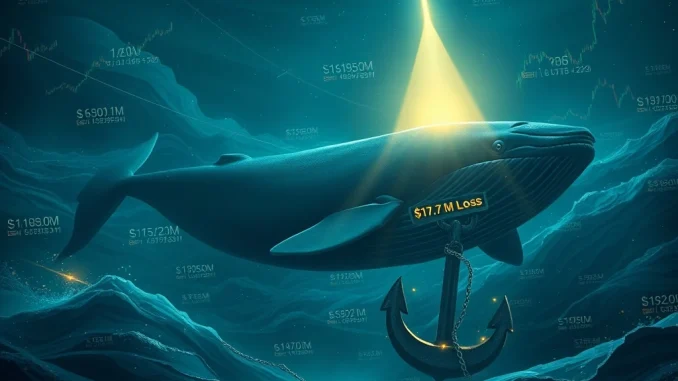
On-chain, March 2025: A single, high-stakes transaction has illuminated the perilous edge of decentralized finance leverage. Blockchain data reveals a major trader, colloquially known as a ‘whale,’ injected $1.2 million in USDC stablecoin into the HyperLiquid perpetual futures platform. This capital infusion was a defensive maneuver to protect a heavily leveraged long position in the HYPE token, a position reportedly carrying an unrealized loss of $16.7 million and over $1.6 million in cumulative funding costs. The move underscores the intense pressure and complex risk management at play in crypto’s leveraged trading arenas, where fortunes can pivot on a single price tick.
Anatomy of a High-Stakes HyperLiquid Rescue
The transaction, visible on-chain, shows a clear sequence of events. A wallet address controlled by the large trader transferred the substantial sum of USDC to its account on HyperLiquid. This platform specializes in perpetual futures contracts, allowing traders to take leveraged positions on cryptocurrency prices without an expiry date. The whale held a 5x leveraged long position on HYPE, meaning for every $1 of their own capital, they controlled $5 worth of the token. While leverage amplifies gains, it also dramatically accelerates losses and brings the holder closer to a liquidation threshold—the price point at which the exchange automatically closes the position to prevent debt.
By depositing fresh capital, the whale increased their account’s collateral. This action effectively lowers the liquidation price, giving the HYPE position more room to breathe before facing automatic closure. It is a classic, though costly, strategy in futures trading known as ‘adding to a losing position’ or ‘defending a margin.’ The data suggests the trader believed the market would eventually reverse in their favor, justifying the additional $1.2 million risk to save a much larger, though currently unrealized, investment.
The Crushing Weight of Leverage and Funding Rates
Two critical factors compound the whale’s dilemma: leverage mechanics and funding costs. The 5x leverage means the position’s value is highly sensitive to HYPE’s price movements. A relatively small drop can trigger massive unrealized losses, as evidenced by the $16.7 million figure. More insidiously, perpetual contracts employ a funding rate mechanism to tether the contract price to the underlying asset’s spot price.
- Funding Rate Payments: When the market is heavily skewed towards longs (as signaled by this whale’s large position), longs pay a periodic fee to shorts. This $1.6 million cost represents a continuous drain on the trader’s collateral, paid every few hours, regardless of price movement.
- Death by a Thousand Cuts: These payments can erode a position’s health even if the asset’s price stagnates, creating a scenario where a trader is slowly bled dry while waiting for a rally.
The following table outlines the key pressures on the whale’s position:
| Pressure Factor | Description | Quantified Impact |
|---|---|---|
| Unrealized Loss | Loss on paper due to HYPE price decline below entry. | $16.7 Million |
| Funding Costs | Cumulative fees paid to hold the leveraged long. | $1.6 Million |
| New Collateral | Fresh USDC deposited to lower liquidation price. | $1.2 Million |
| Leverage Multiplier | Amplification factor for both gains and losses. | 5x |
Historical Context and the Psychology of Whale Trades
This event is not an isolated incident in cryptocurrency history. Similar defensive deposits have been observed during major market downturns, such as the Luna/Terra collapse in 2022 or the FTX-induced volatility in late 2022. Large traders often face a psychological trap known as the ‘sunk cost fallacy,’ where prior investments justify escalating commitment to a failing course of action. On-chain analysts monitor these moves closely, as a successful defense can signal a local market bottom if the whale’s conviction proves correct. Conversely, a subsequent liquidation can trigger cascading sell-offs, exacerbating downward price movement for the asset and potentially related tokens in the whale’s portfolio.
The public nature of blockchain data transforms these high-stakes financial decisions into transparent case studies. They provide real-time lessons on risk management, the severe consequences of high leverage in volatile markets, and the immense capital required to move against prevailing market trends. For retail traders, observing such events serves as a stark reminder of the asymmetry in resources and risk tolerance between different market participants.
Implications for HyperLiquid and DeFi Risk Models
This incident also highlights the evolving role of decentralized exchanges like HyperLiquid. As on-chain trading volumes grow, the protocols themselves must manage systemic risk. A liquidation of this magnitude would have been processed entirely by the platform’s smart contracts, potentially testing its liquidity depth and stability mechanisms. The whale’s decision to add collateral, therefore, not only protects their own capital but also temporarily mitigates a risk event for the protocol and its other users.
Furthermore, it underscores a key narrative in decentralized finance: the migration of sophisticated, institutional-grade trading strategies onto transparent, non-custodial platforms. The tools—leverage, perpetuals, complex collateral management—are now available in a permissionless environment. This democratizes access but also democratizes the potential for catastrophic loss, all played out on a public ledger for anyone to scrutinize.
Conclusion
The HyperLiquid whale‘s $1.2 million deposit is a dramatic example of modern financial warfare waged on the blockchain. It represents a calculated, high-conviction bet to salvage a position deep underwater, battling both market price and relentless funding costs. While the ultimate outcome for this specific HYPE long remains tied to the token’s future price action, the event itself is a powerful tutorial on the mechanics and immense risks of leveraged trading in cryptocurrency. It reinforces the critical importance of understanding liquidation mechanics, the true cost of leverage, and the profound psychological pressures faced by large-scale market participants, all visible through the unambiguous lens of on-chain data.
FAQs
Q1: What is a ‘whale’ in cryptocurrency?
A whale is a term for an individual or entity that holds a large enough amount of a particular cryptocurrency that their trading activity can significantly influence the market price.
Q2: What does a 5x long position mean?
It means the trader is using leverage to control a position worth five times their initial collateral. They profit five times more if the price goes up but lose five times more if it goes down, accelerating the path to liquidation.
Q3: What are funding costs in perpetual futures?
Funding costs are periodic payments exchanged between long and short traders to ensure the perpetual contract’s price stays aligned with the spot price. The side with more open interest typically pays the side with less.
Q4: Why would someone add money to a losing trade?
By adding more collateral (margin), a trader lowers the liquidation price of their position. This gives the asset more room to fluctuate and potentially recover before the exchange automatically closes the trade at a total loss.
Q5: What happens if the whale’s position is liquidated on HyperLiquid?
The platform’s smart contracts would automatically sell the position’s collateral to close it. This could create a large market sell order for HYPE, potentially driving its price down further and affecting other traders.
This article was produced with AI assistance and reviewed by our editorial team for accuracy and quality.