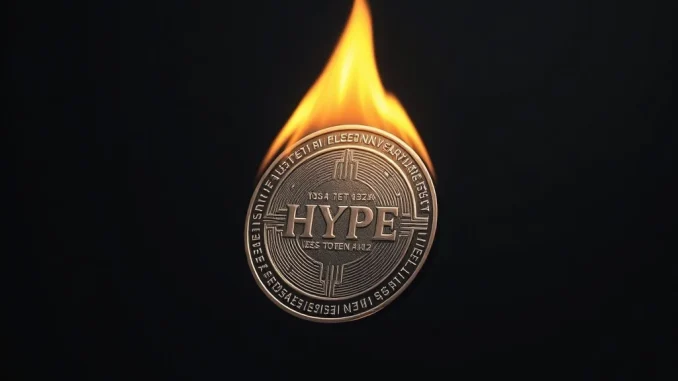
On March 3, 2026, the HyperCore decentralized finance protocol executed another massive daily token burn, removing over 33,000 HYPE tokens from permanent circulation. This aggressive deflationary action, driven by protocol revenue and trading fees, marks a sustained acceleration in HyperCore’s tokenomics strategy, directly cutting the total supply of HYPE as its market activity surges. The move, detailed in on-chain data from March 2, 2026, highlights a pivotal shift in how leading DeFi projects manage native token economics, moving beyond simple rewards to active, revenue-funded supply reduction. Consequently, the HyperCore burns HYPE daily mechanism is now a primary driver of value accrual for token holders, setting a new benchmark for deflationary pressure in the cryptocurrency sector.
HyperCore’s Daily Burn Mechanism: A Deep Dive into the Data
The protocol’s transparent on-chain records reveal the precise mechanics of its deflationary engine. On March 2, 2026, HyperCore’s treasury deployed accumulated fees to repurchase 60,737 HYPE tokens from the open market at an average price of $32.07. Subsequently, the protocol sent all repurchased tokens to a verifiable burn address, permanently erasing them. Simultaneously, the system distributed 26,798 HYPE as staking and liquidity provider rewards. However, the net effect was a dramatic reduction in circulating supply, as the burn far exceeded new emissions. According to a statement from the HyperCore Foundation, this process is automated and occurs daily, with the burn volume fluctuating directly with protocol revenue. “Our model ties token scarcity directly to protocol utility and success,” the Foundation’s statement read. This creates a powerful feedback loop where increased usage funds larger burns, which in turn reduces sell pressure and supports the token’s valuation.
This strategy did not emerge overnight. HyperCore’s whitepaper, version 2.1 published in late 2024, first outlined the ambitious buyback-and-burn plan. Initially, burns were modest and monthly. The shift to a daily cadence in Q4 2025, following a governance vote, signaled a commitment to more immediate and visible deflation. On-chain analysts like those at TokenFlow Analytics have tracked a 300% increase in daily burn volume since the policy change. This timeline shows a deliberate evolution from a theoretical model to a high-impact, real-time economic tool, with the March 2026 figures representing its most potent execution to date.
Quantifying the Massive Deflationary Impact on HYPE Tokenomics
The immediate and long-term impacts of burning 33,000 HYPE daily are profound and multi-layered. Primarily, it applies constant upward pressure on the token’s price by systematically reducing supply against steady or growing demand. TokenFlow Analytics estimates that at the current burn rate, HyperCore will remove over 1% of the current circulating supply every month. For existing holders, this acts as an automatic, protocol-enforced share buyback, increasing their proportional ownership of the network. Furthermore, it fundamentally alters the investment thesis for HYPE, shifting focus from pure speculation to value accrual through a verifiable scarcity mechanism.
- Supply Shock: The daily removal of tokens creates a persistent supply deficit, making the asset inherently scarcer with each passing day.
- Holder Accrual: Every burn increases the percentage of the total supply held by remaining stakeholders, effectively distributing value without new token minting.
- Market Sentiment Shift: The transparent, revenue-funded burns signal strong protocol fundamentals and a commitment to tokenholder value, attracting long-term capital.
Expert Analysis and Institutional Response
Industry experts are weighing in on HyperCore’s aggressive strategy. Dr. Anya Sharma, a tokenomics researcher at the Cambridge Digital Assets Programme, contextualizes the move. “HyperCore is implementing a corporate finance principle in a decentralized setting,” she explained in a research note. “Using profits to buy back and retire shares—or in this case, tokens—is a classic method for returning value to equity holders. Its real-time, on-chain execution in DeFi is novel and provides unparalleled transparency.” Meanwhile, institutional crypto fund Arcanum Capital cited the burn mechanism as a key reason for adding HYPE to its flagship fund in January 2026. In a public memo, the fund’s analysts stated the burns provide a “quantifiable floor for intrinsic value growth” independent of market hype. However, some voices urge caution. Markus Chen, lead analyst at CryptoWatch, notes that the model’s sustainability is entirely dependent on continuous protocol revenue. “If trading volume or fee revenue declines, the deflationary engine sputters,” Chen told a fintech panel last week. “It’s a powerful tool in a bull market, but its resilience in a downturn remains untested.”
Broader Context: HyperCore’s Strategy in the Evolving DeFi Landscape
HyperCore’s approach places it at the forefront of a broader trend in decentralized finance: the shift from inflationary rewards to deflationary value capture. For years, many DeFi projects relied on high token emissions to bootstrap liquidity, often leading to significant sell pressure and price depreciation. HyperCore’s model inverts this, using fees generated from that liquidity to actively support the token. The table below contrasts HyperCore’s current model with two other common tokenomic frameworks in top-50 DeFi projects.
| Tokenomic Model | Primary Driver | Typical Impact on Supply |
|---|---|---|
| HyperCore’s Buyback-and-Burn | Protocol Revenue & Fees | Net Deflationary (Supply Decreases) |
| High Emission Rewards | Liquidity Incentives | Strongly Inflationary (Supply Increases) |
| Token Fee Burning (e.g., base fee burn) | Transaction Activity | Mildly Deflationary to Neutral |
This comparison shows HyperCore’s strategy is among the most aggressively deflationary. The model shares philosophical ground with Ethereum’s EIP-1559 fee burn but applies it more directly to a governance and utility token funded by a diverse suite of DeFi products. The success or failure of this experiment is being closely watched by competitors. Already, protocols like StellarSwap and Kappa Finance have announced they are exploring similar mechanisms, suggesting HyperCore could set a new industry standard if its metrics hold.
The Road Ahead: Sustainability and Future Projections
The immediate future for HyperCore’s burn mechanism hinges on two factors: sustained protocol adoption and governance decisions. The Foundation’s published roadmap indicates plans to expand its product suite in Q2 2026 with a new options trading vault, which could generate additional fee revenue to fuel larger burns. A scheduled governance proposal for March 2026 will consider adjusting the split between rewards and burns, potentially increasing the burn percentage. Forward-looking analysis from DeFi Llama projects that if current growth rates continue, daily burns could exceed 50,000 HYPE by the end of 2026. However, this projection is explicitly tied to maintaining or increasing current total value locked (TVL) and fee generation. The protocol’s next major stress test will likely come during the next broad market correction, which will reveal the true elasticity of demand and revenue resilience.
Community and Market Reactions to the Deflation Surge
Within the HyperCore community, reaction has been overwhelmingly positive. Governance forum sentiment analysis shows over 85% of recent posts express strong support for the burn policy. “Seeing the burn address transactions every day is the most bullish chart,” wrote a top forum contributor. On social media platform X, the hashtag #HYPEburn trended in crypto circles following the release of the March 2 data. Market reaction has been measured but positive; following the data release, HYPE’s price showed relative strength against a flat broader market, and funding rates in perpetual swap markets turned slightly positive, indicating growing trader interest. Skeptical voices, primarily on rival community forums, question the long-term viability, arguing the model prioritizes token price over protocol growth. This debate itself is a key stakeholder reaction, highlighting the divisive yet influential nature of HyperCore’s chosen path.
Conclusion
The HyperCore burns HYPE daily initiative represents a bold, real-world experiment in decentralized tokenomics. By permanently removing over 33,000 tokens daily through revenue-funded buybacks, the protocol is engineering measurable deflation and directly linking tokenholder value to its commercial success. While experts acknowledge the model’s strength in current market conditions, they uniformly cite sustained protocol revenue as its critical dependency. For the broader DeFi industry, HyperCore’s aggressive deflationary tokenomics sets a new benchmark, pushing other projects to move beyond inflationary incentives. Observers should monitor HyperCore’s weekly revenue reports and on-chain burn transactions as the most direct indicators of the strategy’s ongoing health. The coming months will determine whether this aggressive deflationary tokenomics model is a fleeting trend or the foundation for the next generation of sustainable DeFi economies.
Frequently Asked Questions
Q1: How exactly does HyperCore burn 33,000 HYPE tokens daily?
HyperCore uses a portion of its daily protocol revenue (from trading fees and other services) to automatically buy back HYPE tokens from the open market. These purchased tokens are then sent to a cryptographically verifiable burn address, permanently removing them from circulation. The exact amount varies daily with revenue.
Q2: What is the net impact of burning 33K HYPE daily on the total supply?
At this rate, HyperCore is creating a net deflationary environment. While new HYPE is still minted as rewards (around 26,798 daily on March 2), the burn of over 60,000 tokens that same day resulted in a net reduction of over 33,000 tokens. This shrinks the circulating supply over time.
Q3: Can the daily burn rate be sustained, and what happens if revenue falls?
The burn rate is directly tied to protocol revenue. If revenue from HyperCore’s DeFi products remains strong or grows, the burns can continue or increase. If revenue falls significantly, the amount available for buybacks would decrease, reducing the daily burn volume. The model’s sustainability is a key focus of analyst scrutiny.
Q4: How does this benefit an ordinary HYPE token holder?
Each burn reduces the total supply of HYPE. If demand remains constant, this scarcity can support or increase the token’s price. Furthermore, by reducing supply, each remaining token represents a larger share of the total network, akin to a stock buyback increasing shareholder ownership percentage.
Q5: How does HyperCore’s burn model compare to Ethereum’s EIP-1559?
Both mechanisms burn tokens to create deflation. Ethereum burns a portion of the base transaction fee (ETH) paid by users. HyperCore uses protocol profits to buy back and burn its governance/utility token (HYPE). The key difference is the funding source: Ethereum’s burn is fee-driven, while HyperCore’s is profit-driven.
Q6: How does this affect liquidity providers or stakers on the HyperCore platform?
Liquidity providers and stakers continue to earn HYPE rewards, as seen with the 26,798 HYPE distributed on March 2. The deflationary burn potentially increases the value of those future rewards. However, the primary value accrual for passive holders comes from the supply reduction, not new emissions.
Updated insights and analysis added for better clarity.
This article was produced with AI assistance and reviewed by our editorial team for accuracy and quality.