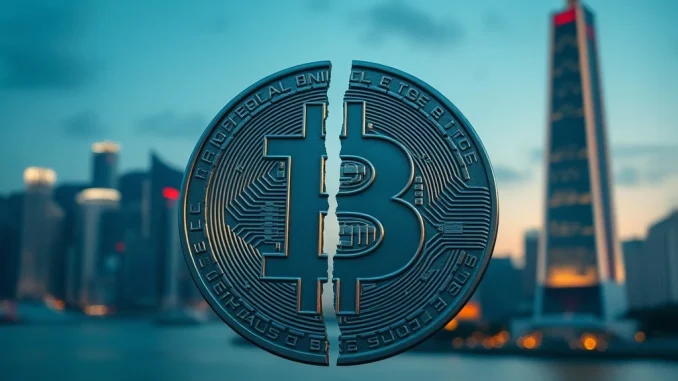
HONG KONG/SOUTH KOREA — February 9, 2026: A potential multi-billion dollar leveraged trade implosion by a Hong Kong-based fund and a staggering $42.5 billion administrative error at South Korea’s Bithumb exchange have sent shockwaves through Asian cryptocurrency markets this week. Industry analysts are scrambling to connect the dots between a theorized Bitcoin ETF blowup that may have accelerated Bitcoin’s slide toward $60,000 and a ‘phantom’ Bitcoin incident that questions fundamental exchange custody practices. These parallel crises underscore the growing systemic risks emerging from the intersection of traditional finance leverage and digital asset infrastructure.
The Hong Kong Fund Theory: A Leveraged Bitcoin ETF Unwind
A viral market theory, first articulated by Parker White, chief of operations at DeFi Development Corp, suggests a Hong Kong fund’s collapse triggered Thursday’s cross-asset sell-off. The hypothesis centers on the fund’s use of cheap Japanese yen funding to execute leveraged options trades on BlackRock’s spot Bitcoin ETF (IBIT). Consequently, IBIT recorded a historic $10 billion in trading volume precisely as Bitcoin touched weekly lows. White noted the curious absence of massive liquidations on centralized exchanges, pointing instead to stress among large IBIT holders. “We know that Asian traders, particularly in China, have been deeply involved in the Silver and Gold trade,” White stated. “We also know that the JPY carry trade has been unwinding at an increasingly rapid pace.”
Franklin Bi, General Partner at Pantera Capital, corroborated the theory’s plausibility, highlighting how such activity could fly under the crypto market’s radar. The structure is critical: funds holding concentrated IBIT positions, rather than diversified baskets, often use such single-asset vehicles to isolate margin risk. This context suggests a fund borrowed yen, bought bullish IBIT options betting on a Bitcoin rebound, and faced forced liquidation as losses mounted and funding conditions tightened. The market awaits May’s Form 13F filings for definitive proof, but the theory already links Thursday’s simultaneous plunges in Bitcoin and silver to a broader, yen-funded cross-asset margin unwind.
Bithumb’s $42.5 Billion ‘Phantom’ Bitcoin Debacle
Meanwhile, South Korean regulators have launched on-site inspections at Bithumb following an operational catastrophe. During a promotional campaign, a ‘fat finger’ error distributed roughly 620,000 BTC—worth nearly $42.5 billion—to users, with some receiving over 2,000 BTC each. Although Bithumb recovered 99.7% of the assets, users managed to sell 1,788 BTC of what the exchange now calls ‘phantom’ Bitcoin. The deeper issue emerged from a mid-year filing: Bithumb reported holding only about 42,031 BTC in August. This figure is approximately 15 times less than the amount it erroneously distributed.
This discrepancy raises a fundamental question of custodial integrity. If Bithumb did not accumulate an additional 577,969 BTC after its filing, it distributed more Bitcoin to user accounts than it actually held in reserve. Under South Korea’s strict crypto user protection law, exchanges must hold all assets deposited by customers one-to-one. Financial Supervisory Service (FSS) governor Lee Chan-jin confirmed regulatory action is possible under existing rules. The incident has ignited a fierce debate about proof-of-reserves and real-time auditing requirements for major exchanges.
Expert Analysis: Systemic Implications and Regulatory Response
Market observers see these events as connected symptoms of maturation pains. “The Hong Kong theory shows how crypto volatility is now transmitted through regulated, traditional finance vehicles like ETFs,” said a Singapore-based hedge fund analyst who requested anonymity. “A leveraged ETF blowup has a different contagion profile than a Celsius or FTX collapse—it affects different counterparties.” Regarding Bithumb, experts stress the technical versus legal definition of ‘holding.’ An exchange might use off-chain internal ledger entries for promotional rewards, but the law’s requirement is unambiguous. The FSS inspection will likely focus on whether this was a catastrophic software bug or a symptom of deeper reserve management issues.
Broader Market Context: Ether Whale Unwind and Japanese Policy
The week’s turbulence extended beyond Bitcoin. Trend Research, an aggressive Ether whale linked to Hong Kong’s Liquid Capital founder Yi Lihua (Jack Yi), completely unwound its massive leveraged position. After accumulating roughly 651,000 Aave-wrapped ETH by January’s end, the entity sold its entire holding as prices fell, leaving only $10,000 in USDC. Yi built the position by using ETH as collateral on Aave to borrow stablecoins and buy more ETH—a classic leveraged long strategy vulnerable to market dips. In a machine-translated post, Yi remained optimistic: “Pessimists are often right, but optimists win in the end,” he wrote, suggesting bear markets present accumulation opportunities.
In a contrasting positive development, Japan’s snap election reduced policy uncertainty. Prime Minister Sanae Takaichi’s Liberal Democratic Party secured a super-majority, providing clarity for ongoing crypto tax and regulatory discussions. Key debates include whether to shift crypto from the Payment Services Act to the Financial Instruments and Exchange Act—a move that would enable crypto ETFs—and if crypto gains should be taxed at a flat ~20% rate like securities, rather than the current top marginal rate of 55%. Finance Minister Satsuki Katayama has already signaled support for blockchain-based fintech initiatives, including ETFs.
| Event | Key Entity/Location | Estimated Scale/Impact |
|---|---|---|
| Potential ETF Leverage Unwind | Hong Kong Fund | Linked to $10B IBIT volume; theorized catalyst for BTC drop to ~$60,000 |
| ‘Phantom’ BTC Distribution | Bithumb (South Korea) | 620,000 BTC ($42.5B) erroneously sent; 1,788 BTC irrecoverably sold |
| Ether Whale Liquidation | Trend Research (Hong Kong) | Full unwind of ~651,000 ETH position; leveraged long strategy collapsed |
| Regulatory Election Outcome | Japan | Super-majority victory reduces uncertainty for crypto tax/ETF policy |
What Happens Next: Investigations and Market Recalibration
The immediate focus turns to verification and regulatory response. The Hong Kong fund theory will remain speculative until 13F filings in May reveal any fund’s dramatic reduction in IBIT holdings. Market participants will scrutinize yen funding costs and cross-asset correlations for further stress signals. In South Korea, the FSS’s on-site inspection at Bithumb will determine if the error was operational or custodial, potentially leading to sanctions and stricter real-time proof-of-reserves mandates for all domestic exchanges. The outcome could set a precedent for global exchange oversight.
Industry and Community Reactions
The crypto community’s reaction has been bifurcated. Traditional finance commentators express concern about the opacity of leverage in the new ETF ecosystem, calling for better reporting on options and derivatives linked to these products. Crypto-native observers, meanwhile, view the Bithumb incident as a stark reminder of exchange counterparty risk, bolstering arguments for decentralized custody and self-sovereign wallets. “These events aren’t about Bitcoin’s failure,” tweeted a popular analyst. “They’re about the failure of risky leverage and centralized control points around Bitcoin.”
Conclusion
The events of February 2026 reveal a cryptocurrency market at a complex crossroads. The potential Hong Kong fund blowup illustrates how digital asset volatility now propagates through regulated, traditional finance conduits, creating new vectors for contagion. Bithumb’s ‘phantom’ Bitcoin crisis, conversely, exposes enduring foundational risks within centralized custodial models. Together, they present regulators with a dual challenge: overseeing the integration of crypto into mainstream finance while ensuring the basic security and integrity of the platforms at its base. For investors, the lessons are clear—understand the leverage in your ETF, and know precisely where your exchange holds your assets. The market’s next moves will hinge on the credibility of the coming investigations and the industry’s commitment to building more resilient infrastructure.
Frequently Asked Questions
Q1: What is the main theory behind the recent Bitcoin sell-off?
The leading theory suggests a Hong Kong-based fund used cheap Japanese yen loans to take leveraged options positions on BlackRock’s IBIT Bitcoin ETF. As Bitcoin’s price fell and funding conditions tightened, this position was forcibly liquidated, contributing to the sell-off and IBIT’s record $10 billion trading volume.
Q2: How much Bitcoin did Bithumb mistakenly distribute, and why is it called ‘phantom’ BTC?
Bithumb’s error distributed approximately 620,000 BTC, worth $42.5 billion. It’s called ‘phantom’ Bitcoin because the amount distributed far exceeded the 42,031 BTC the exchange reported holding in its latest financial filing, suggesting users were credited with Bitcoin that may not have been fully backed in reserve.
Q3: What are the potential regulatory consequences for Bithumb in South Korea?
South Korea’s Financial Supervisory Service (FSS) has launched an on-site inspection. Under the country’s crypto user protection law, exchanges must hold 100% of customer assets. Bithumb could face sanctions, fines, and may be forced to adopt more stringent, real-time proof-of-reserves audits.
Q4: How does the unwinding of the Trend Research Ether position connect to these events?
Trend Research’s complete liquidation of its massive, leveraged ETH position exemplifies the same market dynamic of forced selling under pressure. It highlights how leveraged strategies, whether in ETFs or direct crypto holdings, amplified the recent market downturn across multiple assets.
Q5: What was the positive news from Japan’s election for cryptocurrency?
Japan’s snap election gave a super-majority to the ruling party, reducing political uncertainty. This stability supports ongoing efforts to reform crypto taxation (potentially lowering rates) and to reconsider the legal framework, which could pave the way for crypto ETFs in Japan.
Q6: When will we know for sure if a Hong Kong fund caused the ETF sell-off?
Definitive evidence may come in May 2026 when U.S. financial institutions file their Form 13F reports for Q1. These filings will show any fund’s significant changes in IBIT holdings, potentially confirming the liquidation theory.