In a potential landmark agreement for both the artificial intelligence and clean energy sectors, fusion startup Helion Energy is reportedly negotiating to supply substantial power to OpenAI, according to March 2026 reports. Both companies share backing from prominent tech investor Sam Altman, creating a strategic alignment that could accelerate commercial fusion deployment. The discussions, first reported by Axios, represent one of the most significant corporate power purchase agreements in fusion energy history.
Helion’s Proposed Power Deal with OpenAI
The preliminary agreement under discussion would guarantee OpenAI access to 12.5% of Helion’s projected electricity production. Specifically, this translates to five gigawatts by 2030 and fifty gigawatts by 2035. For context, five gigawatts could power approximately 3.75 million homes based on U.S. Energy Information Administration averages. Meanwhile, Microsoft, OpenAI’s primary partner, previously secured a similar arrangement with Helion in 2023 for power delivery starting in 2028.
These ambitious targets imply rapid scaling capabilities for Helion’s technology. The company’s reactors are designed to generate fifty megawatts each. Consequently, meeting the 2030 commitment would require constructing eight hundred reactors within four years. Furthermore, achieving the 2035 target demands an additional seventy-two hundred reactors in the subsequent five years. This aggressive timeline places Helion years ahead of most competitors targeting commercial operations in the early 2030s.
Helion’s Distinct Fusion Technology Approach
Most fusion energy companies pursue conventional approaches that harvest heat from fusion reactions to drive steam turbines. However, Helion employs a fundamentally different methodology. The company’s design utilizes magnetic fields to directly convert fusion energy into electricity. This innovative system could potentially offer higher efficiency than traditional heat-based methods.
The Technical Process Behind Helion’s Reactor
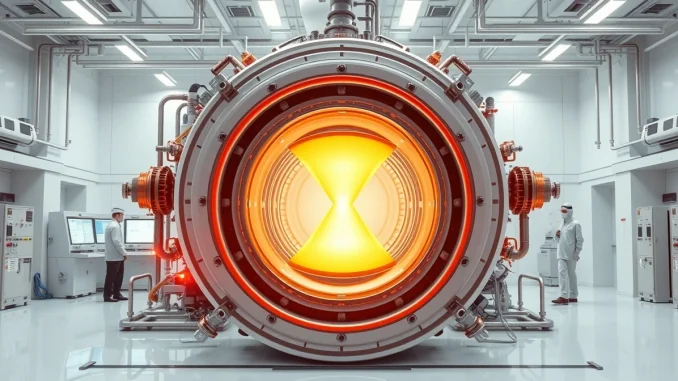
Helion’s hourglass-shaped reactor operates through a multi-stage process. First, fusion fuel converts into plasma at both ends of the chamber. Next, magnetic fields accelerate these plasma streams toward each other. When they collide at the center, additional magnets compress the merged plasma until fusion occurs. The reaction then pushes against the magnets, generating electrical current directly without steam intermediaries.
Currently, Helion operates its Polaris prototype reactor. In February 2026, the company announced it achieved plasma temperatures of 150 million degrees Celsius. This milestone approaches the 200 million degrees Celsius threshold Helion identifies as necessary for commercial operations. The company continues testing toward this critical temperature goal.
Strategic Connections Through Sam Altman
Sam Altman’s involvement creates a connective thread between these organizations. Altman participated in Helion’s $425 million funding round last year alongside investors including Mithril, Lightspeed, and SoftBank. Although Altman reportedly stepped down as Helion’s board chair and recused himself from these specific negotiations, his influence on the matchmaking remains evident.
This pattern mirrors Altman’s approach with Oklo, a small modular nuclear reactor startup. Last year, Altman resigned as board chair of Oklo following its merger with his acquisition company AltC. Oklo’s leadership stated this move would enable exploration of strategic partnerships with leading AI companies, potentially including OpenAI. These parallel developments suggest a coordinated strategy to secure clean, abundant power for energy-intensive AI operations.
Broader Context: AI’s Growing Energy Demands
Artificial intelligence models require substantial computational resources, translating to significant electricity consumption. Recent studies indicate that training large language models can consume megawatt-hours of power. Furthermore, inference operations during deployment create ongoing energy demands. Consequently, major AI companies actively seek reliable, scalable, and sustainable power sources.
Fusion energy offers particular advantages for this application. The technology promises continuous baseload power without carbon emissions. Additionally, fusion facilities typically require less land than equivalent solar or wind installations. These characteristics make fusion potentially ideal for powering data centers that host AI systems.
Industry Implications and Competitive Landscape
Helion’s reported timeline positions it ahead of numerous fusion competitors. Companies like Commonwealth Fusion Systems, TAE Technologies, and General Fusion target commercial demonstration in the early-to-mid 2030s. Meanwhile, international projects like ITER focus on research rather than commercial power generation. Helion’s aggressive schedule, if achieved, could establish early market dominance.
The potential OpenAI agreement follows increasing corporate investment in fusion energy. Amazon recently committed to purchasing power from fusion startup Zap Energy. Google has partnered with TAE Technologies on computational research. These developments indicate growing confidence among technology giants that fusion will become commercially viable within this decade.
Technical and Commercial Challenges Ahead
Despite promising developments, significant hurdles remain for Helion and the broader fusion industry. Engineering reliable containment of hundred-million-degree plasma presents immense technical challenges. Additionally, manufacturing thousands of reactors requires establishing complex supply chains and manufacturing facilities. Regulatory approval processes for novel nuclear technologies also present uncertainties.
Financial considerations add another layer of complexity. Constructing eight thousand reactors represents a capital investment likely exceeding tens of billions of dollars. Helion must secure substantial additional funding beyond its current $425 million war chest. The company’s ability to attract this investment will depend on continued technical progress and demonstration of commercial viability.
Environmental and Economic Impacts
Successful fusion deployment could transform global energy systems. Fusion generates electricity without greenhouse gas emissions during operation. The technology also produces minimal long-lived radioactive waste compared to conventional nuclear fission. Furthermore, fusion fuel sources like deuterium are abundant in seawater, offering essentially limitless supply.
Economically, fusion could stabilize electricity prices by providing predictable power costs over decades. For AI companies like OpenAI, this price stability enables more accurate long-term operational planning. Additionally, domestic fusion development enhances energy security by reducing dependence on imported fuels.
Conclusion
The reported discussions between Helion and OpenAI represent a potential convergence point for two transformative technologies: artificial intelligence and fusion energy. This Helion fusion power arrangement could provide OpenAI with the clean, scalable electricity required for advancing AI capabilities. Simultaneously, it offers Helion a committed customer to support its ambitious deployment timeline. While numerous technical and commercial challenges remain, this potential partnership illustrates how corporate power purchase agreements might accelerate fusion energy’s transition from laboratory experiment to commercial reality. The outcome of these negotiations could significantly influence both the AI industry’s environmental footprint and the timeline for fusion energy commercialization.
FAQs
Q1: What is the reported deal between Helion and OpenAI?
The reported agreement would guarantee OpenAI 12.5% of Helion’s electricity production, specifically five gigawatts by 2030 and fifty gigawatts by 2035, according to March 2026 reports.
Q2: How does Helion’s fusion technology differ from other approaches?
Unlike most fusion companies that use heat to create steam for turbines, Helion’s design uses magnetic fields to directly convert fusion energy into electricity, potentially offering higher efficiency.
Q3: What role does Sam Altman play in these companies?
Sam Altman has invested in both Helion and OpenAI. He reportedly stepped down as Helion’s board chair and recused himself from negotiations, but his involvement facilitated the connection between the companies.
Q4: Why would OpenAI need fusion power?
Artificial intelligence operations require substantial electricity for training and running models. Fusion offers continuous, carbon-free power that could meet AI’s growing energy demands sustainably.
Q5: How does Helion’s timeline compare to other fusion companies?
Helion aims for commercial-scale power by 2028, potentially years ahead of most competitors targeting the early 2030s for commercial operations.
Q6: What technical milestones has Helion recently achieved?
In February 2026, Helion announced its Polaris prototype achieved plasma temperatures of 150 million degrees Celsius, approaching the 200 million degrees needed for commercial operations.
Updated insights and analysis added for better clarity.
This article was produced with AI assistance and reviewed by our editorial team for accuracy and quality.