LONDON, March 2025 – A simmering geopolitical dispute over Greenland’s strategic future could trigger a devastating tariff war between the United States and the European Union, potentially dragging global GDP growth down to a concerning 2.6% according to a comprehensive new analysis from Oxford Economics. The U.K.-based research firm’s report outlines a high-stakes scenario where trade barriers escalate, delivering a significant shock to the world economy and threatening the fragile post-pandemic recovery.
Greenland Tariff War Scenario: A Detailed Economic Analysis
Oxford Economics constructed a detailed model examining the potential fallout from renewed U.S. interest in acquiring Greenland, a vast autonomous Danish territory. The firm analyzed a specific escalation path where the U.S. imposes substantial new tariffs—specifically an additional 25% levy—on imports from six key European Union nations. Consequently, this aggressive move would prompt immediate and escalating retaliatory measures from the EU bloc. The combined economic size of these two entities means the resulting trade disruption would not remain contained; instead, it would ripple through global supply chains and financial markets. The report’s central finding is stark: global economic expansion could slow to just 2.6%, a rate not seen since the 2009 financial crisis, excluding the anomalous 2020 pandemic year.
Projected Impacts on Major Economies
The direct economic consequences for the primary actors would be severe and immediate. Oxford Economics projects that U.S. GDP could fall by up to 1% from current baseline forecasts under their modeled scenario. This decline would stem from higher import costs for businesses and consumers, reduced export competitiveness, and general market uncertainty. Similarly, the Eurozone would experience a comparable negative impact on its economic output. However, European economies might feel the pain over a more extended period due to structural differences and potentially less agile policy responses. The interconnected nature of modern finance ensures that these regional downturns would quickly translate into reduced global trade volumes, lower business investment, and weakened consumer confidence worldwide.
Historical Context and Growth Trajectory Disruption
To understand the gravity of a 2.6% global growth rate, Oxford Economics provides crucial historical comparison. The global economy has maintained a relatively stable growth band of 2.8% to 2.9% over the past three years, a period marked by recovery from pandemic disruptions and adaptation to new technological paradigms. A drop to 2.6% would represent a meaningful deceleration, breaking this stability and signaling broader economic headwinds. The report emphasizes that this would mark the lowest growth level since the aftermath of the 2008-2009 global financial crisis, highlighting the severity of the potential disruption. This context is vital for policymakers and investors assessing risk.
Mechanisms of Global Economic Contagion
How would a bilateral U.S.-EU dispute cause worldwide economic damage? Oxford Economics identifies several transmission channels. First, global supply chains, already reconfigured after recent shocks, would face new bottlenecks and cost pressures. Second, financial markets would react to uncertainty with increased volatility, potentially tightening credit conditions. Third, reduced business confidence in the world’s two largest economic blocs would lead to postponed capital expenditures and hiring freezes. Finally, the report notes that emerging markets, which often depend on exports to advanced economies, would be particularly vulnerable to a decline in Western demand. This multifaceted contagion effect underpins the firm’s global growth downgrade.
The analysis includes a comparison of recent global GDP growth trends versus the projected scenario:
| Year | Global GDP Growth | Contextual Notes |
|---|---|---|
| 2022 | 2.9% | Post-pandemic normalization |
| 2023 | 2.8% | Stable, moderate expansion |
| 2024 | 2.9% | Continued steady growth |
| 2025 (Projected Baseline) | ~2.8% | Pre-conflict forecast |
| 2025 (Tariff War Scenario) | 2.6% | Oxford Economics model outcome |
Geopolitical Roots of the Greenland Dispute
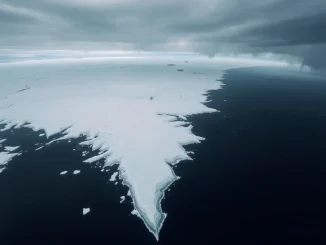
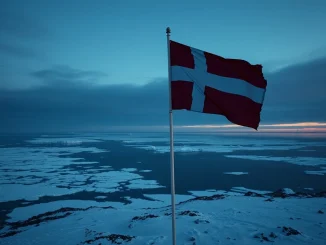
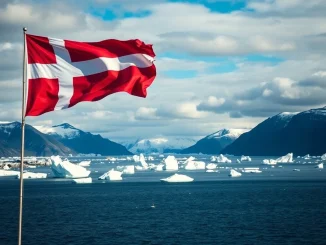
The potential conflict centers on Greenland, the world’s largest island, which holds significant strategic and economic value. Its geographic position offers command over Arctic shipping lanes, which are becoming more navigable due to climate change. Furthermore, the island possesses substantial untapped mineral resources, including rare earth elements critical for modern technology and green energy solutions. While Greenland is an autonomous territory within the Kingdom of Denmark, its foreign and security policy remains largely managed by Copenhagen, which is a member of the European Union. Any unilateral move by the United States to alter this status quo is viewed by European capitals as a direct challenge to regional sovereignty and stability, setting the stage for a severe diplomatic and economic confrontation.
Expert Insights on Trade Policy and Escalation Risks
Economic historians and trade policy analysts note that the Oxford Economics scenario follows a familiar but dangerous pattern. Trade conflicts often begin with targeted measures but can rapidly escalate into broader economic warfare as political pressures mount. The report serves as a preventive warning, modeling the economic cost of such a path. Experts stress that modern economies are deeply integrated, making tariff wars particularly damaging. They also highlight that the current international rules-based trading system, embodied by the World Trade Organization, lacks strong mechanisms to quickly de-escalate conflicts between its largest members, increasing the risk of prolonged disputes.
Broader Implications for International Relations and Markets
Beyond pure GDP metrics, a Greenland-centered tariff war would have profound secondary effects. It could accelerate the fragmentation of the global economy into competing geopolitical blocs, a process often termed “decoupling” or “friend-shoring.” Additionally, it would likely undermine multilateral cooperation on other critical issues like climate change and global health. For financial markets, the uncertainty would trigger a flight to safety, boosting assets like the U.S. dollar and gold while pressuring equities and corporate bonds. Central banks would face a difficult policy dilemma: combatting the inflationary pressure from higher tariffs while also supporting growth in a slowing economy.
Key risk factors identified in the report include:
- Supply Chain Re-shock: New tariffs would disrupt recently stabilized logistics networks.
- Currency Volatility: Competitive devaluations could emerge as a secondary conflict front.
- Investment Chill: Long-term cross-border investment would decline due to political risk.
- Commodity Price Spikes: Strategic resources could become pawns in the dispute.
Conclusion
The Oxford Economics report on the potential Greenland tariff war provides a sobering, data-driven assessment of how a geopolitical flashpoint can translate into tangible global economic damage. The projection that global GDP growth could fall to 2.6% underscores the high stakes involved in managing transatlantic relations and Arctic sovereignty. While the scenario remains a projection, it serves as a critical reminder of the deep interconnectedness of the modern world economy and the severe costs of protectionist escalation. The analysis ultimately highlights the importance of diplomatic channels and multilateral frameworks in resolving disputes before they inflict widespread economic harm.
FAQs
Q1: What is the core finding of the Oxford Economics report on Greenland?
The core finding is that a potential tariff war between the U.S. and the EU, triggered by a dispute over Greenland, could reduce global GDP growth to 2.6%, a significant drop from the recent stable range of 2.8-2.9%.
Q2: How would a U.S.-EU tariff war specifically impact their own economies?
According to the model, U.S. GDP could fall by up to 1% from current forecasts, and the Eurozone would experience a similar magnitude of negative impact, though potentially over a longer timeframe.
Q3: Why is Greenland so strategically important in this context?
Greenland is strategically vital due to its location controlling emerging Arctic shipping routes and its vast reserves of untapped critical minerals, making it a focal point for great-power economic and security interests.
Q4: How does a 2.6% global growth rate compare historically?
Excluding the 2020 pandemic year, a 2.6% global GDP growth rate would be the lowest since 2009, following the global financial crisis, marking a serious deceleration from recent trends.
Q5: What are the main channels through which this dispute would hurt the global economy?
The main channels are disrupted global supply chains, reduced business investment due to uncertainty, financial market volatility, and weakened export demand for emerging markets, creating a contagion effect.
Updated insights and analysis added for better clarity.
This article was produced with AI assistance and reviewed by our editorial team for accuracy and quality.