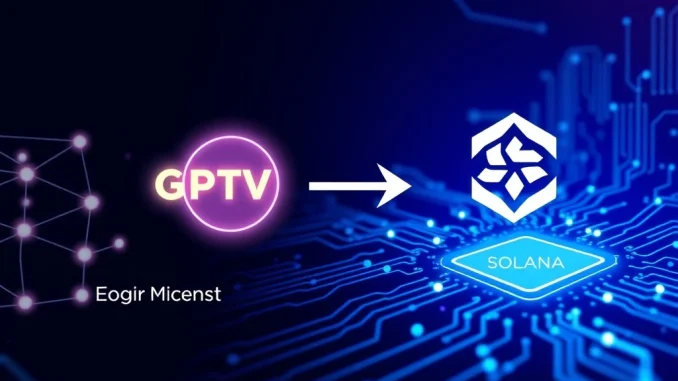
Global, March 2025: The blockchain project GPTVerse has officially completed its migration to the Solana network, a significant technical overhaul aimed at delivering substantial improvements for its $GPTV token holders. This strategic move, finalized this week, transitions the entire GPTVerse ecosystem from its previous blockchain infrastructure to Solana, primarily to leverage its renowned capabilities for high-speed transactions and minimal costs. The migration promises to address common pain points in decentralized applications by offering users a more efficient and resilient network experience.
GPTVerse Completes Strategic Solana Migration
The core announcement confirms that the GPTVerse platform and its native $GPTV token now reside entirely on the Solana blockchain. A blockchain migration is a complex, coordinated process where a project’s smart contracts, tokens, and operational logic are transferred from one underlying network to another. For GPTVerse, this decision culminates months of development and testing. The primary drivers, as outlined in the project’s technical documentation, are the pursuit of greater scalability, reduced transaction fees (often called gas fees), and improved overall network stability. Such migrations have become an established trend in the cryptocurrency sector as projects seek optimal infrastructure to support user growth and functional complexity.
Analyzing the Promised Benefits for $GPTV Holders
The migration’s value proposition centers on three tangible benefits for consumers and holders of the $GPTV token: transaction speed, cost efficiency, and network robustness. Solana’s architecture is designed to process thousands of transactions per second (TPS), a stark contrast to the limitations of older, more congested blockchains. For users interacting with GPTVerse’s applications—whether for transactions, staking, or governance voting—this translates to near-instantaneous confirmation times. Furthermore, Solana’s fee structure is notably lower, often costing fractions of a cent per transaction. This reduction eliminates a significant barrier to frequent interaction, making micro-transactions and everyday use economically feasible. Finally, Solana’s unique proof-of-history consensus mechanism aims to provide a resilient and high-uptime network, potentially reducing downtime and failed transactions.
The Technical Execution and User Implications
Executing a full token migration requires meticulous planning to ensure no user funds are lost. Typically, the process involves snapshotting holdings on the old chain, disabling old contracts, and issuing equivalent tokens on the new chain. GPTVerse likely guided users through a process where old $GPTV tokens were swapped or bridged to new Solana-based $GPTV tokens. For existing holders, the immediate implication is that their tokens now exist as SPL tokens (Solana Program Library tokens), compatible with wallets like Phantom and Solflare. All future trading, liquidity provision, and platform utility will occur exclusively on the Solana network, necessitating users to familiarize themselves with Solana’s ecosystem of decentralized exchanges (DEXs) and tools.
Contextualizing the Move Within Broader Crypto Trends
GPTVerse’s migration is not an isolated event but part of a larger narrative in blockchain development. The industry has witnessed several high-profile migrations, such as when the decentralized exchange SushiSwap expanded to multiple chains or when Audius migrated to Solana in 2021. These moves are often driven by the “blockchain trilemma”—the challenge of balancing decentralization, security, and scalability. Projects frequently launch on established networks like Ethereum for security and community but later seek alternative layer-1 or layer-2 solutions to scale. Solana has positioned itself as a leading high-performance chain, attracting projects that prioritize throughput and low latency. This trend underscores a maturing market where infrastructure choice is a critical strategic decision.
Potential Challenges and Considerations
While the benefits are clear, migrations carry inherent risks and challenges. Technical hiccups during the swap process can lead to user confusion or temporary loss of access. Furthermore, migrating to a new chain means inheriting its unique risks; Solana has experienced network outages in the past, though its development focus has been on strengthening stability. Ecosystem fragmentation is another consideration, as some users may be reluctant to move from familiar chains. The success of GPTVerse’s migration will depend not only on the technical delivery but also on the clarity of communication, support provided to the community, and the subsequent performance of its applications on the new network.
Conclusion
The completed GPTVerse migration to Solana represents a pivotal chapter for the project, fundamentally upgrading its operational backbone. By prioritizing transaction speed, lower fees, and network resilience, the move directly addresses key usability factors that can hinder adoption in decentralized ecosystems. For $GPTV token holders, the change should manifest as a smoother, more cost-effective experience when engaging with the GPTVerse platform. This strategic infrastructure shift highlights the ongoing evolution within the cryptocurrency sector, where the pursuit of optimal performance continues to reshape project roadmaps and user expectations.
FAQs
Q1: What does the GPTVerse migration to Solana mean for me as a $GPTV holder?
If you held $GPTV tokens before the migration, you should have received an equivalent amount of the new Solana-based $GPTV tokens. You now need a Solana-compatible wallet (like Phantom) to hold and manage them, and all future transactions will occur on the Solana network.
Q2: How do I access my $GPTV tokens after the migration?
You must use a wallet that supports the Solana blockchain and the SPL token standard. Import your wallet using your seed phrase or private key into a Solana-supporting wallet application. Your new tokens should be visible there if you held them in a self-custody wallet during the snapshot.
Q3: Why did GPTVerse choose Solana over other blockchains?
Based on public rationale, GPTVerse likely chose Solana for its high transaction throughput (speed), very low transaction fees, and growing ecosystem of decentralized applications and developers, which align with goals for scalability and user experience.
Q4: Are there any risks associated with this blockchain migration?
Primary risks included the technical execution of the token swap (potential for user error) and the inherent characteristics of the new network. Users must ensure they follow official migration guides precisely to avoid loss of funds and understand they are now subject to Solana’s network performance and security model.
Q5: Where will I be able to trade the new Solana-based $GPTV token?
The token will be tradable on decentralized exchanges (DEXs) within the Solana ecosystem, such as Raydium, Orca, or Jupiter. Centralized exchange listings may also be updated to support the new token contract address on Solana.
Updated insights and analysis added for better clarity.
This article was produced with AI assistance and reviewed by our editorial team for accuracy and quality.