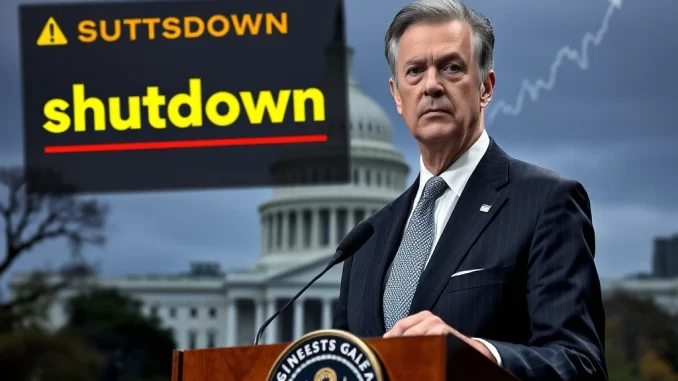
Federal Reserve Chair Jerome Powell has issued a stark warning: a potential **government shutdown** would cause a temporary contraction in U.S. economic activity. This caution comes as markets, including cryptocurrencies, closely monitor macroeconomic stability. Therefore, understanding these traditional economic pressures becomes crucial for all investors.
Jerome Powell’s Dire Forecast for Economic Activity
Federal Reserve Chair Jerome Powell recently delivered a significant economic assessment. He stated clearly that a prolonged **government shutdown** would temporarily contract economic activity. This contraction could affect various sectors. Powell noted that inflation remains elevated, despite some recent improvements. Consequently, the Fed continues its vigilance.
However, Powell also highlighted a more optimistic underlying trend. Data available before the shutdown threat suggested the economy was moving onto a more solid trajectory. This indicates resilience in some areas. Furthermore, current data shows that both layoffs and hiring levels remain low. This suggests a relatively stable labor market, at least for now.
Understanding the Impact of a Government Shutdown
A **government shutdown** occurs when Congress fails to pass appropriations bills. This leads to a halt in funding for many non-essential government operations. The immediate effects are widespread. For example, hundreds of thousands of federal employees face furloughs. Additionally, various government services cease.
The economic ripple effects are significant. Here are key areas impacted:
- Federal Worker Furloughs: Furloughed employees stop receiving paychecks. This directly reduces consumer spending. Consequently, local businesses near federal hubs suffer.
- Halted Services: Agencies responsible for permits, loans, and data collection might close. This disrupts business operations across many industries. Therefore, it creates uncertainty.
- Reduced Confidence: Consumer and business confidence often declines. This can lead to decreased investment and spending. Ultimately, this slows overall **economic activity**.
- Delayed Data: Key economic data releases often get postponed. This makes it harder for policymakers and businesses to make informed decisions.
Historically, past shutdowns have demonstrated measurable impacts on GDP growth. These contractions, while temporary, create significant headwinds.
Inflation Concerns and the Federal Reserve’s Stance
Chair Powell reiterated that **inflation** remains ‘somewhat high.’ This statement underscores the **Federal Reserve’s** ongoing battle against rising prices. The Fed has implemented a series of interest rate hikes. These actions aim to cool the economy. Ultimately, they seek to bring inflation back to its 2% target.
High inflation erodes purchasing power. It also creates instability for businesses. The Fed’s commitment to price stability is unwavering. Therefore, any economic disruption, like a shutdown, complicates their efforts. A contraction in economic activity could present a new challenge. It might force the Fed to reassess its monetary policy strategy.
Signs of a Solid Economic Trajectory
Despite the shutdown warning, Powell pointed to positive underlying economic data. This data suggested a more ‘solid trajectory’ for the economy. Specifically, he highlighted robust job market conditions. Layoffs currently remain at low levels. Moreover, hiring activity has not significantly decreased. These factors indicate a resilient labor market.
Such strength offers a buffer against potential shocks. However, a **government shutdown** could erode this progress. It could undermine consumer confidence. It could also disrupt business planning. The delicate balance of economic recovery remains vulnerable. The **Federal Reserve** carefully monitors these indicators. They seek to guide the economy toward sustained growth without reigniting inflation.
The Federal Reserve’s Role in Economic Stability
The **Federal Reserve** plays a critical role in maintaining U.S. economic stability. Its dual mandate includes maximizing employment and keeping prices stable. Powell’s remarks reflect this responsibility. He provides clear warnings about potential threats. The Fed uses various tools to achieve its goals. These include setting interest rates and managing the money supply. A government shutdown complicates these efforts. It introduces an external, non-monetary shock to the system. This makes the Fed’s job of forecasting and responding more challenging. Therefore, their communications become even more vital for market participants.
Potential Market Reactions and Future Outlook
The prospect of a **government shutdown** typically introduces market volatility. Investors become cautious. They seek safe-haven assets. This can include government bonds. It can also influence cryptocurrency markets. While crypto often operates independently, broader economic instability can affect investor sentiment. Therefore, a slowdown in **economic activity** in the traditional sector can ripple through digital assets.
The immediate future depends on legislative actions. Avoiding a shutdown remains the primary goal. If a shutdown occurs, its duration will dictate the severity of the economic impact. The **Federal Reserve** will continue to monitor the situation closely. Their statements and actions will be critical. They will aim to mitigate any adverse effects. Ultimately, maintaining a stable economic environment is paramount for sustained growth.
Conclusion
Federal Reserve Chair Jerome Powell’s warning about a **government shutdown** highlights significant economic risks. A temporary contraction in **economic activity** could occur. This would impact various sectors. Despite underlying signs of economic strength, such a disruption is unwelcome. The **Federal Reserve** continues its fight against **inflation**. Therefore, any additional instability complicates its mission. Market participants should remain vigilant. They must observe both legislative developments and the Fed’s responses. This careful monitoring is essential for navigating potential economic headwinds.
Frequently Asked Questions (FAQs)
Q1: What did Jerome Powell say about a government shutdown?
A1: Federal Reserve Chair Jerome Powell warned that a **government shutdown** would cause a temporary contraction in U.S. **economic activity**. He emphasized that this disruption would impact the overall economy.
Q2: How does a government shutdown affect economic activity?
A2: A shutdown typically furloughs federal workers, halts non-essential government services, and reduces consumer and business confidence. These factors collectively slow down economic growth and spending, leading to a contraction in **economic activity**.
Q3: What is the Federal Reserve’s stance on inflation?
A3: Powell stated that **inflation** remains ‘somewhat high.’ The **Federal Reserve** continues its efforts to bring inflation down to its 2% target, using tools like interest rate adjustments to achieve price stability.
Q4: Did Powell mention any positive economic signs?
A4: Yes, Powell noted that data before the shutdown threat suggested the economy was on a ‘more solid trajectory.’ He also highlighted that layoffs and hiring currently remain at low levels, indicating some underlying labor market strength.
Q5: How might a government shutdown impact financial markets?
A5: A shutdown often introduces market uncertainty and volatility. Investors may become more cautious, potentially seeking safer assets. While direct impacts on cryptocurrency vary, broader economic instability can influence overall market sentiment, affecting various asset classes.