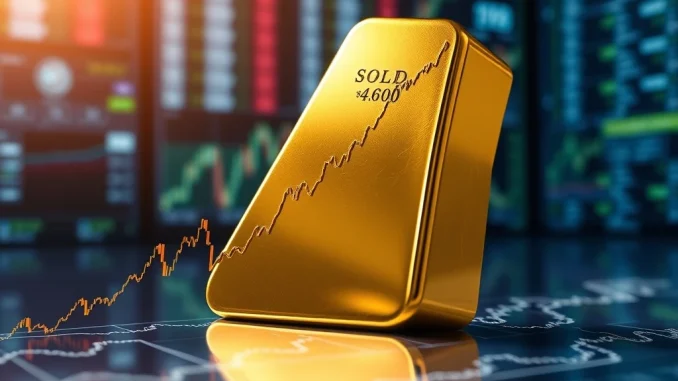
Global financial markets witnessed a historic moment this week as the spot gold price surged past a monumental barrier, setting a new all-time high above $4,600 per ounce. This remarkable ascent represents a gain of approximately $280 per ounce since the start of the year, signaling a profound shift in investor sentiment and macroeconomic dynamics. The move has captured the attention of central banks, institutional investors, and individual savers worldwide, prompting a deep analysis of the underlying forces.
Gold Price Achieves Unprecedented Milestone
The London Bullion Market Association (LBMA) fixing confirmed the breakthrough, with spot gold trading firmly above the $4,600 threshold. This milestone eclipses the previous record set in late 2024. Consequently, market analysts are scrutinizing the rapid pace of this appreciation. The precious metal has demonstrated remarkable resilience and upward momentum throughout the first quarter of 2025. For context, this represents a year-to-date increase of over 6.5%, significantly outpacing many traditional equity indices during the same period.
Several concurrent factors are fueling this historic rally. Primarily, persistent geopolitical tensions in Eastern Europe and the South China Sea continue to drive safe-haven demand. Simultaneously, shifting monetary policy expectations among major central banks are altering the landscape for non-yielding assets. Furthermore, sustained central bank purchasing, particularly from institutions in emerging markets, provides a consistent and powerful bid under the market. This multifaceted demand creates a robust foundation for higher prices.
Analyzing the Drivers Behind the Surge
The rally is not an isolated event but the result of a powerful convergence of macroeconomic trends. First, inflationary pressures, while moderating from their peaks, remain structurally higher than the pre-pandemic decade. Investors increasingly view physical gold as a critical long-term store of value against currency debasement. Second, a weakening U.S. dollar index (DXY) over recent months has made dollar-denominated gold cheaper for holders of other currencies, thereby stimulating international demand.
Expert Perspective on Market Dynamics
Dr. Anya Sharma, Chief Commodities Strategist at Global Markets Insight, provided context: “The move above $4,600 is technically and fundamentally significant. Our analysis shows that central bank demand has transitioned from a supportive factor to a primary price driver. In 2024 alone, official sector purchases exceeded 1,000 tonnes for the second consecutive year. This structural change in ownership provides a durable floor for prices.” This expert insight underscores a key transformation in the gold market’s underlying architecture.
Additionally, the investment flow into gold-backed exchange-traded funds (ETFs) has turned positive after a period of outflows. Data from the World Gold Council indicates that global gold ETFs added over 50 tonnes in the last month. Retail demand for physical bars and coins also remains robust in key markets like Germany, the United States, and China. The table below illustrates key demand sectors for gold:
| Demand Sector | 2024 Contribution | 2025 Trend (Q1) |
|---|---|---|
| Central Banks | 1,050 tonnes | Strongly Positive |
| Investment (ETF & Bar/Coin) | Mixed | Turning Positive |
| Jewelry | Steady | Moderately Positive |
| Technology | Stable | Neutral |
Historical Context and Future Trajectory
To fully appreciate the current price, a historical lens is essential. Adjusted for inflation, today’s nominal high still sits below the peak of the early 1980s in real terms. However, the nominal breakthrough is psychologically powerful for market participants. The journey to $4,600 has been characterized by increased volatility but a clear upward trend over the past five years. Key technical analysis levels were decisively broken during this rally, inviting further momentum-based buying from algorithmic trading systems.
Market observers are now monitoring several indicators for clues on sustainability. These include:
- Real Yields: The direction of inflation-adjusted bond yields remains a critical inverse correlate for gold.
- Currency Markets: Further dollar weakness could propel additional gains.
- Geopolitical Developments: Any escalation in global tensions would likely accelerate safe-haven flows.
- Physical Premiums: The premiums paid for physical bars over the spot price indicate retail market tightness.
Conversely, a rapid return to aggressive monetary tightening by the Federal Reserve or a sharp, sustained rally in the dollar could present headwinds. However, the consensus among many analysts is that the long-term bull case for gold remains intact due to debt levels, geopolitical fragmentation, and the ongoing diversification of global reserve assets.
Broader Market Impact and Implications
The reverberations of gold’s surge extend far beyond the commodities complex. Equity markets, particularly mining sectors, have reacted strongly. Major gold mining indices have outperformed the broader market by a wide margin year-to-date. This performance highlights increased investor interest in leveraged plays on the gold price. Additionally, the rise has implications for currency reserves and national balance sheets. Countries with substantial gold holdings, such as the United States, Germany, and Italy, have seen a marked increase in the value of their reserves.
For individual investors, the new high prompts a reassessment of portfolio allocation. Financial advisors often cite a 5-10% allocation to physical gold or gold-backed assets as a diversification hedge. The current momentum is leading to renewed conversations about this strategic position. Importantly, the rise also affects industries downstream, such as jewelry and electronics, where higher input costs may eventually need to be passed on to consumers.
Conclusion
The breach of the $4,600 level for the spot gold price marks a definitive chapter in financial history. This new all-time high is underpinned by a complex mix of geopolitical unease, monetary policy shifts, and strong institutional demand. While short-term corrections are always possible in any asset class, the fundamental drivers appear supportive for the medium to long term. The gold price surge serves as a powerful barometer of current global economic anxieties and the enduring search for tangible, trusted value. Market participants will continue to monitor the factors that propelled gold to this record, as they hold significant clues for the broader financial landscape in 2025 and beyond.
FAQs
Q1: What is the “spot gold price”?
The spot price is the current market price for immediate delivery and payment of gold. It serves as the global benchmark for pricing physical gold, derivatives, and gold-related products.
Q2: Why does a weaker U.S. dollar often lead to a higher gold price?
Gold is priced in U.S. dollars globally. When the dollar weakens, it takes fewer units of other currencies (like euros or yen) to buy one dollar, making dollar-priced gold effectively cheaper for international buyers, which increases demand and price.
Q3: How does inflation affect the gold price?
Gold is historically perceived as a store of value and a hedge against inflation. When the purchasing power of fiat currencies declines due to rising prices, investors often allocate funds to gold to preserve their wealth, driving up its price.
Q4: Who are the largest holders of gold?
The largest holders are central banks and national governments. The United States holds the largest official gold reserves, followed by Germany, the International Monetary Fund (IMF), Italy, and France.
Q5: What are the main ways for an individual to invest in gold?
Individuals can invest through physical bullion (bars, coins), gold-backed Exchange-Traded Funds (ETFs), shares in gold mining companies, or gold futures and options contracts, each with different risk, liquidity, and storage profiles.
This article was produced with AI assistance and reviewed by our editorial team for accuracy and quality.