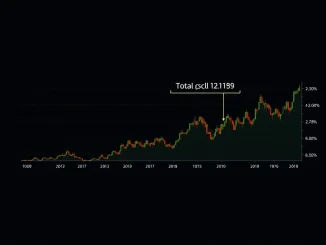
Global Financial Markets, April 2025: The global commodities market witnessed a seismic event as the market capitalization of gold surged by an astonishing $1.65 trillion in a single trading session. This unprecedented daily gain, driven by spot gold prices breaching the $5,500 per ounce barrier, brought the precious metal’s total valuation to a point where its one-day increase nearly equaled the entire market capitalization of Bitcoin, which stands at approximately $1.75 trillion. The scale of this movement has sent shockwaves through traditional finance and digital asset circles alike, prompting a reevaluation of asset correlations and safe-haven dynamics.
Gold Market Cap Surge: Analyzing the $1.65 Trillion Day
The reported $1.65 trillion increase in gold’s market capitalization represents one of the largest single-day value creations for any asset class in modern financial history. Market capitalization for a commodity like gold is calculated by multiplying the total estimated above-ground supply by the current spot price. The surge past $5,500 per ounce was the primary driver. This move did not occur in a vacuum. Analysts point to a confluence of factors that created a perfect storm for gold bulls. Persistent geopolitical tensions, shifting central bank policies regarding reserve assets, and inflationary pressures that have proven more stubborn than anticipated in certain economies have collectively fueled a massive flight to perceived safety. The trading volume in gold futures and physically-backed exchange-traded funds (ETFs) reportedly reached multi-year highs, indicating broad-based institutional and retail participation.
Bitcoin Value Comparison and Market Implications
The immediate comparison to Bitcoin’s total market value, at roughly $1.75 trillion, provides a stark frame of reference for the magnitude of gold’s move. While Bitcoin is a decentralized digital asset with a finite supply of 21 million coins, gold is a physical commodity with a vast, though slowly growing, above-ground stockpile. The fact that gold’s daily gain could almost cover Bitcoin’s entire valuation highlights the sheer scale of capital flows involved. This event challenges the emerging narrative of Bitcoin as “digital gold.” In a period of extreme market stress, traditional gold absorbed a tidal wave of capital that, in percentage terms, dwarfed movements in the cryptocurrency market. The table below illustrates the key metrics of this comparison.
| Asset | Key Metric (April 2025) | Approximate Value | Context |
|---|---|---|---|
| Gold | Single-Day Market Cap Increase | $1.65 Trillion | Driven by spot price >$5,500/oz |
| Bitcoin (BTC) | Total Market Capitalization | $1.75 Trillion | Based on circulating supply and price |
| Gold | Total Above-Ground Supply | ~210,000 Tonnes | Estimate from World Gold Council |
| Bitcoin (BTC) | Total Supply Cap | 21 Million Coins | Hard-coded protocol limit |
This juxtaposition raises critical questions about asset class maturity, liquidity depth, and investor behavior during crises. Bitcoin experienced volatility during the same period, but its price action was not correlated in a way that suggested it was absorbing the same safe-haven flows as gold. This decoupling is a significant data point for portfolio managers who may have considered the assets as partial substitutes.
Historical Context and Precedent for Gold Moves
While historic in absolute dollar terms, large percentage swings in gold are not without precedent. The 1970s and early 1980s saw periods of extreme volatility as the metal broke free from fixed pricing. However, the base value of the market today is so large that a percentage move that would have been notable decades ago now translates into a trillion-dollar headline figure. The move to $5,500 per ounce represents a continuation of a long-term bull market that has seen gold appreciate significantly from its sub-$300 levels at the turn of the millennium. Each major leg higher has been associated with crises: the 2008 financial crisis, the 2020 pandemic, and now the geopolitical and monetary uncertainties of the mid-2020s. The current surge appears to be an acceleration of this long-term trend, amplified by modern electronic trading and instantaneous global capital mobility.
Consequences for Investors and Global Finance
The immediate consequence for investors is a dramatic repricing of risk and a reassessment of asset allocation models. Portfolios heavily weighted toward equities or certain bonds may have suffered relative losses compared to those holding physical gold or mining shares. Central banks, particularly those that have been net buyers of gold for over a decade, have seen the value of their reserves swell. This strengthens their balance sheets and could influence monetary policy decisions. For the mining industry, such a price spike makes previously marginal deposits economically viable, potentially leading to an expansion in exploration and production. However, it also introduces higher volatility and potential for a sharp correction, which can complicate long-term project financing. In currency markets, nations that are major gold producers may see their currencies strengthen, all else being equal.
- Portfolio Rebalancing: Institutional investors are forced to recalibrate models that did not anticipate such a sharp, non-correlated move in a major asset class.
- Central Bank Strategy: Validates the recent strategic shift by many central banks to increase gold holdings as a de-dollarization and diversification tactic.
- Market Volatility: Such a large, rapid move can destabilize derivatives markets, including futures and options, leading to increased margin calls and potential liquidity shortfalls in other areas.
- Inflation Expectations: A sustained high gold price is often interpreted by the market as a signal of entrenched long-term inflation expectations, affecting bond yields.
Conclusion
The gold market cap increase of $1.65 trillion in one day is a landmark event in financial history, underscoring the metal’s enduring role during periods of profound uncertainty. The fact that this single-day gain rivaled the entire Bitcoin value highlights the immense scale of traditional financial markets and the powerful, sometimes overwhelming, flows that can move through them. While Bitcoin and digital assets represent a transformative new asset class, this episode demonstrates that in moments of acute systemic stress, the collective market action can still pivot overwhelmingly toward ancient stores of value. This event will be studied for years as a case study in market dynamics, safe-haven asset performance, and the evolving relationship between traditional and digital finance.
FAQs
Q1: How is the market capitalization of gold calculated?
A1: Gold’s market cap is an estimate calculated by multiplying the total amount of above-ground gold (all the gold ever mined, estimated at roughly 210,000 tonnes) by the current spot price per ounce. It represents the total implied value of all existing gold holdings.
Q2: What caused spot gold prices to surge above $5,500 an ounce?
A2: The surge was attributed to a combination of factors including heightened geopolitical risks, actions by central banks (like increased buying for reserves), sustained inflationary pressures, and a broad-based market search for safe-haven assets amid economic uncertainty.
Q3: Does this mean Bitcoin failed as a “digital gold” or hedge?
A3: Not necessarily. It demonstrates a decoupling in this specific event. Different assets can serve as hedges against different risks. Bitcoin’s performance is influenced by its own unique set of technological, regulatory, and adoption drivers, which did not align with the traditional safe-haven trade on this particular day.
Q4: What are the practical implications for an average investor?
A4: For the average investor, it reinforces the importance of diversification. It also shows that even assets considered stable can experience extreme volatility. Investors should review their portfolio allocation to ensure it aligns with their risk tolerance, especially regarding concentrated positions.
Q5: Could such a large one-day move in gold be sustained?
A5: While prices can remain elevated, single-day gains of this magnitude are extremely rare and often see partial retracements as markets digest the move and profit-taking occurs. The long-term trend is more significant than any single day’s volatility.