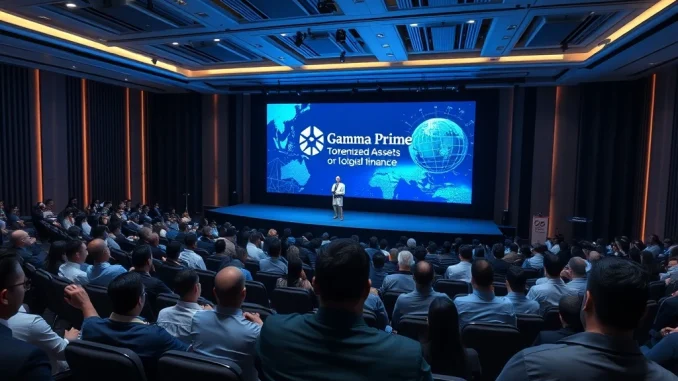
Hong Kong, February 9, 2026: The financial district of Hong Kong served as the backdrop for a significant convergence of traditional finance and emerging digital asset technology. On this date, Gamma Prime, a prominent firm in the digital asset infrastructure space, hosted the Tokenized Capital Summit 2026. The event successfully gathered over two thousand investors, fund managers, and financial innovators. Its core mission was to demonstrate and discuss the practical implementation of tokenization for private market investments on a global scale.
Tokenized Capital Summit Bridges a Critical Divide
The Tokenized Capital Summit represented more than a typical industry conference. It functioned as a strategic forum addressing a persistent gap in modern finance. For years, the worlds of institutional capital and decentralized Web3 protocols have operated in parallel, often with limited dialogue. This summit, by bringing together such a large and diverse cohort, aimed to build a functional bridge. The discussions moved beyond theoretical potential to focus on operational frameworks, regulatory considerations, and real-world use cases for tokenizing private equity, venture capital, real estate, and other alternative assets.
Hong Kong’s selection as the host city was deliberate. The region has actively positioned itself as a hub for both conventional finance and digital asset innovation. Its regulatory environment has evolved to provide clearer guidelines for virtual asset service providers. This context provided a relevant and serious setting for discussions about bringing institutional-grade private investments onto blockchain-based platforms. The summit’s scale—over 2,000 attendees—signaled substantial and growing interest from the professional investment community.
Gamma Prime’s Vision for a Tokenized Marketplace
A central focus of the summit was the detailed showcase of Gamma Prime’s own platform. The company presented its vision for a tokenized global marketplace designed specifically for private investments. In traditional finance, private market assets are often characterized by high minimum investments, long lock-up periods, and limited liquidity. Gamma Prime’s proposed marketplace utilizes blockchain technology to address these specific challenges.
The technology allows for the creation of digital tokens that represent fractional ownership in an underlying asset. This process, known as tokenization, can potentially lower barriers to entry for accredited investors. Furthermore, a secondary market for these tokens could introduce a new layer of liquidity to asset classes traditionally considered illiquid. At the summit, Gamma Prime outlined the architectural pillars of its marketplace:
- Compliance-First Design: Integrating identity verification (KYC) and accreditation checks directly into the asset issuance and trading process.
- Interoperability: Building connectivity with both traditional banking rails and multiple blockchain networks to facilitate seamless fund flows.
- Asset Servicing: Developing smart contract frameworks to automate distributions, voting rights, and other corporate actions for token holders.
- Institutional-Grade Security: Emphasizing custody solutions and security protocols that meet the stringent requirements of large asset managers and family offices.
The Historical Context of Asset Tokenization
The concept of representing ownership digitally is not new. Traditional securities have been dematerialized and held in electronic form for decades through systems like the Depository Trust & Clearing Corporation (DTCC). Tokenization on blockchain is a logical, albeit significant, evolution of this process. It introduces a programmable, transparent, and globally accessible ledger. The journey began with the tokenization of simple assets like cryptocurrencies and has progressively moved toward more complex financial instruments.
Major financial institutions, including global banks and asset managers, have launched pilot projects for tokenizing bonds, funds, and money market instruments since the early 2020s. Gamma Prime’s focus on the private markets segment targets an area where the efficiency gains from tokenization could be particularly pronounced. The 2026 summit in Hong Kong can be viewed as a milestone indicating that this niche is moving from experimentation toward early-stage commercialization.
Implications for the Future of Private Investing
The activities and discussions at the Tokenized Capital Summit carry several important implications for the future landscape of investment. First, the event underscores a maturation in the dialogue between crypto-native firms and traditional finance. The conversation has shifted from “if” to “how” and “when.” Second, the development of dedicated marketplaces like Gamma Prime’s could gradually reshape capital formation. Smaller fund managers and project sponsors may gain access to a broader, global pool of investors without relying solely on traditional placement agents.
However, significant hurdles remain. Regulatory harmonization across different jurisdictions is a complex, ongoing process. The legal treatment of a tokenized private equity interest varies widely from country to country. Furthermore, technological risks, including smart contract vulnerabilities and the evolving landscape of digital asset custody, require robust solutions. The summit likely dedicated substantial time to these practical challenges, reflecting the industry’s move toward problem-solving rather than promotion.
The table below outlines a simplified comparison between traditional private investment processes and a potential tokenized model:
| Aspect | Traditional Model | Tokenized Model (Potential) |
|---|---|---|
| Minimum Investment | Often high ($500k+) | Potentially lower, fractional |
| Settlement Time | Days to weeks (T+) | Near-instant (on-chain) |
| Secondary Liquidity | Very limited, negotiated | Possible via regulated digital exchange |
| Record Keeping | Centralized, opaque | Transparent, immutable ledger |
| Global Access | Geographically restricted | Borderless, subject to compliance |
Conclusion
The Tokenized Capital Summit 2026 in Hong Kong marked a definitive step in the integration of blockchain technology into the core mechanisms of private capital markets. By convening over two thousand professionals, Gamma Prime facilitated a necessary and advanced dialogue on the future of investment. The showcased global marketplace for tokenized private investments represents a concrete attempt to solve long-standing issues of accessibility and liquidity in alternative assets. While the path forward involves navigating complex regulatory and technological terrain, the scale and seriousness of this summit indicate that tokenization is transitioning from a niche concept to a mainstream consideration for the global financial industry. The evolution of this space will depend on continued collaboration, clear regulation, and the development of trustworthy infrastructure like that proposed at the event.
FAQs
Q1: What is the Tokenized Capital Summit?
The Tokenized Capital Summit is a major financial conference focused on the intersection of traditional private investments and blockchain-based tokenization. The 2026 edition in Hong Kong, hosted by Gamma Prime, brought together investors to discuss and showcase practical applications for this technology.
Q2: What does “tokenization” mean in this context?
Tokenization refers to the process of creating a digital token on a blockchain that represents a fractional ownership interest in a real-world asset, such as private company equity, real estate, or a venture capital fund. This digital representation can make buying, selling, and managing the asset more efficient.
Q3: Why is Hong Kong a relevant location for this summit?
Hong Kong has established itself as a leading global financial center that is also proactively developing a regulatory framework for digital assets and Web3 businesses. This makes it an ideal neutral ground for discussions between traditional finance institutions and technology innovators.
Q4: What are the main benefits of tokenizing private investments?
Potential benefits include increased liquidity through the possibility of secondary trading, lower minimum investment sizes due to fractionalization, faster and cheaper settlement processes, and enhanced transparency through immutable record-keeping on a blockchain.
Q5: What are the biggest challenges facing the adoption of tokenized private markets?
The primary challenges are regulatory uncertainty and fragmentation across different countries, the need for robust legal frameworks to define digital ownership rights, technological risks related to security and custody, and achieving sufficient liquidity and adoption to create viable marketplaces.