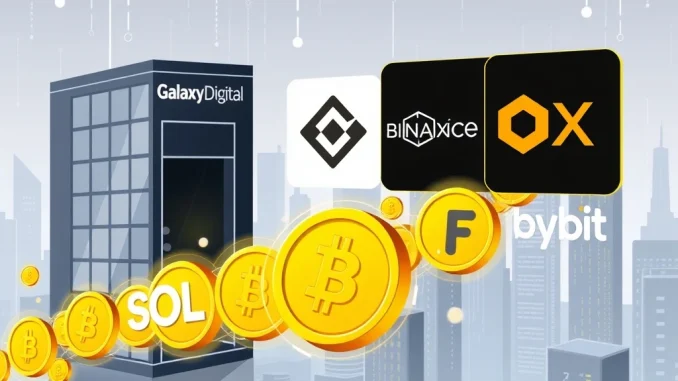
New York, April 2025: Galaxy Digital, the prominent digital asset and blockchain financial services firm, executed a significant transfer of $16 million worth of Solana (SOL) to three of the world’s largest cryptocurrency exchanges: Binance, OKX, and Bybit. This substantial movement of assets, tracked via public blockchain data, represents a notable action by a major institutional player within the Solana ecosystem and coincides with a period of heightened trading volume and developer activity on the network. While the precise motive behind the transfer remains undisclosed by the firm, market analysts and on-chain data specialists are examining the move for its potential strategic implications regarding liquidity management, staking strategies, or preparatory positioning.
Analyzing the $16 Million Solana Transfer
Blockchain analytics platforms first flagged the transaction in early April 2025. The transfer originated from a wallet address associated with Galaxy Digital and distributed approximately $16 million worth of SOL tokens across deposit addresses for Binance, OKX, and Bybit. The execution appears deliberate, splitting the capital across multiple venues rather than concentrating it on a single platform. In the context of institutional crypto operations, such a maneuver typically serves specific operational purposes. These can range from preparing assets for client sales or over-the-counter (OTC) trades to repositioning staked assets or simply enhancing liquidity across key trading hubs to facilitate future transactions. The timing is particularly noteworthy, as it follows several months of sustained growth in Solana’s decentralized finance (DeFi) total value locked (TVL) and non-fungible token (NFT) trading volumes, suggesting Galaxy Digital is actively engaging with a revitalized ecosystem.
Galaxy Digital’s Role in the Cryptocurrency Landscape
To understand the significance of this transfer, one must consider Galaxy Digital’s position. Founded by investor Mike Novogratz, the firm operates as a bridge between traditional finance and the digital asset world. Its business spans asset management, trading, investment banking, and mining services. As a publicly traded company on the Toronto Stock Exchange, its actions are scrutinized by both crypto-native and traditional investors. The firm has been a long-term supporter of various blockchain protocols, and its treasury and investment movements are often viewed as signals of institutional sentiment or strategic shifts. A move involving Solana, a layer-1 blockchain known for its high throughput and low transaction costs, underscores the asset’s continued relevance within institutional portfolios. Galaxy’s decision to utilize three top-tier global exchanges also highlights the critical infrastructure role these platforms play for large-scale market participants, providing the necessary depth and liquidity for significant capital movements.
Context: The Resurgent Solana Network
The transfer occurs against a backdrop of a strengthening Solana network. After a challenging period following the FTX collapse in late 2022, which created significant indirect exposure, the Solana ecosystem has demonstrated remarkable resilience. Key indicators show a robust recovery:
- Developer Activity: Consistent monthly active developer counts have returned to pre-crisis levels, with new projects launching across DeFi, gaming, and consumer applications.
- Network Performance: Solana has maintained high uptime and processed a growing number of transactions, supported by validator client diversity and improved network infrastructure.
- Market Metrics: SOL’s trading volume and price have shown increased stability and growth, attracting renewed interest from both retail and institutional traders.
For an entity like Galaxy Digital, these factors make Solana a strategically important asset, warranting active management of its holdings.
Potential Interpretations and Market Implications
Market observers have proposed several plausible explanations for the transfer, each with different implications. It is crucial to note that without an official statement from Galaxy Digital, these remain informed interpretations based on common industry practices.
Liquidity Provision for Client Activity: The most straightforward explanation is that Galaxy is positioning SOL on exchanges to facilitate anticipated client demand. This could involve preparing for OTC desk sales, executing trades for its asset management funds, or providing liquidity for venture portfolio companies looking to liquidate tokens. Moving funds to exchanges in advance allows for faster execution when needed.
Staking Reallocation or Reward Harvesting: Institutions often stake a portion of their Proof-of-Stake assets like SOL to earn yield. Transferring tokens from a private staking setup or a decentralized protocol to an exchange could indicate an intent to unstake, sell staking rewards, or re-stake through an exchange’s simplified staking service, which offers easier management for large balances.
Strategic Rebalancing or Risk Management: The move could be part of a broader portfolio rebalance. By moving assets to highly liquid exchanges, Galaxy Digital gains optionality. It can quickly convert SOL to other assets (like stablecoins or Bitcoin) if its investment thesis changes or if it needs to hedge exposure. Distributing across three exchanges also mitigates counterparty risk, ensuring no single platform holds all the assets.
Preparatory Move for Derivatives or Lending: Exchanges like Binance, OKX, and Bybit offer sophisticated financial products, including futures, options, and lending markets. Transferring a large spot position can be the first step in establishing a complex derivatives strategy or engaging in collateralized lending to generate additional yield on idle assets.
On-Chain Data and Transparency
The very fact that this transaction is publicly visible underscores a defining characteristic of blockchain technology: transparency. Anyone can audit the flow of funds from Galaxy Digital’s known addresses to the publicly identified deposit addresses of major exchanges. This level of visibility forces institutional players to act with the knowledge that their movements may be analyzed, which in turn can influence market psychology. Large inflows to exchange wallets are traditionally monitored as potential precursors to selling pressure, as they increase the immediate supply of an asset available on the market. However, in the nuanced world of institutional finance, the reality is often more complex than simple preparation for a sale.
Conclusion: A Signal of Active Institutional Engagement
Galaxy Digital’s transfer of $16 million in Solana to Binance, OKX, and Bybit is a significant on-chain event that highlights the ongoing maturation of cryptocurrency markets. It demonstrates how major financial institutions actively manage digital asset portfolios with the same strategic considerations applied to traditional holdings—liquidity, risk, yield, and operational efficiency. While the specific catalyst remains known only to Galaxy, the action itself confirms Solana’s entrenched position within the institutional framework and reflects confidence in the liquidity and services provided by leading global exchanges. For the broader market, it serves as a reminder that beneath the price charts, sophisticated capital allocation is constantly at work, shaping the flow and utility of digital assets like Solana.
FAQs
Q1: What exactly did Galaxy Digital do?
Galaxy Digital moved approximately $16 million worth of Solana (SOL) cryptocurrency from its own wallets to deposit addresses controlled by three major cryptocurrency exchanges: Binance, OKX, and Bybit.
Q2: Does this mean Galaxy Digital is selling its Solana?
Not necessarily. Transferring assets to an exchange is a prerequisite for selling, but it also enables other actions like staking, using the tokens as collateral for loans, or preparing for client-related transactions. The transfer indicates an intent to make the assets more liquid or active, but the ultimate purpose is not publicly confirmed.
Q3: Why use three different exchanges instead of one?
Using multiple exchanges is a common risk management and operational strategy for large institutions. It diversifies counterparty risk (so no single exchange holds all the assets), provides access to different liquidity pools and financial products, and can allow for better execution prices on large orders.
Q4: How does this affect the price of Solana (SOL)?
The direct impact is uncertain. Large inflows to exchanges can sometimes precede selling activity, which may exert downward pressure on price. However, if the transfer is for staking, lending, or other non-sale purposes, the market impact may be neutral. The news itself can influence trader sentiment based on their interpretation of the move.
Q5: What is Galaxy Digital’s history with Solana?
Galaxy Digital has been involved with the Solana ecosystem for several years, through investments, trading, and likely holding SOL in its treasury and funds. The firm’s venture arm, Galaxy Ventures, has invested in numerous projects built on the Solana blockchain.
Updated insights and analysis added for better clarity.
This article was produced with AI assistance and reviewed by our editorial team for accuracy and quality.