New York, NY, April 2025: Forward Industries (NASDAQ: FWDI), a company that made headlines by transforming itself into the largest publicly traded Solana treasury, now faces a severe financial reckoning. As Solana’s market price experiences a significant correction, FWDI’s strategic bet has resulted in an unrealized loss approaching $1 billion, sending its own stock price into a parallel downward spiral. This event represents a critical case study in the volatile intersection of traditional corporate finance and cryptocurrency asset management.
FWDI Solana Treasury: From Bold Strategy to Financial Strain
Forward Industries, originally known for its design and manufacturing of carry cases and accessories, executed a dramatic pivot in recent years. The company’s leadership decided to allocate a substantial portion of its corporate treasury into Solana (SOL), a leading blockchain platform known for its high speed and low transaction costs. This move was part of a broader trend where some public companies sought exposure to digital assets as a hedge against inflation and a play on technological innovation. FWDI’s accumulation of over 7 million SOL tokens positioned it uniquely as a Nasdaq-listed entity with a crypto-native balance sheet. However, this concentration of assets has become a primary source of financial vulnerability. The company’s quarterly filings now show a massive discrepancy between the acquisition cost of its SOL holdings and their current market value, creating a paper loss that impacts shareholder equity and market perception.
Anatomy of the Nearly $1 Billion Unrealized Loss
An unrealized loss, also known as a paper loss, occurs when an asset’s market price falls below its purchase price, but the asset has not yet been sold. For FWDI, this situation is acute. The scale of the loss is a direct function of two key variables: the size of its treasury and the magnitude of Solana’s price decline.
- Treasury Size: Holding over 7 million SOL represents one of the largest corporate positions in any single cryptocurrency.
- Price Volatility: Cryptocurrencies like Solana are inherently volatile, subject to broad market sentiment, technological developments, and regulatory news.
- Accounting Treatment: Under applicable accounting standards, these holdings are likely marked to market, meaning their value on the balance sheet fluctuates with the daily price of SOL.
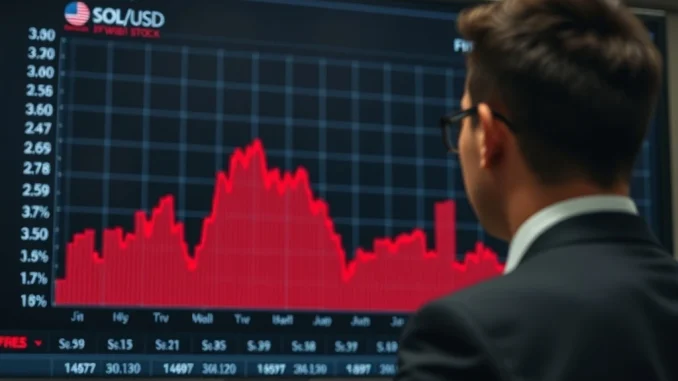
The consequent drop in FWDI’s stock price reflects investor concern over the erosion of the company’s asset base and questions about its capital allocation strategy. The correlation between SOL’s price and FWDI’s stock chart has become strikingly evident to market observers.
Corporate Treasury Management in the Crypto Era
FWDI’s situation is not isolated but serves as a high-profile example of the risks inherent in corporate cryptocurrency adoption. Other companies, most notably MicroStrategy with its Bitcoin holdings, have pursued similar strategies with varying results. The critical difference often lies in risk management frameworks, diversification, and the stated long-term conviction of the leadership. Financial analysts are now scrutinizing FWDI’s communications to understand its tolerance for volatility and its plans, if any, to hedge its position or adjust its strategy. The episode raises fundamental questions about how traditional corporate governance models adapt to the 24/7, high-volatility nature of digital asset markets.
Market Implications and Regulatory Scrutiny
The financial strain at FWDI occurs within a broader context of increasing regulatory attention on public companies holding digital assets. Securities regulators are keenly interested in the disclosure, custody, and valuation of these assets to ensure investor transparency. FWDI’s substantial losses may prompt calls for clearer accounting guidelines and risk disclosures for publicly listed companies with significant crypto treasuries. Furthermore, the event could influence institutional sentiment, potentially making boards of directors more cautious about approving large-scale crypto allocations. The market is watching to see if this represents a stumbling block for corporate crypto adoption or merely a painful lesson in portfolio management during a bear market cycle.
What’s Next for Forward Industries (FWDI)?
The path forward for FWDI involves several strategic crossroads. Management must communicate clearly with shareholders about its commitment to its Solana holdings and its vision for the company’s future. Options range from holding firm, citing a long-term belief in Solana’s underlying technology, to strategically divesting portions of the treasury to shore up the balance sheet. The company could also pivot back to emphasizing its traditional operating business to generate cash flow independent of crypto market cycles. The coming quarterly earnings calls and SEC filings will be critical in assessing the board’s response to this financial pressure. The company’s actions will be dissected as a bellwether for other firms considering or already holding crypto assets.
Conclusion
The situation at Forward Industries (FWDI) underscores the profound risks and rewards of integrating cryptocurrency into a corporate treasury strategy. While the potential for outsized gains exists, the FWDI Solana treasury now exemplifies the downside of high concentration and market volatility. This event provides a crucial, real-world lesson for investors, corporate treasurers, and regulators about asset diversification, risk disclosure, and the long-term strategic alignment required when a public company ventures into the digital asset space. The resolution of this unrealized loss will be closely monitored as a significant chapter in the evolving narrative of traditional finance and cryptocurrency convergence.
FAQs
Q1: What is an unrealized loss?
An unrealized loss, or paper loss, is a decrease in the value of an asset that an investor still holds. The loss is “unrealized” because the asset has not been sold; it only exists on paper based on current market prices.
Q2: Why does FWDI’s stock price fall when Solana’s price drops?
FWDI’s primary reported asset is its large holding of Solana (SOL) tokens. When SOL’s market value decreases, the total value of FWDI’s assets on its balance sheet also decreases. This erosion of asset value makes the company less valuable in the eyes of investors, leading to selling pressure on its stock.
Q3: Can FWDI recover from this loss without selling its Solana?
Yes, if the market price of Solana increases back above FWDI’s average purchase price, the unrealized loss would shrink or turn into an unrealized gain. Recovery is contingent on SOL’s market performance.
Q4: How is this different from a company like MicroStrategy holding Bitcoin?
While both are public companies holding crypto, MicroStrategy’s position in Bitcoin is larger and more central to its corporate identity. The strategies, risk tolerance, and investor communication of the two companies differ. MicroStrategy has consistently articulated a long-term “hold” strategy, which its investor base has largely accepted.
Q5: What are the risks for other companies holding cryptocurrency?
Primary risks include extreme price volatility, regulatory uncertainty, cybersecurity threats related to custody, evolving accounting standards, and potential reputational damage if the strategy performs poorly. Companies must weigh these against the potential benefits of diversification and exposure to a new asset class.
Updated insights and analysis added for better clarity.
This article was produced with AI assistance and reviewed by our editorial team for accuracy and quality.