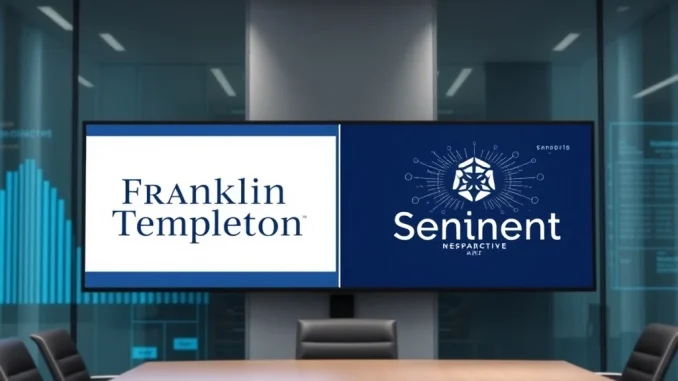
San Mateo, California, April 2025: In a significant development at the intersection of traditional finance and cutting-edge technology, global asset management giant Franklin Templeton has announced a strategic investment in the artificial intelligence project Sentient. This move signals a growing institutional commitment to exploring the practical applications of artificial general intelligence within the financial sector. The collaboration aims to co-develop advanced, institutional-grade financial services by leveraging Sentient’s open-source AGI framework, marking a pivotal step toward integrating sophisticated reasoning technology into live financial production environments.
Franklin Templeton’s Strategic Investment in Sentient AI
Franklin Templeton, a firm with over seven decades of history and approximately $1.6 trillion in assets under management, has built a reputation for measured, long-term investment strategies. The decision to invest in Sentient represents a calculated foray into the frontier of AI development. Unlike narrow AI applications designed for specific tasks, Sentient focuses on artificial general intelligence—a system with the capacity to understand, learn, and apply intelligence across a broad range of cognitive tasks, much like a human. This investment is not merely financial; it is a strategic partnership. The two entities plan to collaborate closely over the coming months, with Franklin Templeton providing domain expertise in global finance and Sentient contributing its open-source reasoning technology. The goal is to build and test tangible AI use cases that can operate within the rigorous, compliance-driven world of institutional finance.
The Implications of AGI for Financial Services
The partnership targets a fundamental challenge in modern finance: processing vast, unstructured datasets to generate actionable insights. Current AI models excel at pattern recognition within defined parameters, but the promise of AGI lies in its potential for complex reasoning and adaptive problem-solving. For an asset manager like Franklin Templeton, potential applications are profound. These could include, but are not limited to:
- Dynamic Risk Assessment: Moving beyond static models to systems that can reason through novel market events, geopolitical shifts, and interconnected economic variables in real-time.
- Portfolio Construction & Optimization: Utilizing AGI to synthesize fundamental analysis, quantitative data, and macroeconomic trends to propose and adjust investment theses.
- Operational Efficiency: Automating complex middle- and back-office functions that require nuanced judgment and reconciliation of disparate information sources.
- Regulatory Compliance & Reporting: Interpreting and applying evolving regulatory frameworks across multiple jurisdictions to ensure adherence.
The “open-source” nature of Sentient’s technology is a critical differentiator. It suggests a development philosophy aimed at transparency, community collaboration, and auditability—attributes that are increasingly valued in regulated industries wary of “black box” AI systems.
Contextualizing the Move in Financial Technology History
Franklin Templeton’s investment follows a clear historical trajectory of financial institutions adopting new technologies. The 1980s saw the rise of electronic trading platforms, the 2000s brought algorithmic and high-frequency trading, and the 2010s were defined by the integration of machine learning for fraud detection and credit scoring. Each phase involved a shift from purely human-driven processes to augmented, technology-enabled decision-making. The exploration of AGI represents the next potential frontier, aiming to move from automation of tasks to augmentation of strategic reasoning. This partnership is among the first of its scale to explicitly target AGI’s application in live financial environments, positioning both firms at the leading edge of what some analysts call “Cognitive Finance.”
Sentient’s Open-Source AGI Framework Explained
Sentient distinguishes itself in the crowded AI landscape by championing an open-source approach to AGI development. In practical terms, this means the core code and research driving its reasoning technology are publicly accessible for review, contribution, and iteration. This model contrasts with the closed, proprietary systems developed by many large tech companies. For a financial partner like Franklin Templeton, this openness offers several advantages:
| Advantage | Explanation |
|---|---|
| Transparency & Auditability | Regulators and internal compliance teams can, in theory, inspect the underlying logic of the AI, which is crucial for meeting financial industry standards. |
| Reduced Vendor Lock-in | The firm is not solely dependent on a single provider’s proprietary technology, offering more control over its technological destiny. |
| Community-Driven Innovation | Progress can be accelerated by a global community of researchers and developers, not just Sentient’s internal team. |
| Security | Open-source code is subject to continuous scrutiny by a global community, which can help identify and patch vulnerabilities quickly. |
The collaboration will test this framework in high-stakes financial scenarios, providing real-world data on its robustness, scalability, and practical utility.
The Roadmap and Expected Impact
The announcement specifies a collaborative development period spanning “the next several months.” This timeline suggests an initial phase focused on prototyping and sandbox testing rather than an immediate, full-scale deployment. Industry observers will be watching for pilot programs or case studies resulting from this partnership. A successful demonstration could catalyze further institutional adoption of AGI technologies, potentially reshaping competitive dynamics in asset management. Conversely, it will also highlight the significant technical and regulatory hurdles that remain, such as ensuring deterministic outcomes, managing bias, and achieving explainability for every AI-driven decision. The partnership’s progress will serve as a valuable benchmark for the entire fintech sector.
Conclusion
Franklin Templeton’s strategic investment in Sentient AI represents a bold and calculated convergence of institutional finance and advanced artificial intelligence research. It moves the conversation about AGI from theoretical research labs into the pragmatic, results-oriented world of global asset management. The focus on developing institutional-grade financial services using open-source technology underscores a commitment to transparency and practical innovation. While the full implications will unfold over years, this partnership immediately establishes a significant beachhead for artificial general intelligence in finance, setting a precedent for how legacy financial institutions can engage with frontier technology to shape the future of the industry.
FAQs
Q1: What is the main goal of the Franklin Templeton and Sentient partnership?
The primary goal is to co-develop advanced, institutional-grade financial services and applications by integrating Sentient’s open-source artificial general intelligence technology into Franklin Templeton’s financial production environments. They aim to create practical AI use cases for complex tasks like risk assessment and portfolio optimization.
Q2: What is artificial general intelligence (AGI), and how is it different from regular AI?
Artificial General Intelligence refers to a type of AI that possesses the ability to understand, learn, and apply knowledge across a wide range of tasks, adapting to new situations much like human intelligence. This contrasts with narrow or weak AI, which is designed and trained for a specific, limited task, such as image recognition or playing a game.
Q3: Why is Sentient’s open-source approach important for finance?
In the heavily regulated financial industry, transparency and auditability are paramount. An open-source AGI framework allows for greater scrutiny of the AI’s decision-making logic by regulators, compliance teams, and the firm itself. This helps build trust, ensures adherence to standards, and avoids over-reliance on a single vendor’s proprietary “black box” system.
Q4: What kind of financial services could this AGI collaboration create?
Potential applications include dynamic, real-time risk assessment models that adapt to novel market events, advanced portfolio construction tools that synthesize diverse data sources, automation of complex operational and compliance processes, and enhanced macroeconomic analysis.
Q5: Is this investment part of a larger trend in finance?
Yes. This move is part of a sustained trend where major financial institutions are investing in and partnering with advanced technology firms to maintain a competitive edge. It follows earlier waves of adopting electronic trading, algorithms, and machine learning, now progressing toward exploring more autonomous, reasoning-based systems like AGI.